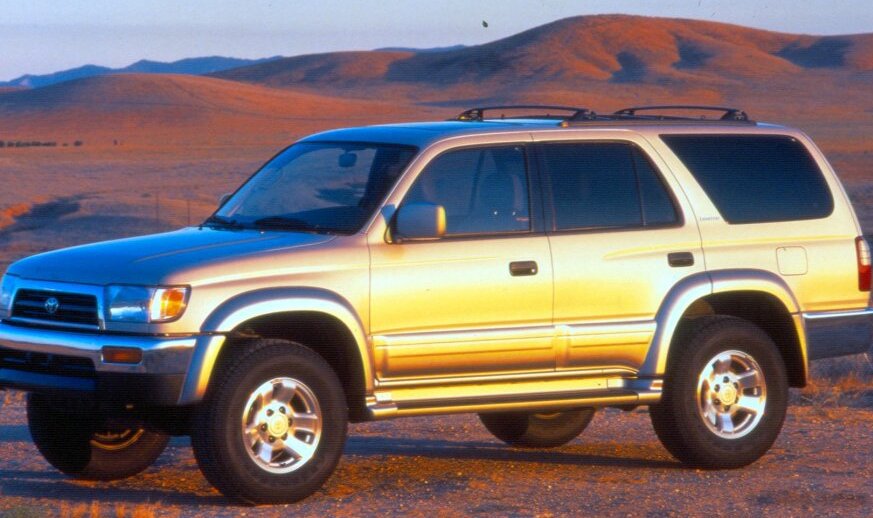
The Toyota 4Runner III, produced between 1995 and 1999, represented a significant evolution of Toyota’s popular SUV. This generation, known internally as the 180 series, continued the 4Runner’s reputation for ruggedness and off-road capability while introducing refinements in comfort and technology. The 3.0 TD (125 hp) Automatic variant occupied a specific niche within the lineup, offering a diesel-powered option with the convenience of an automatic transmission. This configuration was primarily aimed at buyers seeking a balance between fuel efficiency, towing capacity, and ease of driving, particularly in markets where diesel fuel was readily available and preferred.
Technical Specifications
| Brand | Toyota |
| Model | 4Runner |
| Generation | 4Runner III |
| Type (Engine) | 3.0 TD (125 Hp) Automatic |
| Start of production | 1995 |
| End of production | 1999 |
| Powertrain Architecture | Internal Combustion engine |
| Body type | SUV |
| Seats | 5 |
| Doors | 3 |
| Fuel consumption (urban) | 15 l/100 km (15.7 US mpg, 18.8 UK mpg, 6.7 km/l) |
| Fuel consumption (extra urban) | 5.6 l/100 km (42 US mpg, 50.4 UK mpg, 17.9 km/l) |
| Fuel consumption (combined) | 10 l/100 km (23.5 US mpg, 28.2 UK mpg, 10 km/l) |
| Fuel Type | Diesel |
| Maximum speed | 150 km/h (93.21 mph) |
| Weight-to-power ratio | 13.8 kg/Hp, 72.3 Hp/tonne |
| Weight-to-torque ratio | 5.9 kg/Nm, 170.5 Nm/tonne |
| Power | 125 Hp @ 3600 rpm |
| Power per litre | 41.9 Hp/l |
| Torque | 295 Nm @ 2000 rpm (217.58 lb.-ft. @ 2000 rpm) |
| Engine layout | Front, Longitudinal |
| Engine Model/Code | 1KZ-TE |
| Engine displacement | 2982 cm3 (181.97 cu. in.) |
| Number of cylinders | 4 |
| Engine configuration | Inline |
| Cylinder Bore | 96 mm (3.78 in.) |
| Piston Stroke | 103 mm (4.06 in.) |
| Compression ratio | 21.2:1 |
| Number of valves per cylinder | 2 |
| Fuel injection system | Precombustion chamber injection |
| Engine aspiration | Turbocharger |
| Valvetrain | OHC |
| Engine oil capacity | 7 l (7.4 US qt | 6.16 UK qt) |
| Coolant capacity | 10 l (10.57 US qt | 8.8 UK qt) |
| Kerb Weight | 1730 kg (3814 lbs.) |
| Max. weight | 2430 kg (5357.23 lbs.) |
| Max load | 700 kg (1543.24 lbs.) |
| Trunk (boot) space – minimum | 1263 l (44.6 cu. ft.) |
| Trunk (boot) space – maximum | 2257 l (79.71 cu. ft.) |
| Fuel tank capacity | 70 l (18.49 US gal | 15.4 UK gal) |
| Length | 4539 mm (178.7 in.) |
| Width | 1689 mm (66.5 in.) |
| Height | 1689-1745 mm (66.5 – 68.7 in.) |
| Wheelbase | 2675 mm (105.31 in.) |
| Front track | 1506 mm (59.29 in.) |
| Rear (Back) track | 1496-1509 mm (58.9 – 59.41 in.) |
| Ride height (ground clearance) | 216-241 mm (8.5 – 9.49 in.) |
| Minimum turning circle (turning diameter) | 11.4 m (37.4 ft.) |
| Approach angle | 32-36° |
| Departure angle | 26-29° |
| Drivetrain Architecture | Rear wheel drive |
| Number of gears and type of gearbox | 4 gears, automatic transmission |
| Front suspension | Double wishbone |
| Rear suspension | Independent multi-link suspension |
| Front brakes | Ventilated discs |
| Rear brakes | Drum |
| Assisting systems | ABS (Anti-lock braking system) |
| Steering type | Steering rack and pinion |
| Power steering | Hydraulic Steering |
| Tires size | 225/75 R15; 265/70 R16 |
| Wheel rims size | 7J x 15; 7J x 16 |
INTRODUCTION
The Toyota 4Runner III 3.0 TD Automatic, produced from 1995 to 1999, was a key variant within the third-generation 4Runner lineup. Built on the 180 platform, this model offered a diesel engine paired with a four-speed automatic transmission. This combination was particularly popular in European and Asian markets, where diesel engines were favored for their fuel efficiency and torque. The 4Runner III represented a shift towards a more refined and comfortable SUV experience compared to its predecessors, while still maintaining its off-road prowess. The 3.0 TD Automatic trim sat in a mid-range position, offering a balance of features and affordability.
Powertrain & Engine Architecture
The heart of the 4Runner III 3.0 TD Automatic is the 1KZ-TE 3.0-liter inline-four cylinder diesel engine. This engine utilizes a precombustion chamber injection system, a common design for diesel engines of that era, which improves combustion efficiency and reduces noise. The 1KZ-TE is a robust and reliable engine known for its longevity. It features a single overhead camshaft (OHC) valvetrain and is equipped with a turbocharger to boost power output to 125 horsepower at 3600 rpm and 295 Nm (217.58 lb.-ft.) of torque at 2000 rpm. The automatic transmission is a conventional four-speed unit, designed to provide smooth and convenient shifting. While not known for its sporty performance, the transmission is durable and well-suited to the engine’s torque characteristics.
Driving Characteristics
The 4Runner III 3.0 TD Automatic delivers a driving experience focused on practicality and ease of use. The automatic transmission eliminates the need for manual gear changes, making it ideal for city driving and towing. However, the 125 hp output and the inherent characteristics of the automatic transmission mean that acceleration is not particularly brisk. Compared to the gasoline-powered 4Runners or even the higher-output diesel variants, the 3.0 TD Automatic feels somewhat underpowered, especially when fully loaded or tackling steep inclines. The four-speed automatic transmission’s gear ratios are optimized for fuel efficiency and towing, rather than outright performance. The turbocharger does provide a noticeable boost in torque at lower engine speeds, aiding in everyday driving situations.
Equipment & Trim Levels
The 3.0 TD Automatic trim level typically included features such as power windows, power locks, and air conditioning as standard equipment. Interior upholstery was usually cloth, with options for upgraded materials available. The dashboard layout was functional and straightforward, with easy-to-read gauges and controls. Optional extras included a sunroof, upgraded audio system, and alloy wheels. The level of equipment was generally considered adequate for the price point, offering a comfortable and practical interior without being overly luxurious.
Chassis & Braking
The 4Runner III features a robust body-on-frame construction, providing excellent durability and off-road capability. The front suspension utilizes a double wishbone design, while the rear suspension employs an independent multi-link setup. This combination provides a comfortable ride on paved roads while still allowing for significant wheel travel off-road. Braking duties are handled by ventilated discs at the front and drum brakes at the rear. An Anti-lock Braking System (ABS) was standard, enhancing safety and control during emergency braking situations. The steering system is a rack and pinion setup with hydraulic power assistance, providing precise and responsive steering feel.
Market Reception & Comparison
The 4Runner III 3.0 TD Automatic received generally positive reviews, particularly in markets where diesel engines were popular. Critics praised its fuel efficiency, reliability, and comfortable ride. However, some reviewers noted the engine’s lack of outright power compared to gasoline alternatives. Compared to the gasoline-powered 4Runners, the 3.0 TD Automatic offered significantly better fuel economy, making it a more economical choice for long-distance driving. Compared to other diesel-powered SUVs of the time, the 4Runner offered a good balance of performance, reliability, and off-road capability.
Legacy
The 1KZ-TE engine, found in the 4Runner III 3.0 TD Automatic, has earned a reputation for exceptional reliability and longevity. Properly maintained examples can easily exceed 200,000 miles (320,000 kilometers) without major issues. In the used car market today, these 4Runners are sought after by those looking for a durable and dependable SUV. While they may not offer the latest technology or the highest levels of performance, their simplicity and robustness make them a practical and affordable choice. The 4Runner III 3.0 TD Automatic remains a testament to Toyota’s commitment to building high-quality, long-lasting vehicles.