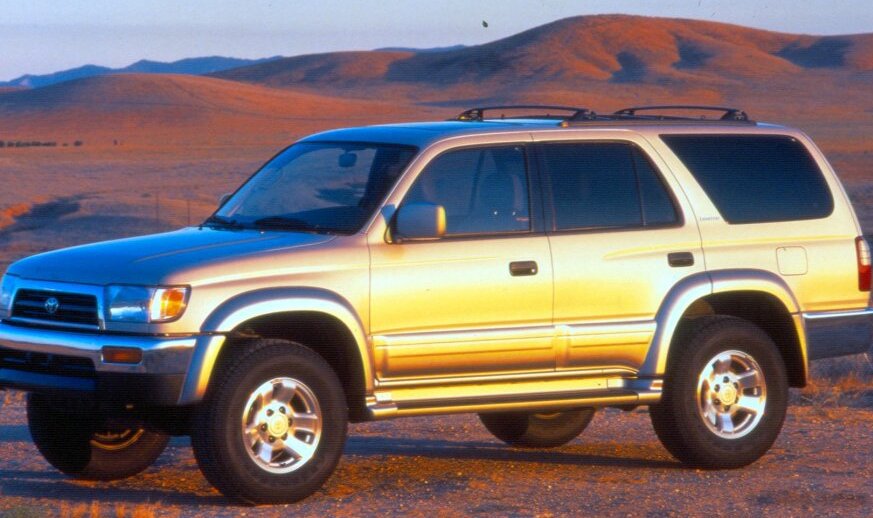
The Toyota 4Runner III, produced between 1995 and 1999, represented a significant evolution of Toyota’s popular mid-size SUV. This generation, internally designated as the 180 series, built upon the success of its predecessors by offering increased refinement, improved capability, and a more powerful engine option. The 3.4 V6 24V (183 hp) 4×4 variant occupied a sweet spot in the lineup, providing a balance of performance, fuel economy, and off-road prowess for the North American market, where the 4Runner was particularly well-received. It was positioned as a step up from the base 2.7-liter four-cylinder models, appealing to buyers who needed more power for towing, hauling, or tackling challenging terrain.
Technical Specifications
| Brand | Toyota |
| Model | 4Runner |
| Generation | 4Runner III |
| Type (Engine) | 3.4 V6 24V (183 Hp) 4×4 |
| Start of production | 1995 |
| End of production | 1999 |
| Powertrain Architecture | Internal Combustion engine |
| Body type | SUV |
| Seats | 5 |
| Doors | 5 |
| Fuel consumption (urban) | 13.8 l/100 km (17 US mpg, 20.5 UK mpg) |
| Fuel consumption (extra urban) | 11.7 l/100 km (20.1 US mpg, 24.1 UK mpg) |
| Fuel Type | Petrol (Gasoline) |
| Maximum speed | 175 km/h (108.74 mph) |
| Weight-to-power ratio | 9.5 kg/Hp |
| Weight-to-torque ratio | 5.9 kg/Nm |
| Power | 183 Hp @ 4800 rpm |
| Power per litre | 54.2 Hp/l |
| Torque | 294 Nm @ 3600 rpm (216.84 lb.-ft. @ 3600 rpm) |
| Engine layout | Front, Longitudinal |
| Engine Model/Code | 5VZ-FE |
| Engine displacement | 3378 cm3 (206.14 cu. in.) |
| Number of cylinders | 6 |
| Engine configuration | V-engine |
| Cylinder Bore | 93.5 mm (3.68 in.) |
| Piston Stroke | 82 mm (3.23 in.) |
| Compression ratio | 9.6:1 |
| Number of valves per cylinder | 4 |
| Fuel injection system | Multi-port manifold injection |
| Engine aspiration | Naturally aspirated |
| Valvetrain | DOHC |
| Engine oil capacity | 5.2 l (5.49 US qt | 4.58 UK qt) |
| Coolant capacity | 8 l (8.45 US qt | 7.04 UK qt) |
| Kerb Weight | 1740 kg (3836.04 lbs.) |
| Max. weight | 2381 kg (5249.21 lbs.) |
| Max load | 641 kg (1413.16 lbs.) |
| Trunk (boot) space – minimum | 1263 l (44.6 cu. ft.) |
| Trunk (boot) space – maximum | 2257 l (79.71 cu. ft.) |
| Fuel tank capacity | 70 l (18.49 US gal | 15.4 UK gal) |
| Permitted trailer load with brakes (12%) | 2268 kg (5000.08 lbs.) |
| Length | 4539 mm (178.7 in.) |
| Width | 1689 mm (66.5 in.) |
| Height | 1689-1745 mm (66.5 – 68.7 in.) |
| Wheelbase | 2675 mm (105.31 in.) |
| Front track | 1506 mm (59.29 in.) |
| Rear (Back) track | 1496-1509 mm (58.9 – 59.41 in.) |
| Ride height (ground clearance) | 216-241 mm (8.5 – 9.49 in.) |
| Minimum turning circle (turning diameter) | 11.4 m (37.4 ft.) |
| Approach angle | 32-36° |
| Departure angle | 26-29° |
| Drive wheel | All wheel drive (4×4) |
| Number of gears and type of gearbox | 5 gears, manual transmission |
| Front suspension | Double wishbone |
| Rear suspension | Independent multi-link suspension |
| Front brakes | Ventilated discs |
| Rear brakes | Drum |
| Assisting systems | ABS (Anti-lock braking system) |
| Steering type | Steering rack and pinion |
| Power steering | Hydraulic Steering |
| Tires size | 225/75 R15; 265/70 R16 |
| Wheel rims size | 7J x 15; 7J x 16 |
Powertrain & Engine Architecture
The heart of this 4Runner variant was the 5VZ-FE 3.4-liter V6 engine. This engine was a significant upgrade over the previous 3.0-liter powerplant, offering increased horsepower and torque. The 5VZ-FE featured a cast-iron block and aluminum cylinder heads, incorporating a double overhead camshaft (DOHC) design with four valves per cylinder. Fuel delivery was handled by a multi-port fuel injection system, optimizing combustion efficiency. The engine’s robust construction and relatively simple design contributed to its reputation for reliability. The 4Runner III was typically equipped with a five-speed manual transmission, but a four-speed automatic transmission was also available, and is the focus of this article. This automatic transmission, the A750F, was known for its durability but could sometimes feel slightly sluggish compared to the manual option, particularly during quick acceleration.
Driving Characteristics
The 3.4L V6 with the automatic transmission provided adequate, though not exhilarating, performance. Acceleration from 0 to 60 mph typically took around 8-9 seconds. The automatic transmission’s gear ratios were tuned for everyday drivability and towing capacity rather than outright speed. While the manual transmission offered a more engaging driving experience, the automatic provided convenience, especially in urban environments or when navigating challenging off-road conditions. The 4Runner’s four-wheel-drive system, with its part-time transfer case, allowed drivers to easily switch between two-wheel drive for fuel efficiency and four-wheel drive for enhanced traction. The suspension, while comfortable, was tuned for a balance between on-road ride quality and off-road capability.
Equipment & Trim Levels
The 4Runner III offered a range of trim levels, with the 3.4 V6 automatic typically found in the SR5 and Limited models. Standard features included air conditioning, power windows and locks, and an AM/FM stereo. SR5 models often added features like cruise control, upgraded upholstery, and alloy wheels. Limited models offered even more luxury, with leather seats, a sunroof, and upgraded audio systems. Optional extras included a CD player, a tow package, and various off-road accessories.
Chassis & Braking
The 4Runner III utilized a body-on-frame construction, providing a robust and durable platform. The front suspension featured double wishbones, while the rear suspension employed an independent multi-link setup. This configuration offered a good balance of ride comfort and off-road articulation. Braking duties were handled by ventilated discs in the front and drum brakes in the rear. Anti-lock brakes (ABS) were standard, enhancing safety and control during emergency braking situations.
Market Reception & Comparison
The 4Runner III, particularly the 3.4 V6 automatic variant, was well-received by critics and consumers alike. It was praised for its reliability, spacious interior, and off-road capability. Compared to the base 2.7-liter four-cylinder models, the 3.4 V6 offered a significant performance boost, making it a more capable tow vehicle and a more enjoyable daily driver. Fuel economy was reasonable for its class, averaging around 17 mpg in the city and 20 mpg on the highway. Compared to competitors like the Jeep Cherokee and the Nissan Pathfinder, the 4Runner offered a reputation for exceptional reliability and strong resale value.
Legacy
The 3.4 V6 engine in the 4Runner III has earned a reputation as one of Toyota’s most durable and reliable powertrains. Many examples of this engine are still on the road today, often with well over 200,000 miles. The 4Runner III, and specifically this 3.4L V6 automatic combination, remains a popular choice in the used car market, prized for its dependability and off-road prowess. While maintenance costs can increase with age, the engine’s inherent robustness and the availability of aftermarket parts ensure that these vehicles can continue to provide years of reliable service.