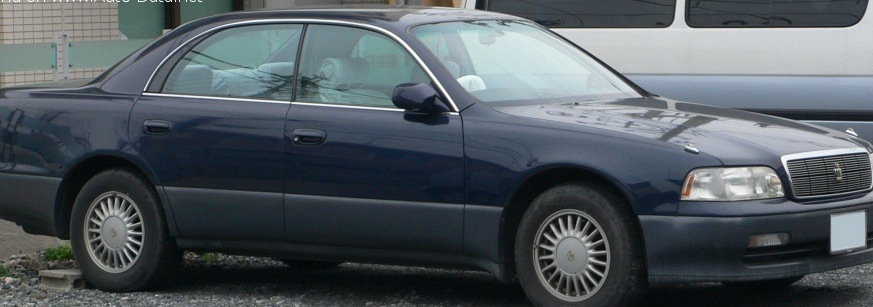
The Toyota Crown Majesta, launched in 1991, represented Toyota’s ambition to create a luxury sedan specifically for the Japanese domestic market (JDM). The first generation, designated the S140 series, aimed to compete with established luxury brands and offered a higher level of refinement and features than the standard Crown. The 3.0i V6 24V variant, powered by the 2JZ-GE engine and paired with a four-speed automatic transmission, occupied a significant position within the Majesta lineup, offering a balance of performance and comfort. Production of the S140 Majesta spanned from 1991 to 1993, establishing a foundation for subsequent generations.
Technical Specifications
| Brand | Toyota |
| Model | Crown Majesta |
| Generation | Crown Majesta I (S140) |
| Type (Engine) | 3.0i V6 24V (230 Hp) Automatic |
| Start of production | 1991 |
| End of production | 1993 |
| Powertrain Architecture | Internal Combustion engine |
| Body type | Sedan |
| Seats | 5 |
| Doors | 4 |
| Fuel Type | Petrol (Gasoline) |
| Weight-to-power ratio | 7.1 kg/Hp, 140.2 Hp/tonne |
| Weight-to-torque ratio | 5.8 kg/Nm, 173.2 Nm/tonne |
| Power | 230 Hp @ 6000 rpm |
| Power per litre | 76.7 Hp/l |
| Torque | 284 Nm @ 4800 rpm, 209.47 lb.-ft. @ 4800 rpm |
| Engine layout | Front, Longitudinal |
| Engine Model/Code | 2JZ-GE |
| Engine displacement | 2997 cm3, 182.89 cu. in. |
| Number of cylinders | 6 |
| Engine configuration | Inline |
| Cylinder Bore | 86 mm, 3.39 in. |
| Piston Stroke | 86 mm, 3.39 in. |
| Compression ratio | 11.3:1 |
| Number of valves per cylinder | 4 |
| Fuel injection system | Multi-port manifold injection |
| Engine aspiration | Naturally aspirated engine |
| Valvetrain | DOHC |
| Engine oil capacity | 5.4 l, 5.71 US qt | 4.75 UK qt |
| Kerb Weight | 1640 kg, 3615.58 lbs |
| Max. weight | 1935 kg, 4265.94 lbs |
| Max load | 295 kg, 650.36 lbs |
| Fuel tank capacity | 80 l, 21.13 US gal | 17.6 UK gal |
| Length | 4900 mm, 192.91 in |
| Width | 1800 mm, 70.87 in |
| Height | 1420 mm, 55.91 in |
| Wheelbase | 2780 mm, 109.45 in |
| Front track | 1535 mm, 60.43 in |
| Rear (Back) track | 1520 mm, 59.84 in |
| Ride height (ground clearance) | 140 mm, 5.51 in |
| Minimum turning circle (turning diameter) | 11.0 m, 36.09 ft |
| Drivetrain Architecture | The Internal combustion engine (ICE) drives the rear wheels of the vehicle. |
| Drive wheel | Rear wheel drive |
| Number of gears and type of gearbox | 4 gears, automatic transmission |
| Front suspension | Double wishbone |
| Rear suspension | Double wishbone |
| Front brakes | Ventilated discs |
| Rear brakes | Ventilated discs |
| Assisting systems | ABS (Anti-lock braking system) |
| Steering type | Steering rack and pinion |
| Power steering | Hydraulic Steering |
| Tires size | 215/65 R15 |
| Wheel rims size | 15 |
Powertrain & Engine Architecture
The heart of the 3.0i Majesta was the 2JZ-GE, a 3.0-liter inline-six engine. This engine was a naturally aspirated, dual overhead camshaft (DOHC) design with four valves per cylinder. The 2JZ-GE utilized a multi-port fuel injection system, delivering precise fuel metering for optimal combustion. Its robust construction and oversquare design (86mm bore and 86mm stroke) contributed to its smooth power delivery and relatively high revving nature. The engine produced 230 horsepower at 6000 rpm and 284 Nm (209.47 lb-ft) of torque at 4800 rpm. Paired with this engine was a four-speed automatic transmission, designed for smooth and comfortable shifts. This transmission wasn’t known for its sportiness, prioritizing refinement over aggressive gear changes.
Driving Characteristics
The 3.0i automatic Majesta offered a comfortable and refined driving experience. While not a sports sedan, the 2JZ-GE provided ample power for effortless cruising and overtaking. The automatic transmission, while smooth, did result in some power loss compared to the available manual transmission. The gear ratios were tuned for relaxed highway driving, with a focus on fuel efficiency and minimizing engine noise. Acceleration from 0 to 60 mph was estimated to be around 8.5-9 seconds, respectable for a large luxury sedan of the era. The rear-wheel-drive configuration provided a balanced feel, although it lacked the all-weather capability of all-wheel-drive systems found in some competitors.
Equipment & Trim Levels
The 3.0i trim level of the Majesta was positioned as a mid-range offering, bridging the gap between the base models and the more luxurious, fully-equipped versions. Standard features included power windows, power locks, air conditioning, a high-quality audio system, and velour upholstery. Higher-end Majestas offered features like leather seats, wood trim, a sunroof, and more advanced audio systems. The interior design emphasized comfort and spaciousness, with ample legroom for both front and rear passengers. Optional extras included upgraded sound systems, automatic climate control, and various exterior enhancements.
Chassis & Braking
The S140 Majesta utilized a double wishbone suspension setup for both the front and rear axles, providing a comfortable ride and good handling characteristics. The suspension was tuned for a balance between comfort and stability, absorbing bumps effectively while maintaining control in corners. Braking duties were handled by ventilated disc brakes on all four wheels, providing adequate stopping power. An Anti-lock Braking System (ABS) was standard, enhancing safety by preventing wheel lockup during hard braking. The steering system employed a rack-and-pinion setup with hydraulic power assistance, offering precise and responsive steering feel.
Market Reception & Comparison
The Toyota Crown Majesta was well-received in the Japanese market, praised for its luxurious features, comfortable ride, and reliable powertrain. Critics noted the 3.0i variant offered a good balance of performance and fuel economy. Compared to the base models with smaller engines, the 3.0i provided a noticeable improvement in acceleration and overall driving experience. However, it wasn’t as sporty as some of its European competitors. Compared to other trims in the Majesta lineup, the 3.0i offered a more compelling package than the smaller displacement engines, while remaining more affordable than the top-of-the-line models. Fuel economy was reasonable for a vehicle of its size and class, averaging around 20-25 mpg in mixed driving conditions.
Legacy
The 2JZ-GE engine, found in the 3.0i Majesta, is renowned for its durability and reliability. With proper maintenance, these engines can easily exceed 200,000 miles. The S140 Majesta, while not as widely exported as other JDM classics, has gained a following among enthusiasts who appreciate its understated luxury and robust engineering. In the used car market, well-maintained examples of the 3.0i Majesta are sought after for their comfortable ride, reliable powertrain, and classic JDM appeal. Parts availability can be a challenge outside of Japan, but the engine’s reputation for longevity means that major repairs are relatively infrequent. The Majesta I established the model as a serious contender in the Japanese luxury sedan segment, paving the way for future generations.