
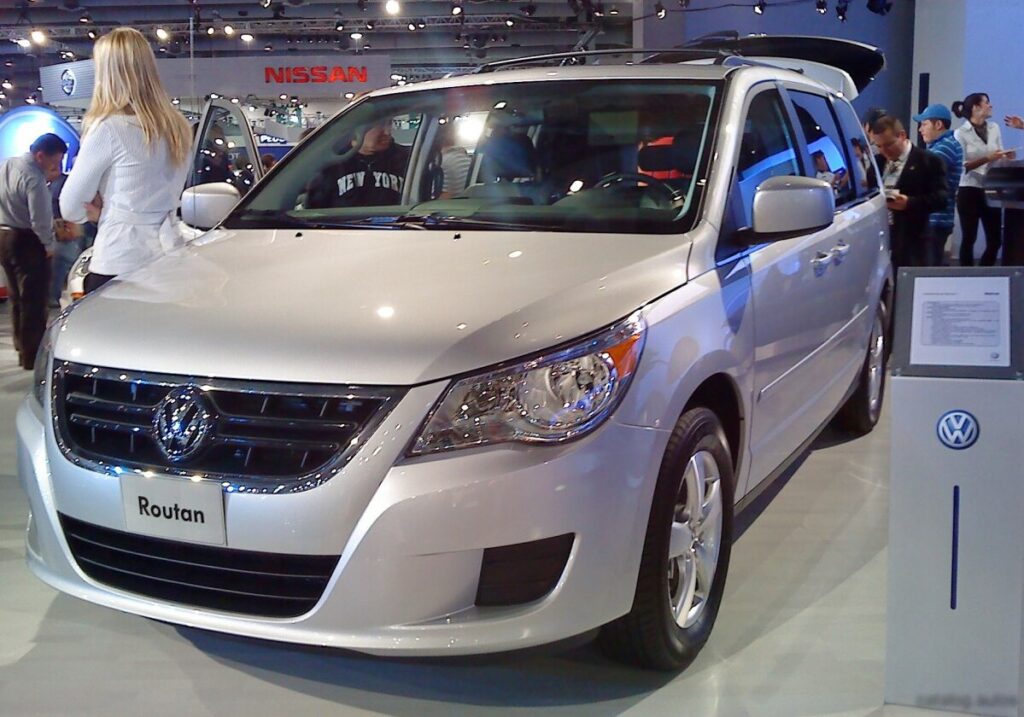
The Volkswagen Routan 4.0 V6 Automatic, produced from 2008 to 2010, represented Volkswagen’s entry into the North American minivan market. Essentially a rebadged Dodge Grand Caravan/Chrysler Town & Country (under a collaborative agreement), the Routan aimed to provide Volkswagen customers with a practical, family-oriented vehicle offering a different aesthetic and driving experience than its American counterparts. This particular variant, equipped with the 4.0-liter V6 engine and a six-speed automatic transmission, was positioned as the premium offering within the Routan lineup, providing a balance of power and convenience. It was part of the first and only generation of the Routan, which was discontinued after a relatively short production run.
Technical Specifications
| Brand | Volkswagen |
| Model | Routan |
| Generation | Routan |
| Type (Engine) | 4.0 V6 (251 Hp) Automatic |
| Start of production | 2008 |
| End of production | 2010 |
| Powertrain Architecture | Internal Combustion engine |
| Body type | Minivan |
| Seats | 7 |
| Doors | 5 |
| Fuel consumption (urban) | 13.8 l/100 km (17 US mpg, 20.5 UK mpg) |
| Fuel consumption (extra urban) | 9.4 l/100 km (25 US mpg, 30.1 UK mpg) |
| Fuel Type | Petrol (Gasoline) |
| Power | 251 Hp |
| Power per litre | 63.5 Hp/l |
| Torque | 351 Nm @ 6000 rpm (258.88 lb.-ft. @ 6000 rpm) |
| Engine layout | Front, Transverse |
| Engine Model/Code | EGQ |
| Engine displacement | 3952 cm3 (241.17 cu. in.) |
| Number of cylinders | 6 |
| Engine configuration | V-engine |
| Cylinder Bore | 96 mm (3.78 in.) |
| Piston Stroke | 91 mm (3.58 in.) |
| Number of valves per cylinder | 4 |
| Fuel injection system | Multi-port manifold injection |
| Engine aspiration | Naturally aspirated engine |
| Valvetrain | SOHC |
| Engine oil capacity | 5.2 l (5.49 US qt | 4.58 UK qt) |
| Coolant | 12.6 l (13.31 US qt | 11.09 UK qt) |
| Trunk (boot) space – maximum | 4100 l (144.79 cu. ft.) |
| Permitted trailer load with brakes (12%) | 1588 kg (3500.94 lbs.) |
| Length | 5143 mm (202.48 in.) |
| Width | 1953 mm (76.89 in.) |
| Height | 1750 mm (68.9 in.) |
| Wheelbase | 3078 mm (121.18 in.) |
| Drivetrain Architecture | The Internal combustion engine (ICE) drives the front wheels of the vehicle. |
| Drive wheel | Front wheel drive |
| Number of gears and type of gearbox | 6 gears, automatic transmission |
| Front suspension | Independent type McPherson |
| Front brakes | Ventilated discs |
| Rear brakes | Disc |
| Assisting systems | ABS (Anti-lock braking system) |
| Steering type | Steering rack and pinion |
| Power steering | Hydraulic Steering |
| Tires size | 225/65 R16; 225/65 R17 |
| Wheel rims size | 6.5J x 16; 6.5J x 17 |
Powertrain & Engine Architecture
The Routan 4.0 V6 utilized the EGQ engine code, a 3.8-liter (actually 4.0L) V6 derived from Chrysler’s engine family. This engine featured a single overhead camshaft (SOHC) design with four valves per cylinder. Fuel delivery was handled by a multi-port fuel injection system. The engine produced 251 horsepower and 351 Nm (258.88 lb-ft) of torque. The six-speed automatic transmission, also sourced from Chrysler, was designed to provide smooth shifting and efficient power delivery. While not a particularly advanced engine in terms of technology, it was known for its robust construction and relatively straightforward maintenance. The transmission featured a conventional torque converter and offered a ‘SelectShift’ function allowing for some degree of driver control over gear selection.
Driving Characteristics
The 4.0 V6 Routan offered a noticeable performance advantage over the lower-trim models equipped with the 3.8-liter V6. Acceleration was brisk, especially considering the vehicle’s size and weight. The automatic transmission generally shifted smoothly, although some reviewers noted a slight hesitation during quick acceleration. The gear ratios were tuned for a balance of fuel economy and usability, prioritizing comfortable cruising over outright performance. Compared to the 3.8L version, the 4.0L provided a more confident experience when fully loaded with passengers and cargo. However, it wasn’t a sporty vehicle; the focus remained on providing a comfortable and practical driving experience.
Equipment & Trim Levels
The 4.0 V6 Routan typically came standard with features such as alloy wheels, power windows and locks, air conditioning, a CD player with auxiliary input, and keyless entry. Higher trim levels added features like leather upholstery, a premium sound system, a rear-seat entertainment system, and power-adjustable front seats. Optional extras included a navigation system, sunroof, and upgraded safety features. The interior design, while functional, was largely based on the Dodge/Chrysler platform, with Volkswagen adding its own touches to the dashboard and trim materials.
Chassis & Braking
The Routan’s chassis was based on the Dodge Grand Caravan/Chrysler Town & Country platform. It featured an independent McPherson strut front suspension and a multi-link rear suspension. Brakes were ventilated discs on the front wheels and solid discs on the rear. Anti-lock brakes (ABS) were standard. The suspension was tuned for comfort, providing a relatively soft ride. Steering was handled by a hydraulic power steering system. The Routan’s weight distribution contributed to predictable handling, but it wasn’t designed for aggressive cornering.
Market Reception & Comparison
The Volkswagen Routan received mixed reviews from automotive critics. While many praised its comfortable ride and spacious interior, others criticized its lack of distinctiveness from the Dodge and Chrysler models. The 4.0 V6 engine was generally well-received for its power, but fuel economy was a concern, averaging around 17 mpg in the city and 25 mpg on the highway. Compared to the base 3.8L Routan, the 4.0L offered a significant performance boost, but at a higher price point. The Routan also faced competition from established minivan players like the Honda Odyssey and Toyota Sienna, which were often praised for their reliability and resale value.
Legacy
The Volkswagen Routan was discontinued after only two model years due to slow sales. While the 4.0 V6 powertrain proved to be relatively reliable, the Routan’s overall reputation suffered from its perceived lack of originality and its association with Chrysler’s quality control issues at the time. On the used car market, the Routan 4.0 V6 can be found at relatively affordable prices. Maintenance costs are generally comparable to other American minivans, and parts availability is good. However, potential buyers should be aware of the vehicle’s history and thoroughly inspect it for any signs of wear or damage. The Routan represents a unique, if ultimately unsuccessful, chapter in Volkswagen’s North American history, demonstrating the company’s attempt to enter a segment dominated by domestic manufacturers.
