
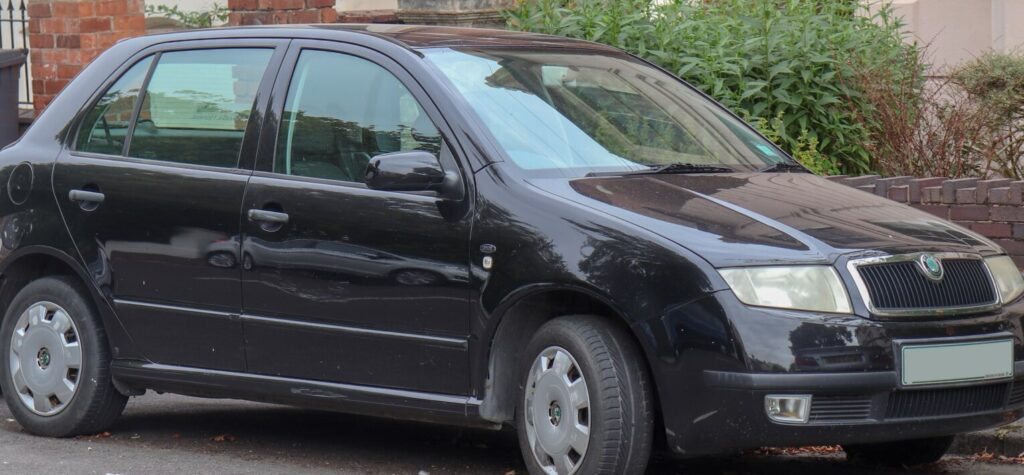
The Skoda Fabia I (6Y) 1.0, produced between October 2000 and August 2004, represented the entry point into the first generation Fabia hatchback range. Positioned as an affordable and economical city car, this variant played a crucial role in establishing Skoda as a mainstream brand in European markets. The 6Y Fabia was built on the Volkswagen Group’s PQ24 platform, shared with the Volkswagen Polo Mk4 and SEAT Ibiza Mk2. This 1.0-liter model aimed to provide basic transportation with a focus on fuel efficiency, appealing to budget-conscious buyers and those new to car ownership.
Technical Specifications
| Brand | Skoda |
| Model | Fabia |
| Generation | Fabia I (6Y) |
| Type (Engine) | 1.0 (50 Hp) |
| Start of production | October, 2000 |
| End of production | August, 2004 |
| Powertrain Architecture | Internal Combustion engine |
| Body type | Hatchback |
| Seats | 5 |
| Doors | 5 |
| Fuel consumption (urban) | 9.4 l/100 km (25 US mpg, 30.1 UK mpg, 10.6 km/l) |
| Fuel consumption (extra urban) | 5.6 l/100 km (42 US mpg, 50.4 UK mpg, 17.9 km/l) |
| Fuel consumption (combined) | 7.1 l/100 km (33.1 US mpg, 39.8 UK mpg, 14.1 km/l) |
| Fuel Type | Petrol (Gasoline) |
| Acceleration 0 – 100 km/h | 20 sec |
| Acceleration 0 – 62 mph | 20 sec |
| Acceleration 0 – 60 mph | 19 sec |
| Maximum speed | 148 km/h (91.96 mph) |
| Weight-to-power ratio | 20.8 kg/Hp, 48.1 Hp/tonne |
| Weight-to-torque ratio | 12.4 kg/Nm, 80.8 Nm/tonne |
| Power | 50 Hp @ 5000 rpm |
| Power per litre | 50.2 Hp/l |
| Torque | 84 Nm @ 2750 rpm (61.96 lb.-ft. @ 2750 rpm) |
| Engine layout | Front, Transverse |
| Engine Model/Code | ARV |
| Engine displacement | 997 cm3 (60.84 cu. in.) |
| Number of cylinders | 4 |
| Engine configuration | Inline |
| Cylinder Bore | 72 mm (2.83 in.) |
| Piston Stroke | 61.2 mm (2.41 in.) |
| Compression ratio | 10:1 |
| Number of valves per cylinder | 2 |
| Fuel injection system | Multi-port manifold injection |
| Engine aspiration | Naturally aspirated engine |
| Engine oil capacity | 4 l (4.23 US qt | 3.52 UK qt) |
| Coolant | 6 l (6.34 US qt | 5.28 UK qt) |
| Kerb Weight | 1040 kg (2292.81 lbs.) |
| Max. weight | 1505 kg (3317.96 lbs.) |
| Max load | 465 kg (1025.15 lbs.) |
| Trunk (boot) space – minimum | 260 l (9.18 cu. ft.) |
| Trunk (boot) space – maximum | 1015 l (35.84 cu. ft.) |
| Fuel tank capacity | 45 l (11.89 US gal | 9.9 UK gal) |
| Length | 3960 mm (155.91 in.) |
| Width | 1645 mm (64.76 in.) |
| Height | 1450 mm (57.09 in.) |
| Wheelbase | 2462 mm (96.93 in.) |
| Front track | 1435 mm (56.5 in.) |
| Rear (Back) track | 1424 mm (56.06 in.) |
| Drivetrain Architecture | The Internal combustion engine (ICE) drives the front wheels of the vehicle. |
| Drive wheel | Front wheel drive |
| Number of gears and type of gearbox | 5 gears, manual transmission |
| Front suspension | Coil spring |
| Rear suspension | Coil spring |
| Front brakes | Disc |
| Rear brakes | Drum |
| Assisting systems | ABS (Anti-lock braking system) |
| Steering type | Steering rack and pinion |
| Tires size | 155/80 R13 |
| Wheel rims size | 5J x 13 |
INTRODUCTION
The Skoda Fabia I 1.0, launched in 2000, was a key component of Skoda’s strategy to offer affordable and reliable vehicles to a wider European audience. It was the base model of the 6Y series, designed to undercut competitors like the Ford Fiesta and Renault Clio in terms of price. The Fabia represented a significant step forward for Skoda, moving away from its communist-era image and embracing modern automotive engineering and design. This particular variant, with its small displacement engine, was primarily targeted at first-time buyers, city dwellers, and those seeking low running costs.
Powertrain & Engine Architecture
The heart of the Fabia 1.0 is the ARV engine, a 997cc inline four-cylinder petrol engine. This engine, a member of Skoda’s EA111 family, featured a single overhead camshaft (SOHC) operating two valves per cylinder. Fuel delivery was handled by a multi-point fuel injection system, providing adequate, though not exceptional, combustion control. The ARV engine was known for its simplicity and durability, but its modest output meant it wasn’t designed for high-performance driving. The engine’s 50 horsepower at 5000 rpm and 84 Nm (62 lb-ft) of torque at 2750 rpm were sufficient for urban driving and moderate highway speeds. The Fabia 1.0 was exclusively offered with a five-speed manual transmission, optimized for fuel economy rather than rapid acceleration. The transmission’s gear ratios were relatively tall, further emphasizing the car’s focus on efficiency.
Driving Characteristics
Driving the Fabia 1.0 was an exercise in economical transportation. Acceleration was leisurely, taking around 20 seconds to reach 62 mph (100 km/h). The engine felt strained when climbing hills or overtaking at higher speeds. However, within city limits, the Fabia 1.0 proved to be nimble and easy to maneuver. The light steering and compact dimensions made parking a breeze. The five-speed manual transmission was smooth and precise, allowing drivers to extract the most from the engine’s limited power. Compared to the more powerful 1.4 and 1.6-liter variants, the 1.0-liter model felt significantly underpowered. The 1.4 offered a noticeable improvement in acceleration and overall drivability, while the 1.6 provided a more refined and responsive driving experience. However, these higher-spec models came at a higher price point.
Equipment & Trim Levels
The Fabia 1.0 was typically equipped with basic, but functional, features. Standard equipment included power steering, central locking, and front airbags. The interior was characterized by its simple, utilitarian design, with hard-wearing plastics and cloth upholstery. Air conditioning, alloy wheels, and electric windows were typically optional extras, often bundled into packages. Trim levels were relatively limited, with the base model offering minimal frills. Higher trim levels added features like a radio/cassette player, upgraded upholstery, and body-colored bumpers. The overall focus was on providing a practical and affordable vehicle, rather than a luxurious one.
Chassis & Braking
The Fabia 1.0 utilized a MacPherson strut front suspension and a torsion beam rear suspension. This setup provided a comfortable, if not particularly sporty, ride. The suspension was tuned for compliance, absorbing bumps and imperfections in the road surface effectively. Braking duties were handled by disc brakes at the front and drum brakes at the rear. Anti-lock Braking System (ABS) was standard, enhancing safety and stability during emergency braking. The chassis was relatively lightweight, contributing to the car’s fuel efficiency. Stabilizer bars were typically omitted on the base model to keep costs down, resulting in slightly more body roll during cornering.
Market Reception & Comparison
The Fabia 1.0 received mixed reviews from automotive critics. While praised for its affordability and fuel economy, it was often criticized for its lack of power and basic interior. Compared to its rivals, the Fabia 1.0 offered a compelling value proposition, particularly for budget-conscious buyers. The 1.4-liter Fabia offered a better balance of performance and economy, but came at a higher price. The 1.0-liter model’s fuel economy was generally superior to that of the larger-engined variants, making it an attractive option for those who primarily drove in urban environments. Reliability was generally good, with the ARV engine proving to be durable and relatively trouble-free.
Legacy
The Skoda Fabia I 1.0, while not a performance icon, played a significant role in establishing Skoda as a credible and affordable car manufacturer. The ARV engine, despite its limitations, proved to be a reliable and economical powerplant. Today, these early Fabias are becoming increasingly rare, and well-maintained examples are sought after by enthusiasts and collectors. The 1.0-liter model remains a testament to Skoda’s commitment to providing practical and affordable transportation. Its simplicity and durability make it a relatively easy car to maintain, and its low running costs continue to appeal to budget-conscious drivers. The Fabia I 1.0 represents a pivotal moment in Skoda’s history, marking its transition from a niche brand to a mainstream automotive player.
