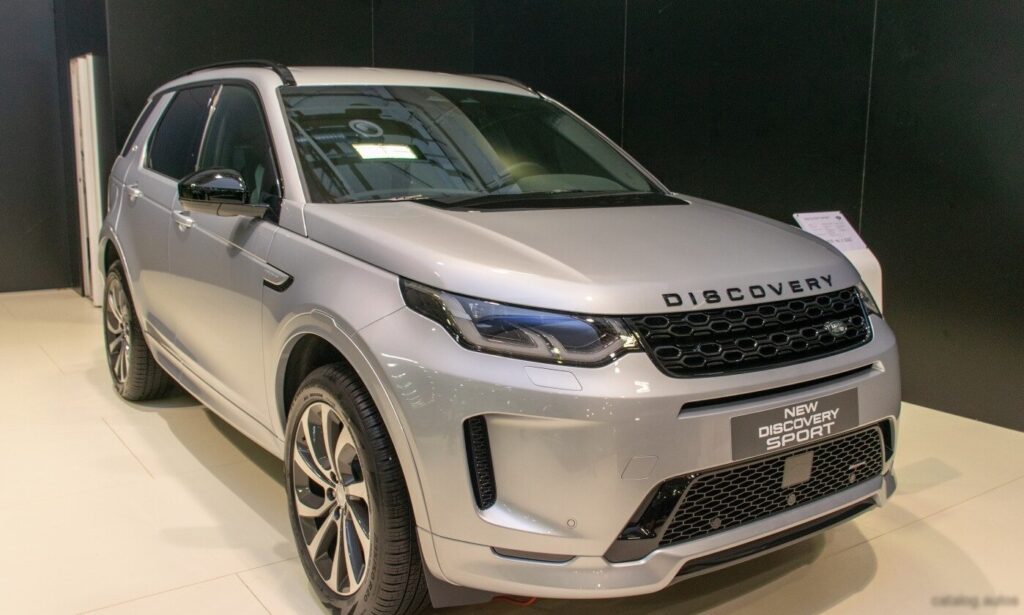
The Land Rover Discovery Sport 2.0 P250, introduced with the facelift in May 2019, represents a mid-range offering within the second-generation Discovery Sport lineup (L550). Positioned above the entry-level models and below the more powerful P300 variant, the P250 combines a 2.0-liter turbocharged four-cylinder engine with a 48-volt mild hybrid system and a nine-speed automatic transmission, offering a balance of performance, efficiency, and practicality. This variant is notable for its standard all-wheel drive and available five-plus-two seating configuration, making it a versatile choice for families. The facelift brought updated styling, improved interior technology, and refinements to the Ingenium engine family.
Technical Specifications
| Brand | Land Rover |
| Model | Discovery Sport |
| Generation | Discovery Sport (facelift 2019) |
| Type | 2.0 P250 (250 Hp) Mild Hybrid AWD Automatic 5+2 Seating |
| Start of production | May, 2019 |
| Powertrain Architecture | MHEV (Mild Hybrid Electric Vehicle) |
| Body type | SUV |
| Seats | 7 |
| Doors | 5 |
| Fuel consumption at Low speed (WLTP) | 13.1-13.6 l/100 km (18 – 17.3 US mpg) |
| Fuel consumption at Medium speed (WLTP) | 9.5-10.0 l/100 km (24.8 – 23.5 US mpg) |
| Fuel consumption at high speed (WLTP) | 7.9-8.5 l/100 km (29.8 – 27.7 US mpg) |
| Fuel consumption at very high speed (WLTP) | 9.3-9.9 l/100 km (25.3 – 23.8 US mpg) |
| Combined fuel consumption (WLTP) | 9.4-10.0 l/100 km (25 – 23.5 US mpg) |
| CO2 emissions (WLTP) | 214-226 g/km |
| Fuel consumption (urban – NEDC) | 10.0-10.2 l/100 km (23.5 – 23.1 US mpg) |
| Fuel consumption (extra urban – NEDC) | 6.9-7.0 l/100 km (34.1 – 33.6 US mpg) |
| Fuel consumption (combined – NEDC) | 8.0-8.2 l/100 km (29.4 – 28.7 US mpg) |
| CO2 emissions (NEDC) | 182-185 g/km |
| Fuel Type | Petrol (Gasoline) |
| Acceleration 0 – 100 km/h | 7.8 sec |
| Acceleration 0 – 62 mph | 7.8 sec |
| Acceleration 0 – 60 mph | 7.3 sec |
| Maximum speed | 224 km/h (139.19 mph) |
| Emission standard | Euro 6d-TEMP-EVAP-ISC |
| Weight-to-power ratio | 7.8 kg/Hp |
| Weight-to-torque ratio | 5.3 kg/Nm |
| Power | 250 Hp @ 5500 rpm |
| Torque | 365 Nm @ 1400-4500 rpm (269.21 lb.-ft.) |
| Engine layout | Front, Transverse |
| Engine Model/Code | Ingenium / PT204 |
| Engine displacement | 1997 cm3 (121.86 cu. in.) |
| Number of cylinders | 4 |
| Engine configuration | Inline |
| Cylinder Bore | 83 mm (3.27 in.) |
| Piston Stroke | 92.3 mm (3.63 in.) |
| Compression ratio | 10.5:1 |
| Number of valves per cylinder | 4 |
| Fuel injection system | Direct injection |
| Engine aspiration | Twin-Turbo, Intercooler |
| Valvetrain | DOHC |
| Engine oil capacity | 7 l (7.4 US qt | 6.16 UK qt) |
| Coolant capacity | 11.2 l (11.83 US qt | 9.85 UK qt) |
| Kerb Weight | 1942 kg (4281.38 lbs.) |
| Max. weight | 2700 kg (5952.48 lbs.) |
| Max load | 758 kg (1671.1 lbs.) |
| Trunk (boot) space – minimum | 157 l (5.54 cu. ft.) |
| Trunk (boot) space – maximum | 1651 l (58.3 cu. ft.) |
| Fuel tank capacity | 67 l (17.7 US gal | 14.74 UK gal) |
| Max. roof load | 75 kg (165.35 lbs.) |
| Permitted trailer load (braked) | 2000 kg (4409.25 lbs.) |
| Permitted trailer load (unbraked) | 750 kg (1653.47 lbs.) |
| Permitted towbar download | 100 kg (220.46 lbs.) |
| Length | 4597 mm (180.98 in.) |
| Width (with mirrors folded) | 2069 mm (81.46 in.) |
| Width (including mirrors) | 2173 mm (85.55 in.) |
| Height | 1727 mm (67.99 in.) |
| Wheelbase | 2741 mm (107.91 in.) |
| Front track | 1626-1636 mm (64.02 – 64.41 in.) |
| Rear track | 1623-1643 mm (63.9 – 64.69 in.) |
| Front overhang | 901 mm (35.47 in.) |
| Rear overhang | 955 mm (37.6 in.) |
| Ride height (ground clearance) | 212 mm (8.35 in.) |
| Drag coefficient (Cd) | 0.34 |
| Minimum turning circle | 12.14 m (39.83 ft.) |
| Approach angle | 22.8-25.0° |
| Departure angle | 28.2-30.2° |
| Ramp-over angle | 20.6° |
| Wading depth | 600 mm (23.62 in.) |
| Drivetrain | All wheel drive (4×4) |
| Number of gears | 9 |
| Gearbox type | Automatic transmission |
| Front suspension | Independent type McPherson |
| Rear suspension | Independent multi-link suspension |
| Front brakes | Ventilated discs, 349 mm |
| Rear brakes | Disc, 325 mm |
| Steering type | Steering rack and pinion |
| Power steering | Electric |
| Tires size | 235/60 R18; 235/55 R19; 235/50 R20; 245/45 R21 |
| Wheel rims size | 8.0J x 18; 8.0J x 19; 8.0J x 20; 8.0J x 21 |
INTRODUCTION
The Land Rover Discovery Sport 2.0 P250, launched in 2019 as part of the model’s facelift, is a compact luxury SUV designed to appeal to buyers seeking a blend of practicality, capability, and refinement. Built on the Land Rover L550 platform, which is also shared with the Range Rover Evoque, the Discovery Sport aims to provide a more accessible entry point into the Land Rover brand. The P250 trim, with its 250 horsepower engine and mild-hybrid technology, occupies a central position in the lineup, offering a step up in performance from the base models while remaining more affordable than the range-topping P300. The availability of optional seven-seat configuration further enhances its appeal to families.
Powertrain & Engine Architecture
At the heart of the Discovery Sport P250 lies the Ingenium PT204 2.0-liter turbocharged four-cylinder gasoline engine. This engine utilizes direct fuel injection and a twin-scroll turbocharger to deliver 250 horsepower at 5500 rpm and 365 Nm (269.21 lb.-ft.) of torque between 1400 and 4500 rpm. The mild-hybrid system, a 48-volt setup, incorporates a belt-integrated starter generator (BiSG) that assists the engine during acceleration and enables smoother start-stop operation, improving fuel efficiency. The engine features a DOHC valvetrain and a compression ratio of 10.5:1. Power is transmitted to all four wheels via a sophisticated nine-speed automatic transmission, known for its smooth shifts and wide gear ratio spread. This transmission is crucial for balancing performance and fuel economy.
Driving Characteristics
The 2.0 P250 offers a composed and refined driving experience. The mild-hybrid system provides a noticeable boost during initial acceleration, mitigating some of the turbo lag often associated with smaller displacement turbocharged engines. The nine-speed automatic transmission is well-tuned, offering seamless gear changes and keeping the engine within its optimal power band. While not as overtly sporty as some competitors, the Discovery Sport P250 provides ample power for everyday driving and highway cruising. The all-wheel-drive system delivers confident traction in various conditions, and Land Rover’s Terrain Response system allows drivers to optimize the vehicle’s settings for different surfaces. Compared to the higher-output P300, the P250 feels slightly less urgent in its acceleration, but the difference is often negligible in real-world driving scenarios. The P250 also offers better fuel economy than the P300.
Equipment & Trim Levels
The Discovery Sport P250 typically comes well-equipped as standard. Key features include leather upholstery, a touchscreen infotainment system with Apple CarPlay and Android Auto compatibility, automatic climate control, and a suite of safety features such as autonomous emergency braking and lane departure warning. Optional extras include a panoramic sunroof, premium audio system, adaptive cruise control, and a powered tailgate. The optional five-plus-two seating configuration adds two small seats in the third row, increasing passenger capacity but reducing cargo space when deployed. Interior trim options vary, with choices in wood veneer, aluminum, and other materials to personalize the cabin.
Chassis & Braking
The Discovery Sport utilizes an independent McPherson strut suspension at the front and an independent multi-link suspension at the rear, providing a comfortable ride and good handling characteristics. The suspension is tuned to prioritize comfort, but it also offers reasonable body control in corners. The P250 is equipped with ventilated disc brakes at the front and solid discs at the rear. Anti-lock braking system (ABS) and electronic stability control (ESC) are standard features, enhancing safety and control. Steering is provided by an electric power steering system, offering a light and precise feel.
Market Reception & Comparison
The Discovery Sport P250 was generally well-received by automotive critics, who praised its stylish design, spacious interior, and capable all-wheel-drive system. The mild-hybrid powertrain was also noted for its contribution to improved fuel efficiency. Compared to rivals such as the Audi Q5, BMW X3, and Mercedes-Benz GLC, the Discovery Sport offered a unique blend of off-road capability and on-road refinement. The P250 trim struck a good balance between performance and economy, making it a popular choice for buyers who didn’t require the extra power of the P300. However, some critics noted that the infotainment system could be slow to respond at times.
Legacy
The Land Rover Discovery Sport 2.0 P250 has proven to be a reliable and durable vehicle, with the Ingenium engine family generally exhibiting good longevity. The mild-hybrid system has also proven to be relatively trouble-free. On the used car market, the P250 trim remains a desirable option, offering a good combination of features, performance, and value. Regular maintenance, including oil changes and fluid checks, is essential to ensure the continued reliability of this powertrain. The Discovery Sport’s blend of practicality, capability, and luxury has cemented its position as a popular choice in the compact luxury SUV segment.