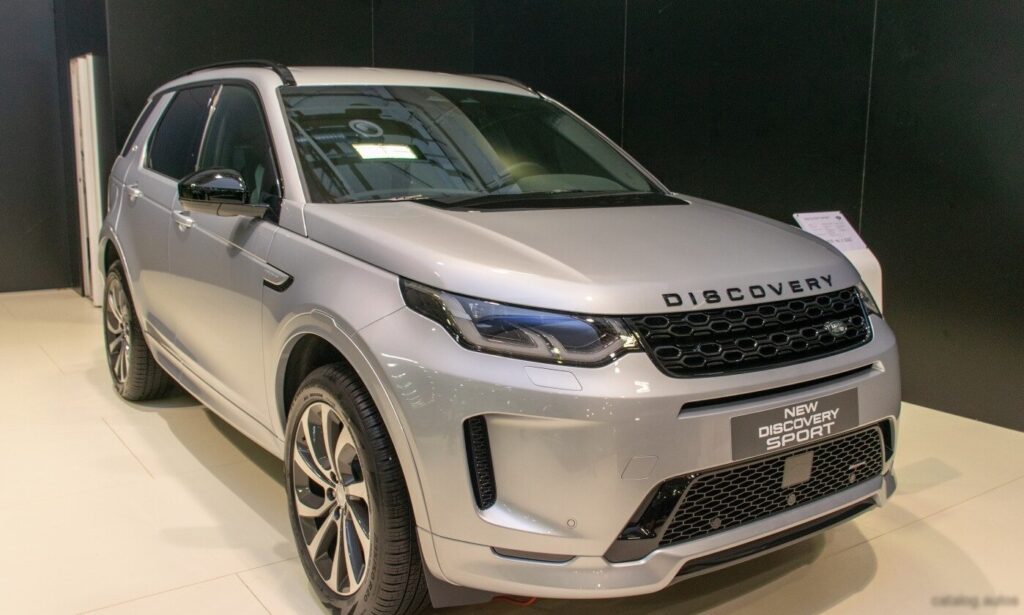
The Land Rover Discovery Sport 2.0 P290 Mild Hybrid AWD Automatic, introduced in August 2020 as part of the facelifted second-generation Discovery Sport (L550), represents a significant step in blending performance, efficiency, and capability within the compact luxury SUV segment. This variant, positioned as a mid-to-high-range offering, leverages Land Rover’s Ingenium engine family and mild-hybrid technology to deliver a refined driving experience. It builds upon the foundation of the original Discovery Sport, which debuted in 2014 as a more accessible entry point into the Land Rover brand, and the 2019 facelift brought updated styling, improved interior technology, and this new powertrain option. The Discovery Sport, in general, aimed to fill a gap between the Range Rover Evoque and the larger Land Rover Discovery, offering a practical and stylish SUV for families and adventurers.
Technical Specifications
| Brand | Land Rover |
| Model | Discovery Sport |
| Generation | Discovery Sport (facelift 2019) |
| Type (Engine) | 2.0 P290 (290 Hp) Mild Hybrid AWD Automatic |
| Start of production | August, 2020 |
| Powertrain Architecture | MHEV (Mild Hybrid Electric Vehicle) |
| Body type | SUV |
| Seats | 5 |
| Doors | 5 |
| Combined fuel consumption (WLTP) | 9.4-9.9 l/100 km (25 – 23.8 US mpg) |
| CO2 emissions (WLTP) | 211-223 g/km |
| Fuel consumption (NEDC, WLTP equivalent) | 7.6 l/100 km (30.9 US mpg) |
| CO2 emissions (NEDC, WLTP equivalent) | 179 g/km |
| Fuel Type | Petrol (Gasoline) |
| Acceleration 0 – 100 km/h | 7.4 sec |
| Acceleration 0 – 62 mph | 7.4 sec |
| Acceleration 0 – 60 mph | 7.0 sec |
| Maximum speed | 233 km/h (144.78 mph) |
| Emission standard | Euro 6 |
| Weight-to-power ratio | 6.5 kg/Hp, 154.1 Hp/tonne |
| Weight-to-torque ratio | 4.7 kg/Nm, 212.5 Nm/tonne |
| Power | 290 Hp @ 5500 rpm |
| Power per litre | 145.2 Hp/l |
| Torque | 400 Nm @ 1500-4500 rpm (295.02 lb.-ft. @ 1500-4500 rpm) |
| Engine layout | Front, Transverse |
| Engine Model/Code | Ingenium / PT204 |
| Engine displacement | 1997 cm3 (121.86 cu. in.) |
| Number of cylinders | 4 |
| Engine configuration | Inline |
| Cylinder Bore | 83.01 mm (3.27 in.) |
| Piston Stroke | 92.3 mm (3.63 in.) |
| Compression ratio | 9.5:1 |
| Number of valves per cylinder | 4 |
| Fuel injection system | Direct injection |
| Engine aspiration | Twin-Turbo, Intercooler |
| Valvetrain | DOHC |
| Engine oil capacity | 7 l (7.4 US qt | 6.16 UK qt) |
| Coolant | 11.2 l (11.83 US qt | 9.85 UK qt) |
| Kerb Weight | 1882 kg (4149.1 lbs.) |
| Trunk (boot) space – minimum | 897 l (31.68 cu. ft.) |
| Trunk (boot) space – maximum | 1794 l (63.35 cu. ft.) |
| Fuel tank capacity | 67 l (17.7 US gal | 14.74 UK gal) |
| Permitted trailer load with brakes (12%) | 2000 kg (4409.25 lbs.) |
| Permitted trailer load without brakes | 750 kg (1653.47 lbs.) |
| Length | 4597 mm (180.98 in.) |
| Width with mirrors folded | 2069 mm (81.46 in.) |
| Width including mirrors | 2173 mm (85.55 in.) |
| Height | 1727 mm (67.99 in.) |
| Wheelbase | 2741 mm (107.91 in.) |
| Front track | 1625-1636 mm (63.98 – 64.41 in.) |
| Rear (Back) track | 1631-1643 mm (64.21 – 64.69 in.) |
| Front overhang | 901 mm (35.47 in.) |
| Rear overhang | 955 mm (37.6 in.) |
| Ride height (ground clearance) | 212 mm (8.35 in.) |
| Drag coefficient (Cd) | 0.34 |
| Minimum turning circle (turning diameter) | 11.8 m (38.71 ft.) |
| Approach angle | 25° |
| Departure angle | 30.2° |
| Ramp-over (brakeover) angle | 20.6° |
| Wading depth | 600 mm (23.62 in.) |
| Drivetrain Architecture | ICE and electric motor drive front wheels, rear wheels engaged via clutch |
| Drive wheel | All wheel drive (4×4) |
| Number of gears and type of gearbox | 9 gears, automatic transmission |
| Front suspension | Independent type McPherson |
| Rear suspension | Independent multi-link suspension |
| Front brakes | Ventilated discs, 349 mm |
| Rear brakes | Disc, 325 mm |
| Assisting systems | ABS (Anti-lock braking system) |
| Steering type | Steering rack and pinion |
| Power steering | Electric Steering |
| Wheel rims size | 18; 19; 20; 21 |
Powertrain & Engine Architecture
At the heart of the Discovery Sport P290 lies Land Rover’s Ingenium engine family, specifically the PT204 2.0-liter inline-four cylinder gasoline engine. This engine utilizes direct injection and a twin-turbocharger setup, allowing it to produce 290 horsepower at 5500 rpm and 400 Nm (295 lb-ft) of torque between 1500 and 4500 rpm. The ‘P290’ designation directly reflects this power output. The mild-hybrid system, a 48-volt setup, incorporates a Belt-integrated Starter Generator (BiSG) which assists the engine during acceleration, enabling smoother starts and improved fuel economy. The BiSG also allows for extended stop/start functionality. The engine’s valvetrain is a Double Overhead Camshaft (DOHC) configuration with four valves per cylinder, optimizing airflow for enhanced performance. The engine is transversely mounted in the front of the vehicle. The transmission is a sophisticated 9-speed automatic, providing a wide range of gear ratios for both on-road refinement and off-road capability.
Driving Characteristics
The 2.0 P290 offers a noticeable step up in performance compared to lower-powered Discovery Sport variants. The mild-hybrid system contributes to a responsive feel, particularly during initial acceleration. While not as overtly sporty as some competitors, the P290 delivers ample power for everyday driving and confident overtaking maneuvers. The 9-speed automatic transmission generally shifts smoothly, although some drivers have noted occasional hesitancy at lower speeds. The all-wheel-drive system provides excellent traction in various conditions, making it a capable vehicle both on and off the pavement. Compared to a manual transmission equipped Discovery Sport (not widely available with this engine), the automatic prioritizes convenience and ease of use, but sacrifices some driver engagement.
Equipment & Trim Levels
The Discovery Sport 2.0 P290 typically came well-equipped, reflecting its mid-to-high-range positioning. Standard features often included leather upholstery, a touchscreen infotainment system with Apple CarPlay and Android Auto compatibility, automatic climate control, and a suite of driver-assistance technologies such as lane departure warning and emergency braking. Optional extras could include a panoramic sunroof, premium audio system, adaptive cruise control, and various cosmetic enhancements. Trim levels varied by market, but generally offered increasing levels of luxury and technology.
Chassis & Braking
The Discovery Sport utilizes an independent McPherson strut suspension at the front and an independent multi-link suspension at the rear, providing a comfortable ride quality. The chassis is designed to balance on-road handling with off-road capability. Braking duties are handled by ventilated discs at the front (349mm) and solid discs at the rear (325mm). The vehicle is equipped with ABS (Anti-lock Braking System) and electronic stability control as standard safety features.
Market Reception & Comparison
The Discovery Sport 2.0 P290 was generally well-received by automotive critics, who praised its blend of performance, practicality, and luxury. Fuel economy, while improved by the mild-hybrid system, remained a point of contention, as it was not class-leading. Compared to the lower-powered 1.5-liter Ingenium engine variants, the P290 offered a significant performance advantage, but at a higher price point. Against competitors like the BMW X3, Audi Q5, and Mercedes-Benz GLC, the Discovery Sport offered a unique combination of off-road capability and British design flair.
Legacy
The Ingenium engine family, including the PT204 used in the P290, has proven to be relatively reliable, although some owners have reported minor issues with the fuel injection system and turbocharger. The mild-hybrid system has also generally demonstrated good durability. On the used car market, the Discovery Sport 2.0 P290 holds its value reasonably well, appealing to buyers seeking a stylish and capable compact SUV with a decent level of performance. Its blend of luxury, practicality, and off-road ability continues to make it a popular choice in its segment.