
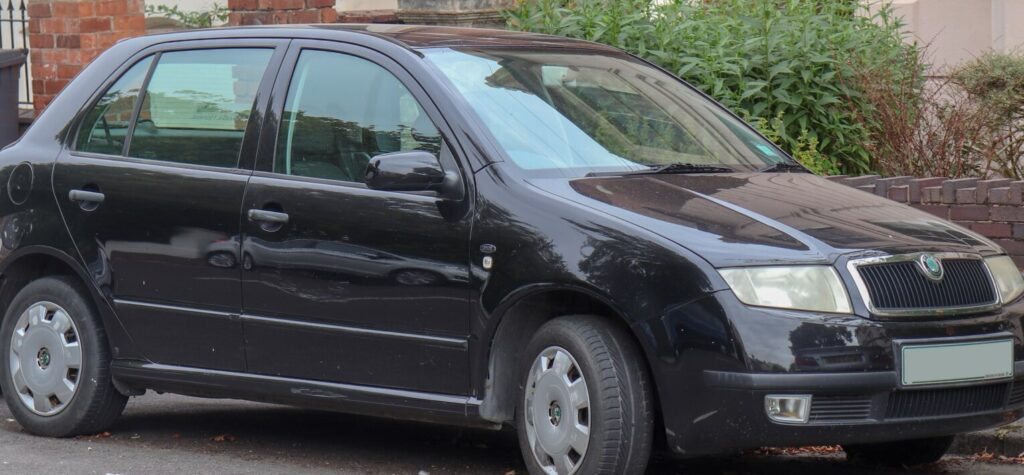
The Skoda Fabia I (6Y) 1.2 i, producing 54 horsepower, was an entry-level variant of the first-generation Fabia hatchback, manufactured between July 2001 and July 2004. Positioned as the most affordable option in the Fabia range, it served as a practical and economical choice for first-time car buyers and those seeking a no-frills city car. The 6Y Fabia represented Skoda’s first completely new model following its acquisition by the Volkswagen Group, built on the Volkswagen A05 (Polo) platform, also known as the 6Y platform. This variant was primarily sold in European markets, where fuel efficiency and affordability were key purchasing considerations.
Technical Specifications
| Brand | Skoda |
| Model | Fabia |
| Generation | Fabia I (6Y) |
| Type (Engine) | 1.2 i (54 Hp) |
| Start of production | July, 2001 |
| End of production | July, 2004 |
| Powertrain Architecture | Internal Combustion engine |
| Body type | Hatchback |
| Seats | 5 |
| Doors | 5 |
| Fuel consumption (urban) | 7.8 l/100 km (30.2 US mpg, 36.2 UK mpg, 12.8 km/l) |
| Fuel consumption (extra urban) | 4.8 l/100 km (49 US mpg, 58.9 UK mpg, 20.8 km/l) |
| Fuel consumption (combined) | 5.9 l/100 km (39.9 US mpg, 47.9 UK mpg, 16.9 km/l) |
| Fuel Type | Petrol (Gasoline) |
| Acceleration 0 – 100 km/h | 18.4 sec |
| Acceleration 0 – 62 mph | 18.4 sec |
| Acceleration 0 – 60 mph | 17.5 sec |
| Maximum speed | 151 km/h (93.83 mph) |
| Weight-to-power ratio | 19.4 kg/Hp, 51.4 Hp/tonne |
| Weight-to-torque ratio | 9.7 kg/Nm, 102.9 Nm/tonne |
| Power | 54 Hp @ 4750 rpm |
| Power per litre | 45.1 Hp/l |
| Torque | 108 Nm @ 3000 rpm (79.66 lb.-ft. @ 3000 rpm) |
| Engine layout | Front, Transverse |
| Engine Model/Code | AWY |
| Engine displacement | 1198 cm3 (73.11 cu. in.) |
| Number of cylinders | 3 |
| Engine configuration | Inline |
| Cylinder Bore | 76.5 mm (3.01 in.) |
| Piston Stroke | 86.9 mm (3.42 in.) |
| Compression ratio | 10.3:1 |
| Number of valves per cylinder | 2 |
| Fuel injection system | Multi-port manifold injection |
| Engine aspiration | Naturally aspirated engine |
| Valvetrain | OHC |
| Engine oil capacity | 2.4 l (2.54 US qt | 2.11 UK qt) |
| Coolant | 5.1 l (5.39 US qt | 4.49 UK qt) |
| Kerb Weight | 1050 kg (2314.85 lbs.) |
| Max. weight | 1570 kg (3461.26 lbs.) |
| Max load | 520 kg (1146.4 lbs.) |
| Trunk (boot) space – minimum | 260 l (9.18 cu. ft.) |
| Trunk (boot) space – maximum | 1015 l (35.84 cu. ft.) |
| Fuel tank capacity | 45 l (11.89 US gal | 9.9 UK gal) |
| Length | 3960 mm (155.91 in.) |
| Width | 1645 mm (64.76 in.) |
| Height | 1450 mm (57.09 in.) |
| Wheelbase | 2462 mm (96.93 in.) |
| Front track | 1435 mm (56.5 in.) |
| Rear (Back) track | 1424 mm (56.06 in.) |
| Drivetrain Architecture | The Internal combustion engine (ICE) drives the front wheels of the vehicle. |
| Drive wheel | Front wheel drive |
| Number of gears and type of gearbox | 5 gears, manual transmission |
| Front suspension | Coil spring |
| Rear suspension | Coil spring |
| Front brakes | Disc |
| Rear brakes | Drum |
| Assisting systems | ABS (Anti-lock braking system) |
| Steering type | Steering rack and pinion |
| Power steering | Hydraulic Steering |
| Tires size | 165/70 R14 |
| Wheel rims size | 14 |
INTRODUCTION
The Skoda Fabia I 6Y 1.2 i was introduced in 2001 as the base model of the first-generation Fabia. It was designed to offer affordable transportation within the European market, competing with vehicles like the Renault Clio, Peugeot 206, and Volkswagen Polo. The 1.2-liter engine was chosen for its fuel efficiency and relatively low emissions, making it attractive to buyers concerned with running costs. This trim level was a key part of Skoda’s strategy to establish itself as a value-oriented brand within the Volkswagen Group.
Powertrain & Engine Architecture
The heart of the Fabia 1.2 i is the AWY engine code, a 1.2-liter inline three-cylinder petrol engine. This engine utilizes a naturally aspirated configuration and multi-point fuel injection. The engine’s relatively simple design contributed to its reliability and ease of maintenance. The overhead camshaft (OHC) valvetrain operates two valves per cylinder. The 1.2-liter engine produced 54 horsepower at 4750 rpm and 108 Nm (79.66 lb-ft) of torque at 3000 rpm. The engine was typically paired with a five-speed manual transmission, although a four-speed automatic transmission was also available, albeit less common. The automatic transmission, while offering convenience, noticeably impacted acceleration and fuel economy.
Driving Characteristics
The Fabia 1.2 i with the manual transmission offered adequate, though uninspiring, performance. Acceleration from 0-60 mph took around 17.5 seconds, and the top speed was approximately 94 mph. The engine felt strained when accelerating hard or climbing hills, requiring frequent gear changes to maintain momentum. The automatic transmission version further diminished performance, with 0-60 mph times extending to around 18.4 seconds. The gear ratios were optimized for fuel economy rather than outright speed. Handling was generally safe and predictable, but the car lacked the dynamic finesse of more powerful Fabia variants. The suspension was tuned for comfort, providing a reasonably smooth ride on most road surfaces.
Equipment & Trim Levels
The 1.2 i Fabia was typically equipped with basic features. Standard equipment included power steering, central locking, front airbags, and an adjustable steering column. Interior upholstery was typically cloth, and the dashboard featured a simple, functional design. Optional extras included air conditioning, electric front windows, and a radio/CD player. Higher trim levels, such as the Classic and Elegance, offered more features as standard, but the 1.2 i remained the entry point to the Fabia range.
Chassis & Braking
The Fabia 1.2 i utilized a MacPherson strut front suspension and a twist-beam rear suspension. The front brakes were disc brakes, while the rear brakes were drum brakes. ABS (Anti-lock Braking System) was standard equipment, enhancing safety. The suspension setup was geared towards providing a comfortable ride, rather than sporty handling. The relatively light weight of the 1.2 i model helped to compensate for the modest braking performance.
Market Reception & Comparison
The Fabia 1.2 i was generally well-received as an affordable and practical city car. Critics praised its fuel efficiency and low running costs, but noted its lack of performance. Compared to the more powerful 1.4-liter and 2.0-liter Fabia variants, the 1.2 i offered significantly less power and refinement. The 1.9 TDI diesel version provided superior fuel economy and torque, but at a higher purchase price. The 1.2 i appealed to buyers who prioritized economy and practicality over driving excitement.
Legacy
The Skoda Fabia I 1.2 i has proven to be a relatively reliable vehicle, with the AWY engine generally considered durable. Common issues include wear and tear on suspension components and occasional problems with the fuel injection system. In the used car market, the 1.2 i Fabia remains an affordable option for those seeking a basic, economical hatchback. Its simplicity and low running costs continue to make it an attractive choice for first-time car owners and those on a tight budget. While not a performance icon, the 1.2 i Fabia played a crucial role in establishing Skoda as a credible and value-driven automotive brand.
