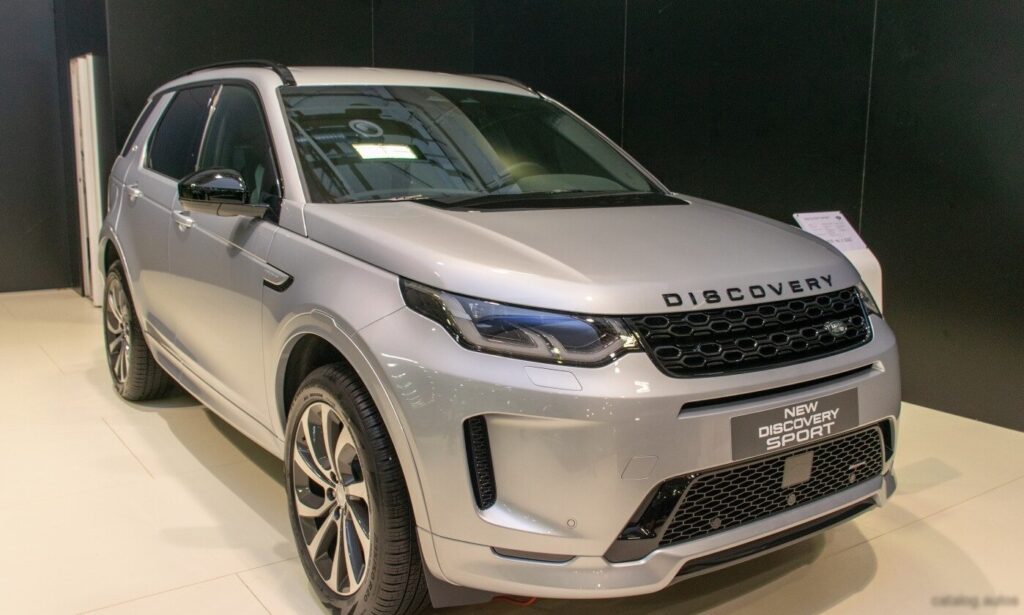
Technical Specifications
| Brand | Land Rover |
| Model | Discovery Sport |
| Generation | Discovery Sport (facelift 2019) |
| Type | 2.0 P290 (290 Hp) Mild Hybrid AWD Automatic 5+2 Seating |
| Start of production | August, 2020 |
| Powertrain Architecture | MHEV (Mild Hybrid Electric Vehicle) |
| Body type | SUV |
| Seats | 7 |
| Doors | 5 |
| Combined fuel consumption (WLTP) | 9.5-10 l/100 km (24.8 – 23.5 US mpg) |
| CO2 emissions (WLTP) | 214-226 g/km |
| Fuel consumption (NEDC) | 7.6 l/100 km (30.9 US mpg) |
| CO2 emissions (NEDC) | 180 g/km |
| Fuel Type | Petrol (Gasoline) |
| Acceleration 0 – 100 km/h | 7.0 sec |
| Acceleration 0 – 62 mph | 7.0 sec |
| Acceleration 0 – 60 mph | 6.6 sec |
| Maximum speed | 233 km/h (144.78 mph) |
| Emission standard | Euro 6 |
| Weight-to-power ratio | 6.8 kg/Hp |
| Weight-to-torque ratio | 4.9 kg/Nm |
| Power | 290 Hp @ 5500 rpm |
| Torque | 400 Nm @ 1500-4500 rpm (295.02 lb.-ft.) |
| Engine layout | Front, Transverse |
| Engine Model/Code | Ingenium / PT204 |
| Engine displacement | 1997 cm3 (121.86 cu. in.) |
| Number of cylinders | 4 |
| Engine configuration | Inline |
| Cylinder Bore | 83.01 mm (3.27 in.) |
| Piston Stroke | 92.3 mm (3.63 in.) |
| Compression ratio | 9.5:1 |
| Number of valves per cylinder | 4 |
| Fuel injection system | Direct injection |
| Engine aspiration | Twin-Turbo, Intercooler |
| Valvetrain | DOHC |
| Engine oil capacity | 7 l (7.4 US qt | 6.16 UK qt) |
| Coolant capacity | 11.2 l (11.83 US qt | 9.85 UK qt) |
| Kerb Weight | 1961 kg (4323.26 lbs.) |
| Trunk (boot) space – minimum | 157 l (5.54 cu. ft.) |
| Trunk (boot) space – maximum | 1651 l (58.3 cu. ft.) |
| Fuel tank capacity | 67 l (17.7 US gal | 14.74 UK gal) |
| Permitted trailer load with brakes (12%) | 2000 kg (4409.25 lbs.) |
| Permitted trailer load without brakes | 750 kg (1653.47 lbs.) |
| Length | 4597 mm (180.98 in.) |
| Width with mirrors folded | 2069 mm (81.46 in.) |
| Width including mirrors | 2173 mm (85.55 in.) |
| Height | 1727 mm (67.99 in.) |
| Wheelbase | 2741 mm (107.91 in.) |
| Front track | 1625-1636 mm (63.98 – 64.41 in.) |
| Rear track | 1631-1643 mm (64.21 – 64.69 in.) |
| Front overhang | 901 mm (35.47 in.) |
| Rear overhang | 955 mm (37.6 in.) |
| Ride height (ground clearance) | 212 mm (8.35 in.) |
| Drag coefficient (Cd) | 0.34 |
| Minimum turning circle | 11.8 m (38.71 ft.) |
| Approach angle | 25° |
| Departure angle | 30.2° |
| Ramp-over angle | 20.6° |
| Wading depth | 600 mm (23.62 in.) |
| Drivetrain Architecture | All wheel drive (4×4). MHEV. |
| Number of gears | 9 |
| Gearbox type | Automatic transmission |
| Front suspension | Independent type McPherson |
| Rear suspension | Independent multi-link suspension |
| Front brakes | Ventilated discs, 349 mm |
| Rear brakes | Disc, 325 mm |
The 2019 facelift of the Land Rover Discovery Sport brought with it a significant powertrain upgrade in the form of the 2.0 P290. Built on the Land Rover-Jaguar Land Rover Longitudinal Vehicle Architecture (previously known as the 1HX0/A3 platform), this variant aimed to deliver a more refined and powerful driving experience while maintaining the practicality and off-road capability expected of the Discovery Sport nameplate. The introduction of mild hybrid technology was a key element, contributing to improved fuel economy and reduced emissions. The optional seven-seat configuration further broadened the appeal of this model to families seeking a versatile premium SUV.
Powertrain & Engine Architecture
At the heart of the 2.0 P290 lies Land Rover’s Ingenium engine family, specifically the PT204 code. This is a 1997cc inline-four cylinder engine featuring direct injection and a twin-turbocharger setup. The twin-scroll turbochargers are designed to minimize turbo lag and provide a broad torque curve. The mild hybrid system utilizes a 48-volt electrical architecture and a belt-integrated starter generator (BiSG). This system allows for engine-off coasting, regenerative braking, and smoother start-stop operation, contributing to fuel savings. The engine produces 290 horsepower at 5500 rpm and 400 Nm (295 lb-ft) of torque between 1500 and 4500 rpm. The engine is paired with a ZF nine-speed automatic transmission, known for its smooth shifting and wide gear ratio spread. This transmission is electronically controlled and adapts to driving conditions and driver input.
Driving Characteristics
The 2.0 P290 offers a noticeable performance improvement over lower-powered Discovery Sport variants. The 0-60 mph acceleration time of 6.6 seconds is brisk for a compact SUV. The nine-speed automatic transmission provides quick and seamless gear changes, and the mild hybrid system contributes to a responsive feel. While not as overtly sporty as some competitors, the Discovery Sport 2.0 P290 delivers ample power for everyday driving and confident overtaking. The all-wheel-drive system provides excellent traction in various conditions, and the Terrain Response system allows drivers to optimize the vehicle’s settings for different surfaces. Compared to the manual transmission options, the automatic offers greater convenience, particularly in urban environments. The higher output compared to the base 2.0-liter engine provides a more engaging driving experience.
Equipment & Trim Levels
The 2.0 P290 typically came equipped with a generous level of standard features. These included leather upholstery, a touchscreen infotainment system with Apple CarPlay and Android Auto compatibility, navigation, climate control, and a suite of safety features such as autonomous emergency braking and lane departure warning. Optional extras included a panoramic sunroof, premium audio system, adaptive cruise control, and a powered tailgate. The five-plus-two seating configuration was an option, adding two smaller seats in the third row, suitable for children or occasional use. Trim levels varied by market, but generally, the 2.0 P290 was positioned as a mid-to-high-spec model, offering a balance of luxury and practicality.
Chassis & Braking
The Discovery Sport utilizes an independent McPherson strut suspension at the front and a multi-link suspension at the rear. This setup provides a comfortable ride quality while maintaining good handling characteristics. The chassis is relatively lightweight, contributing to the vehicle’s agility. The braking system consists of ventilated discs at the front (349mm) and solid discs at the rear (325mm). Anti-lock braking system (ABS) and electronic brakeforce distribution (EBD) are standard features. The steering is electric power-assisted, providing a light and precise feel.
Market Reception & Comparison
The Discovery Sport 2.0 P290 was generally well-received by automotive critics. It was praised for its refined engine, comfortable ride, and spacious interior. The mild hybrid technology was seen as a positive step towards improved fuel efficiency. Compared to other trims in the Discovery Sport lineup, the 2.0 P290 offered a significant performance upgrade, making it a more appealing option for drivers who prioritize power and responsiveness. Fuel economy figures of 9.5-10 l/100 km (24.8-23.5 US mpg) were competitive within the segment, although not class-leading. Reliability reports have been generally positive, with the Ingenium engine proving to be a robust and dependable unit.
Legacy
The Land Rover Discovery Sport 2.0 P290 represents a key milestone in the evolution of the Discovery Sport model. The introduction of mild hybrid technology and the powerful Ingenium engine helped to establish the Discovery Sport as a competitive player in the premium compact SUV segment. The powertrain has proven to be relatively reliable, and well-maintained examples continue to hold their value in the used car market. The combination of luxury, capability, and practicality makes this variant a popular choice for families and individuals seeking a versatile and refined SUV.