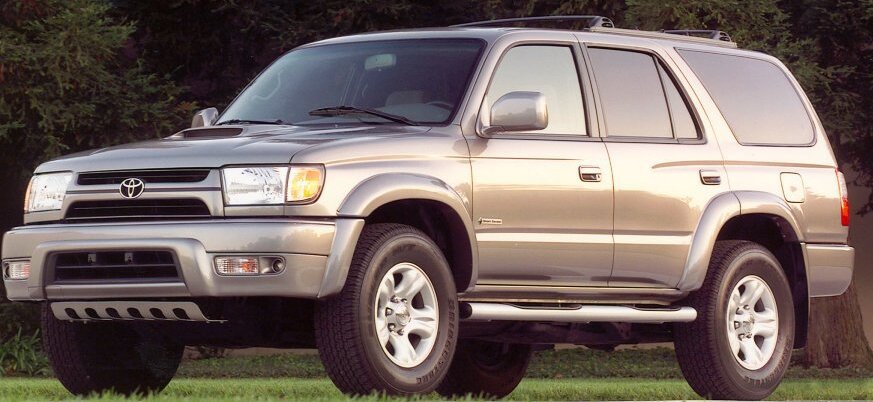
The Toyota 4Runner III, specifically the facelifted version produced from 1999 to 2002, represented a significant evolution of Toyota’s popular mid-size SUV. This generation, internally designated as the 180 series, continued the 4Runner’s reputation for rugged reliability and off-road capability while incorporating refinements in comfort and technology. The 3.4 V6 24V (183 Hp) 4×4 Automatic variant occupied a sweet spot in the lineup, offering a balance of power, convenience, and affordability. It was positioned as a step up from the base 2.7-liter four-cylinder models, appealing to buyers who needed more torque for towing or navigating challenging terrain, but didn’t require the higher price point of the limited trim levels.
Technical Specifications
| Brand | Toyota |
| Model | 4Runner |
| Generation | 4Runner III (facelift 1999) |
| Type (Engine) | 3.4 V6 24V (183 Hp) 4×4 Automatic |
| Start of production | 1999 |
| End of production | 2002 |
| Powertrain Architecture | Internal Combustion engine |
| Body type | SUV |
| Seats | 5 |
| Doors | 5 |
| Fuel Type | Petrol (Gasoline) |
| Weight-to-power ratio | 9.6 kg/Hp, 104 Hp/tonne |
| Weight-to-torque ratio | 6 kg/Nm, 167 Nm/tonne |
| Power | 183 Hp @ 4800 rpm |
| Power per litre | 54.2 Hp/l |
| Torque | 294 Nm @ 3600 rpm, 216.84 lb.-ft. @ 3600 rpm |
| Engine layout | Front, Longitudinal |
| Engine Model/Code | 5VZ-FE |
| Engine displacement | 3378 cm3, 206.14 cu. in. |
| Number of cylinders | 6 |
| Engine configuration | V-engine |
| Cylinder Bore | 93.5 mm, 3.68 in. |
| Piston Stroke | 82 mm, 3.23 in. |
| Compression ratio | 9.6:1 |
| Number of valves per cylinder | 4 |
| Fuel injection system | Multi-port manifold injection |
| Engine aspiration | Naturally aspirated engine |
| Valvetrain | DOHC |
| Engine oil capacity | 5.2 l, 5.49 US qt | 4.58 UK qt |
| Coolant | 8 l, 8.45 US qt | 7.04 UK qt |
| Kerb Weight | 1760 kg, 3880.14 lbs |
| Max. weight | 2381 kg, 5249.21 lbs |
| Max load | 621 kg, 1369.07 lbs |
| Trunk (boot) space – minimum | 1263 l, 44.6 cu. ft. |
| Trunk (boot) space – maximum | 2257 l, 79.71 cu. ft. |
| Fuel tank capacity | 70 l, 18.49 US gal | 15.4 UK gal |
| Permitted trailer load with brakes (12%) | 2268 kg, 5000.08 lbs |
| Length | 4656 mm, 183.31 in. |
| Width | 1690 mm, 66.54 in. |
| Height | 1715-1740 mm, 67.52 – 68.5 in. |
| Wheelbase | 2675 mm, 105.31 in. |
| Front track | 1505 mm, 59.25 in. |
| Rear (Back) track | 1495-1510 mm, 58.86 – 59.45 in. |
| Minimum turning circle (turning diameter) | 11.4 m, 37.4 ft. |
| Drive wheel | All wheel drive (4×4) |
| Number of gears and type of gearbox | 4 gears, automatic transmission |
| Front suspension | Double wishbone |
| Rear suspension | Independent multi-link suspension |
| Front brakes | Ventilated discs |
| Rear brakes | Drum |
| Assisting systems | ABS (Anti-lock braking system) |
| Steering type | Steering rack and pinion |
| Power steering | Hydraulic Steering |
| Tires size | 225/75 R15; 265/70 R16 |
| Wheel rims size | 7J x 15; 7J x 16 |
INTRODUCTION
The 1999-2002 Toyota 4Runner facelift built upon the success of the third-generation model (introduced in 1996). This refresh brought subtle styling changes, including a revised front fascia and updated interior trim. However, the core appeal remained the same: a body-on-frame SUV known for its durability and off-road prowess. The 3.4-liter V6 engine paired with a four-speed automatic transmission was a popular choice, offering a good compromise between performance and fuel efficiency. This combination was available across various trim levels, including the SR5 and Limited, with the SR5 being the more commonly equipped with this powertrain.
Powertrain & Engine Architecture
The heart of this 4Runner variant is the 5VZ-FE 3.4-liter V6 engine. This engine is a naturally aspirated, 24-valve (four valves per cylinder) powerplant featuring a double overhead camshaft (DOHC) design. It utilizes a multi-port fuel injection system, delivering fuel directly to each intake port for optimized combustion. The 5VZ-FE is known for its robust construction and relatively simple design, contributing to its longevity. The engine’s block is cast iron, while the cylinder heads are aluminum alloy, helping to manage weight. The four-speed automatic transmission (typically the A750F) was chosen for its reliability and suitability for both on-road driving and moderate off-road use. While not offering the efficiency of modern transmissions with more gears, it provided smooth shifts and adequate performance for the engine’s output.
Driving Characteristics
The 3.4L V6 Automatic 4Runner delivers a comfortable and capable driving experience. With 183 horsepower and 294 lb-ft of torque, acceleration is adequate for everyday driving, though not particularly sporty. The automatic transmission is tuned for smooth shifts rather than aggressive performance. Compared to the five-speed manual transmission available on some 4Runner models, the automatic offers greater convenience, especially in city traffic. However, the manual transmission provides more driver control and slightly better fuel economy. The 4×4 system, typically a part-time system with a shift-on-the-fly transfer case, allows the driver to easily switch between two-wheel drive and four-wheel drive for varying road conditions. The gear ratios are optimized for a balance of low-end torque for off-roading and comfortable highway cruising.
Equipment & Trim Levels
The SR5 trim, commonly equipped with the 3.4L V6 and automatic transmission, typically included features such as air conditioning, power windows and locks, a CD player, and cloth upholstery. Optional extras included a sunroof, upgraded audio systems, leather upholstery (often found on the Limited trim), and a rear limited-slip differential. The interior design was functional and durable, prioritizing practicality over luxury. Dashboard configuration was relatively straightforward, with easy-to-read gauges and logically placed controls. The Limited trim added more premium features, such as heated seats and automatic climate control.
Chassis & Braking
The 4Runner III utilizes a traditional body-on-frame construction, providing a robust and durable platform. The front suspension features a double wishbone design, while the rear suspension employs an independent multi-link setup. This combination offers a good balance of ride comfort and off-road capability. Braking duties are handled by ventilated discs at the front and drum brakes at the rear. While the drum brakes at the rear were a cost-saving measure, they provided adequate stopping power for the vehicle’s weight and intended use. Anti-lock brakes (ABS) were standard, enhancing safety in emergency braking situations.
Market Reception & Comparison
The 3.4L V6 Automatic 4Runner was well-received by critics and consumers alike. It was praised for its reliability, off-road capability, and comfortable ride. Compared to the base 2.7-liter four-cylinder models, the V6 offered a significant performance upgrade, making it a more appealing choice for those who frequently tow or venture off the beaten path. Fuel economy was reasonable for a vehicle of its size and type, averaging around 16-18 mpg in city driving and 19-21 mpg on the highway. Compared to competitors like the Jeep Cherokee and Nissan Pathfinder, the 4Runner was often seen as the more reliable and durable option.
Legacy
The 5VZ-FE engine, in particular, has earned a reputation for exceptional longevity. Many examples of the 3.4L V6 4Runner have surpassed 200,000 miles with proper maintenance. The automatic transmission, while not as sophisticated as modern units, is also known for its durability. Today, these 4Runners are highly sought after in the used car market, commanding relatively high prices due to their reputation for reliability and off-road capability. Common maintenance items include timing belt replacement (typically recommended every 90,000 miles) and regular fluid changes. Overall, the 1999-2002 Toyota 4Runner 3.4 V6 4×4 Automatic remains a popular and respected SUV, a testament to Toyota’s engineering prowess and commitment to quality.