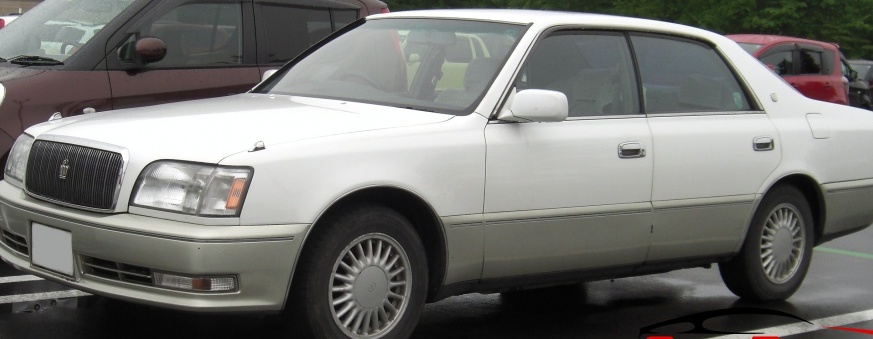
The Toyota Crown Majesta II, specifically the S150 chassis produced between 1995 and 1997, represented a significant evolution of Toyota’s flagship luxury sedan. Positioned above the standard Crown, the Majesta aimed to compete directly with Japanese rivals like the Nissan Cima and Honda Inspire, offering a more opulent experience. This particular variant, equipped with the 4.0-liter V8 engine (1UZ-FE) paired with a four-speed automatic transmission, was a top-of-the-line offering, emphasizing smooth power delivery and refined comfort. The S150 generation built upon the success of the first Majesta, further solidifying Toyota’s presence in the premium sedan segment within the Japanese domestic market (JDM).
Technical Specifications
| Brand | Toyota |
| Model | Crown Majesta |
| Generation | Crown Majesta II (S150) |
| Type (Engine) | 4.0 V8 32V (265 Hp) Automatic |
| Start of production | 1995 |
| End of production | 1997 |
| Powertrain Architecture | Internal Combustion engine |
| Body type | Sedan |
| Seats | 5 |
| Doors | 4 |
| Fuel Type | Petrol (Gasoline) |
| Weight-to-power ratio | 6.1 kg/Hp, 163.6 Hp/tonne |
| Weight-to-torque ratio | 4.5 kg/Nm, 224.1 Nm/tonne |
| Power | 265 Hp @ 5400 rpm |
| Power per litre | 66.8 Hp/l |
| Torque | 363 Nm @ 4600 rpm, 267.74 lb.-ft. @ 4600 rpm |
| Engine layout | Front, Longitudinal |
| Engine Model/Code | 1UZ-FE |
| Engine displacement | 3968 cm3, 242.14 cu. in. |
| Number of cylinders | 8 |
| Engine configuration | V-engine |
| Cylinder Bore | 87.5 mm, 3.44 in. |
| Piston Stroke | 82.5 mm, 3.25 in. |
| Compression ratio | 10.5:1 |
| Number of valves per cylinder | 4 |
| Fuel injection system | Multi-port manifold injection |
| Engine aspiration | Naturally aspirated engine |
| Valvetrain | DOHC |
| Engine oil capacity | 4.8 l, 5.07 US qt | 4.22 UK qt |
| Kerb Weight | 1620 kg, 3571.49 lbs |
| Fuel tank capacity | 80 l, 21.13 US gal | 17.6 UK gal |
| Length | 4900 mm, 192.91 in |
| Width | 1795 mm, 70.67 in |
| Height | 1420 mm, 55.91 in |
| Wheelbase | 2780 mm, 109.45 in |
| Front track | 1535 mm, 60.43 in |
| Rear (Back) track | 1520 mm, 59.84 in |
| Ride height (ground clearance) | 140 mm, 5.51 in |
| Minimum turning circle (turning diameter) | 11.0 m, 36.09 ft |
| Drivetrain Architecture | The Internal combustion engine (ICE) drives the rear wheels of the vehicle. |
| Drive wheel | Rear wheel drive |
| Number of gears and type of gearbox | 4 gears, automatic transmission |
| Front suspension | Double wishbone |
| Rear suspension | Double wishbone |
| Front brakes | Ventilated discs |
| Rear brakes | Ventilated discs |
| Assisting systems | ABS (Anti-lock braking system) |
| Steering type | Steering rack and pinion |
| Power steering | Hydraulic Steering |
| Tires size | 215/65 R15 |
| Wheel rims size | 15 |
Powertrain & Engine Architecture
The heart of this Majesta variant is the 1UZ-FE 4.0-liter V8 engine. This engine, a cornerstone of Toyota’s luxury offerings throughout the 1990s, is renowned for its smoothness and reliability. The 1UZ-FE features a cast-iron block with an aluminum cylinder head, employing dual overhead camshafts (DOHC) and four valves per cylinder. Multi-port fuel injection delivers precise fuel metering, contributing to both performance and efficiency. The engine’s 10.5:1 compression ratio further enhances its power output. Paired with this engine is a four-speed automatic transmission, designed for seamless gear changes and a comfortable driving experience. This transmission, while not offering the latest in gear ratios, was well-suited to the engine’s torque curve, providing adequate acceleration and cruising ability.
Driving Characteristics
The 4.0L V8 automatic Majesta delivers a distinctly different driving experience compared to the four-cylinder or even the six-cylinder versions of the Crown. The V8 provides ample torque throughout the rev range, making for effortless acceleration and relaxed highway cruising. While not a sports sedan, the Majesta’s power allows for confident overtaking maneuvers. The four-speed automatic transmission, while smooth, isn’t particularly quick-shifting by modern standards. The gear ratios are geared towards comfort and fuel economy rather than outright performance. Compared to a manual transmission equipped Majesta, the automatic sacrifices some responsiveness, but gains significantly in ease of use, especially in city traffic. The rear-wheel-drive configuration contributes to a balanced feel, although it doesn’t offer the dynamic handling of some European competitors.
Equipment & Trim Levels
The 4.0 V8 Majesta was typically equipped with a high level of standard features. Interior appointments included plush leather upholstery, power-adjustable front seats (often with memory function), woodgrain trim, and a premium sound system. Climate control was standard, as were power windows, locks, and mirrors. Optional extras could include a navigation system (a relatively new technology at the time), a sunroof, and upgraded audio components. The exterior typically featured chrome accents, alloy wheels, and a generally more refined appearance than lower-trim models. The focus was on creating a luxurious and comfortable environment for both the driver and passengers.
Chassis & Braking
The S150 Majesta utilized a double wishbone suspension setup at both the front and rear, providing a comfortable and controlled ride. The suspension was tuned for smoothness rather than sporty handling. Braking duties were handled by ventilated disc brakes on all four wheels, providing adequate stopping power for the vehicle’s weight and performance. An Anti-lock Braking System (ABS) was standard, enhancing safety and stability during hard braking. Steering was via a hydraulic power steering rack and pinion system, offering a reasonable level of assistance without feeling overly isolated.
Market Reception & Comparison
The Toyota Crown Majesta II 4.0 V8 Automatic was well-received in the Japanese market as a luxurious and reliable alternative to European and American luxury sedans. Critics praised the engine’s smoothness and the car’s overall refinement. However, some noted that the handling wasn’t as sharp as some competitors. Compared to the more fuel-efficient four-cylinder and six-cylinder Majesta variants, the V8 model offered significantly more power but at the expense of fuel economy. The V8 was also more expensive to maintain due to its larger displacement and more complex engine design. Against rivals like the Nissan Cima and Honda Inspire, the Majesta held its own, offering a compelling combination of luxury, performance, and Toyota’s renowned reliability.
Legacy
The 1UZ-FE engine, in particular, has earned a reputation for exceptional durability and longevity. Many examples of the S150 Majesta with this engine are still on the road today, often with high mileage. The four-speed automatic transmission, while not as sophisticated as modern transmissions, has also proven to be relatively reliable. In the used car market, the 4.0 V8 Majesta commands a premium over lower-trim models, particularly those in good condition. The car is often sought after by enthusiasts who appreciate its classic styling, smooth V8 power, and overall build quality. The S150 Majesta represents a high point in Toyota’s luxury car development, showcasing the company’s commitment to engineering excellence and customer satisfaction.