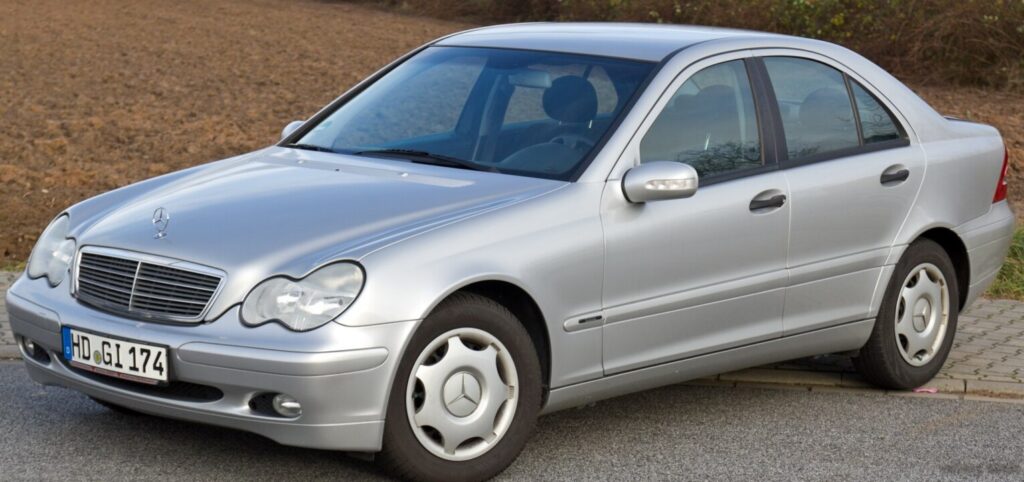
The Mercedes-Benz C 240 V6 Automatic, produced between February 2000 and March 2004, was a significant variant within the W203 C-Class range. Positioned as a mid-range offering, it bridged the gap between the more economical four-cylinder models and the performance-oriented C32 AMG. This model aimed to provide a balance of luxury, refinement, and respectable performance for buyers seeking a comfortable and capable executive sedan. It was primarily sold in Europe and other international markets, representing a key part of Mercedes-Benz’s strategy to offer a diverse C-Class lineup.
Technical Specifications
| Brand | Mercedes-Benz |
| Model | C-class |
| Generation | C-class (W203) |
| Type (Engine) | C 240 V6 (170 Hp) Automatic |
| Start of production | February, 2000 |
| End of production | March, 2004 |
| Powertrain Architecture | Internal Combustion engine |
| Body type | Sedan |
| Seats | 5 |
| Doors | 4 |
| Fuel consumption (economy) – urban (NEDC) | 15.7 l/100 km (15 US mpg, 18 UK mpg, 6.4 km/l) |
| Fuel consumption (economy) – extra urban (NEDC) | 7.9 l/100 km (29.8 US mpg, 35.8 UK mpg, 12.7 km/l) |
| Fuel consumption (economy) – combined (NEDC) | 10.7 l/100 km (22 US mpg, 26.4 UK mpg, 9.3 km/l) |
| CO2 emissions (NEDC) | 243 g/km |
| Fuel Type | Petrol (Gasoline) |
| Acceleration 0 – 100 km/h | 9.5 sec |
| Acceleration 0 – 62 mph | 9.5 sec |
| Acceleration 0 – 60 mph | 9 sec |
| Maximum speed | 232 km/h (144.16 mph) |
| Weight-to-power ratio | 8.6 kg/Hp, 116.4 Hp/tonne |
| Weight-to-torque ratio | 6.1 kg/Nm, 164.4 Nm/tonne |
| Power | 170 Hp @ 5500 rpm |
| Power per litre | 65.5 Hp/l |
| Torque | 240 Nm @ 4500 rpm (177.01 lb.-ft. @ 4500 rpm) |
| Maximum engine speed | 6000 rpm |
| Engine layout | Front, Longitudinal |
| Engine Model/Code | M 112.912 |
| Engine displacement | 2597 cm3 (158.48 cu. in.) |
| Number of cylinders | 6 |
| Engine configuration | V-engine |
| Cylinder Bore | 89.9 mm (3.54 in.) |
| Piston Stroke | 68.2 mm (2.69 in.) |
| Compression ratio | 10.5:1 |
| Number of valves per cylinder | 3 |
| Fuel injection system | Multi-port manifold injection |
| Engine aspiration | Naturally aspirated engine |
| Valvetrain | DOHC |
| Engine oil capacity | 8 l (8.45 US qt | 7.04 UK qt) |
| Coolant | 10.5 l (11.1 US qt | 9.24 UK qt) |
| Kerb Weight | 1460 kg (3218.75 lbs.) |
| Max. weight | 1935 kg (4265.94 lbs.) |
| Max load | 475 kg (1047.2 lbs.) |
| Trunk (boot) space – minimum | 455 l (16.07 cu. ft.) |
| Fuel tank capacity | 62 l (16.38 US gal | 13.64 UK gal) |
| Max. roof load | 100 kg (220.46 lbs.) |
| Permitted trailer load with brakes (12%) | 1500 kg (3306.93 lbs.) |
| Permitted trailer load without brakes | 750 kg (1653.47 lbs.) |
| Length | 4526 mm (178.19 in.) |
| Width | 1728 mm (68.03 in.) |
| Width including mirrors | 1980 mm (77.95 in.) |
| Height | 1427 mm (56.18 in.) |
| Wheelbase | 2715 mm (106.89 in.) |
| Front track | 1493 mm (58.78 in.) |
| Rear (Back) track | 1464 mm (57.64 in.) |
| Front overhang | 755 mm (29.72 in.) |
| Rear overhang | 1056 mm (41.57 in.) |
| Drag coefficient (Cd) | 0.27 |
| Minimum turning circle (turning diameter) | 10.76 m (35.3 ft.) |
| Drivetrain Architecture | The Internal combustion engine (ICE) drives the rear wheels of the vehicle. |
| Drive wheel | Rear wheel drive |
| Number of gears and type of gearbox | 5 gears, automatic transmission |
| Front suspension | Independent type McPherson, Transverse stabilizer |
| Rear suspension | Independent multi-link suspension, Transverse stabilizer |
| Front brakes | Ventilated discs, 300 mm |
| Rear brakes | Disc, 290 mm |
| Assisting systems | ABS (Anti-lock braking system) |
| Steering type | Steering rack and pinion |
| Power steering | Hydraulic Steering |
| Tires size | 205/55 R16 91 V |
| Wheel rims size | 7 J x 16 H 2 |
INTRODUCTION
The W203 Mercedes-Benz C-Class, launched in 2000, represented a significant step forward for the German automaker, moving the compact executive segment upmarket. The C 240 V6 Automatic, introduced in early 2000, was a key component of this strategy. Powered by the M112 V6 engine, it offered a smoother, more refined driving experience than the base four-cylinder models. It was designed to appeal to buyers who prioritized comfort and a prestigious badge over outright sporting performance. The W203 platform, also underpinning the Chrysler Crossfire, aimed to improve build quality and address criticisms leveled at its predecessor, the W202.
Powertrain & Engine Architecture
At the heart of the C 240 V6 lies the M112.912, a 2.6-liter naturally aspirated V6 engine. This engine, part of Mercedes-Benz’s modular V-engine family, featured a 60-degree V-angle and a three-valve-per-cylinder (two intake, one exhaust) DOHC valvetrain. The M112 utilized a multi-port fuel injection system, delivering fuel directly into the intake ports. The engine’s construction incorporated an aluminum alloy block and cylinder heads, contributing to its relatively lightweight design. Paired with the engine was a 5-speed automatic transmission (typically the 722.6), known for its smooth shifts and reliability. This transmission was electronically controlled, adapting shift points based on driving conditions and throttle input. The automatic transmission was a key selling point for buyers prioritizing ease of use and comfort.
Driving Characteristics
The C 240 V6 Automatic offered a distinctly different driving experience compared to the more common four-cylinder C-Class variants. While not a sports sedan, the V6 provided ample power for comfortable highway cruising and confident overtaking. The 170 horsepower and 240 Nm (177 lb-ft) of torque delivered a respectable 0-60 mph time of around 9 seconds. The automatic transmission, while smooth, did slightly diminish acceleration compared to the available manual transmission. Gear ratios were tuned for comfort and fuel efficiency rather than outright performance. The rear-wheel-drive configuration provided a balanced feel, although it lacked the all-weather capability of all-wheel-drive models. The suspension, tuned for comfort, absorbed bumps effectively, but body roll was noticeable during spirited cornering.
Equipment & Trim Levels
The C 240 V6 Automatic typically came well-equipped, reflecting its mid-range positioning. Standard features included automatic climate control, power windows and locks, a multi-function steering wheel, and a premium audio system. Interior upholstery was typically a high-quality cloth or leatherette, with leather being an optional upgrade. Optional extras included a sunroof, heated seats, a navigation system, and upgraded wheels. The dashboard layout was typical of Mercedes-Benz at the time, featuring a classic analog instrument cluster and a centrally mounted display for the audio and climate control systems. The overall interior ambiance was one of understated luxury and refinement.
Chassis & Braking
The W203 C-Class featured an independent suspension system at all four wheels. The front suspension utilized a McPherson strut design with a transverse stabilizer bar, while the rear employed a multi-link setup, also with a stabilizer bar. This configuration provided a good balance of ride comfort and handling. Braking duties were handled by ventilated discs at the front and solid discs at the rear. Anti-lock braking system (ABS) was standard, enhancing safety and control during emergency braking. The C 240 V6, due to its increased weight compared to the four-cylinder models, often featured slightly upgraded brake components.
Market Reception & Comparison
The C 240 V6 Automatic was generally well-received by automotive critics. It was praised for its smooth engine, comfortable ride, and refined interior. However, some reviewers noted that it lacked the sporting character of its rivals, such as the BMW 3 Series. Compared to the C180 or C200 Kompressor models, the C 240 offered significantly more power and a more relaxed driving experience. Fuel economy was reasonable for a V6 engine, but not as frugal as the four-cylinder options. Reliability was generally good, although some owners reported issues with the electronic systems and the automatic transmission over the long term.
Legacy
The M112 V6 engine proved to be a durable and reliable powerplant, and many C 240 V6 models remain on the road today. While not as sought-after as the high-performance AMG variants, the C 240 V6 offers a compelling combination of luxury, comfort, and reliability at an affordable price in the used car market. The W203 C-Class, as a whole, helped to solidify Mercedes-Benz’s position in the compact executive segment, paving the way for the more advanced W204 generation. The C 240 V6 Automatic represents a sweet spot in the W203 lineup, offering a refined and enjoyable driving experience for those seeking a comfortable and capable luxury sedan.