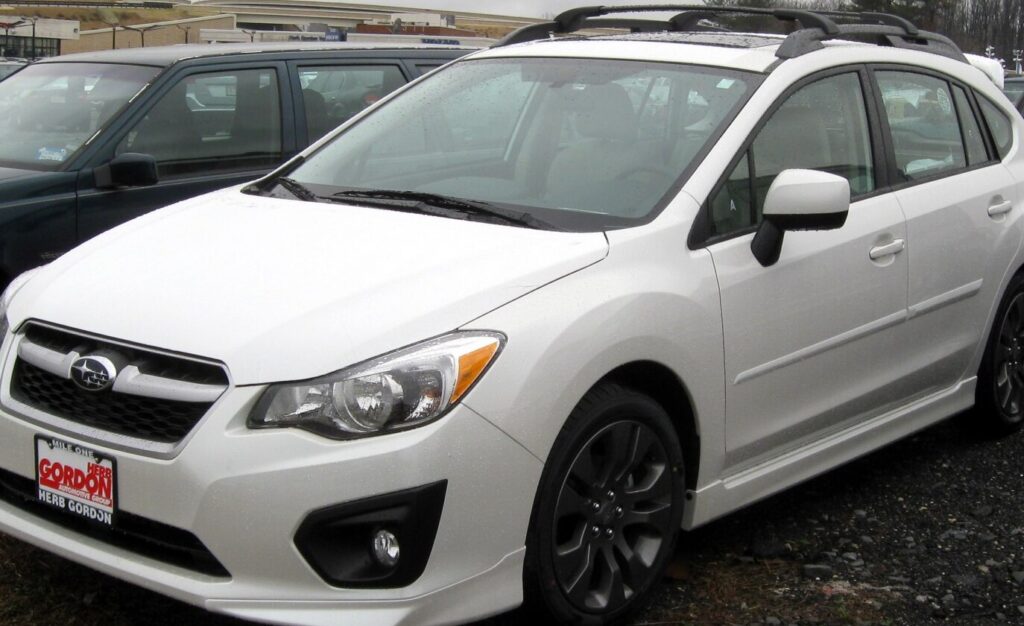
The Subaru Impreza IV Hatchback 2.0i Sport, produced between 2011 and 2015, represented a significant evolution in Subaru’s compact car lineup. Positioned as a sporty, all-wheel-drive option within the fourth generation (GE/GH/GR/GV) Impreza range, this variant combined a 2.0-liter boxer engine with Subaru’s Lineartronic continuously variable transmission (CVT). It aimed to deliver a balance of performance, fuel efficiency, and practicality for the North American and European markets, where the Impreza competed with vehicles like the Honda Civic, Mazda3, and Volkswagen Golf. This specific configuration, the 2.0i Sport AWD Lineartronic, occupied a mid-range position in the Impreza lineup, offering more features and a slightly more engaging driving experience than the base models, but falling short of the performance-oriented WRX and STI trims.
Technical Specifications
| Brand | Subaru |
| Model | Impreza |
| Generation | Impreza IV Hatchback |
| Type | 2.0i Sport (150 Hp) AWD Lineartronic |
| Start of production | 2011 |
| End of production | 2015 |
| Powertrain Architecture | Internal Combustion engine |
| Body type | Hatchback |
| Seats | 5 |
| Doors | 5 |
| Fuel consumption (urban) | 10.6 l/100 km (22.2 US mpg) |
| Fuel consumption (extra urban) | 6 l/100 km (39.2 US mpg) |
| Fuel consumption (combined) | 7.6 l/100 km (30.9 US mpg) |
| Fuel Type | Petrol (Gasoline) |
| Acceleration 0 – 100 km/h | 11.1 sec |
| Acceleration 0 – 62 mph | 11.1 sec |
| Acceleration 0 – 60 mph | 10.5 sec |
| Maximum speed | 193 km/h (119.92 mph) |
| Weight-to-power ratio | 9.1 kg/Hp |
| Weight-to-torque ratio | 7 kg/Nm |
| Power | 150 Hp @ 6200 rpm |
| Torque | 196 Nm @ 4200 rpm (144.56 lb.-ft. @ 4200 rpm) |
| Engine layout | Front, Longitudinal |
| Engine Model/Code | FB20 |
| Engine displacement | 1995 cm3 (121.74 cu. in.) |
| Number of cylinders | 4 |
| Engine configuration | Boxer |
| Cylinder Bore | 84 mm (3.31 in.) |
| Piston Stroke | 90 mm (3.54 in.) |
| Compression ratio | 10.5:1 |
| Number of valves per cylinder | 4 |
| Fuel injection system | Multi-port manifold injection |
| Engine aspiration | Naturally aspirated engine |
| Valvetrain | DOHC |
| Engine oil capacity | 4.8 l (5.07 US qt | 4.22 UK qt) |
| Coolant capacity | 7.7 l (8.14 US qt | 6.78 UK qt) |
| Kerb Weight | 1370 kg (3020.33 lbs.) |
| Trunk (boot) space (minimum) | 1270 l (44.85 cu. ft.) |
| Fuel tank capacity | 55 l (14.53 US gal | 12.1 UK gal) |
| Length | 4415 mm (173.82 in.) |
| Width | 1740 mm (68.5 in.) |
| Height | 1465 mm (57.68 in.) |
| Wheelbase | 2645 mm (104.13 in.) |
| Front track | 1510 mm (59.45 in.) |
| Rear track | 1515 mm (59.65 in.) |
| Minimum turning circle | 10.6 m (34.78 ft.) |
| Drive wheel | All wheel drive (4×4) |
| Front suspension | Independent type McPherson |
| Rear suspension | Double wishbone |
| Front brakes | Ventilated discs |
| Rear brakes | Disc |
| Assisting systems | ABS (Anti-lock braking system) |
| Steering type | Steering rack and pinion |
| Tires size | 205/50 R17 |
| Wheel rims size | 7J x 17 |
Powertrain & Engine Architecture
The heart of the 2.0i Sport was the FB20 2.0-liter horizontally-opposed (boxer) four-cylinder engine. This engine was a key component of Subaru’s strategy to improve fuel efficiency while maintaining the brand’s signature all-wheel-drive capability. The FB series engines, introduced in 2008, featured a more compact design and reduced internal friction compared to their predecessors. The FB20 utilized multi-point fuel injection and a double overhead camshaft (DOHC) valvetrain with four valves per cylinder. The Lineartronic CVT, replacing traditional automatic transmissions, was designed to provide seamless gear changes and optimize engine efficiency. Unlike stepped automatic transmissions, the Lineartronic used a belt and pulley system to provide an infinite number of gear ratios within its operating range. This allowed the engine to consistently operate at its most efficient point, improving fuel economy.
Driving Characteristics
The 150 horsepower and 196 Nm (144.56 lb-ft) of torque delivered by the FB20 and Lineartronic combination resulted in a comfortable, but not particularly sporty, driving experience. Acceleration from 0-60 mph took around 10.5 seconds, which was adequate for everyday driving but slower than the manual transmission versions or the more powerful WRX models. The CVT, while smooth, lacked the direct feel of a traditional gearbox, and some drivers found the simulated “shift points” to be unconvincing. The all-wheel-drive system provided excellent traction in various weather conditions, a hallmark of Subaru vehicles. The Lineartronic’s programming prioritized fuel efficiency, meaning the engine sometimes felt strained during aggressive acceleration. The gear ratios were optimized for cruising and fuel economy, rather than outright performance.
Equipment & Trim Levels
The 2.0i Sport trim level included standard features such as air conditioning, power windows and locks, a six-speaker audio system with a USB input, and keyless entry. Interior upholstery typically consisted of cloth seats with sporty accents. Available options included a sunroof, a premium audio system, and alloy wheels. The dashboard layout was functional and straightforward, with a focus on ease of use. Safety features were a priority, with standard inclusion of anti-lock brakes (ABS), electronic brake-force distribution, and multiple airbags.
Chassis & Braking
The Impreza IV Hatchback utilized a MacPherson strut front suspension and a double-wishbone rear suspension. This setup provided a good balance of ride comfort and handling. The 2.0i Sport typically featured slightly stiffer suspension components compared to the base models, enhancing cornering stability. Braking duties were handled by ventilated discs at the front and solid discs at the rear. ABS was standard, providing enhanced braking control in emergency situations. The chassis was designed to be lightweight yet rigid, contributing to the car’s overall handling characteristics.
Market Reception & Comparison
Critics generally praised the Impreza IV Hatchback for its standard all-wheel drive, practicality, and fuel efficiency. However, the Lineartronic CVT received mixed reviews, with some testers finding it unresponsive and detracting from the driving experience. Compared to the manual transmission versions, the CVT-equipped Impreza offered slightly worse fuel economy and slower acceleration. The 2.0i Sport trim offered a good value proposition, providing a step up in features and styling compared to the base models without the higher price tag of the WRX. Reliability was generally good, although some owners reported minor issues with the CVT over the long term.
Legacy
The Subaru Impreza IV Hatchback 2.0i Sport AWD Lineartronic remains a relatively common sight on the used car market. The FB20 engine, while not known for being exceptionally powerful, has proven to be reasonably reliable with proper maintenance. The Lineartronic CVT, however, requires diligent fluid changes to prevent premature wear. This Impreza variant appeals to buyers seeking a practical, all-weather vehicle with a reputation for dependability. Its combination of fuel efficiency, safety features, and all-wheel-drive capability continues to make it a viable option for those seeking a compact hatchback.