Technical Specifications
| Brand | Subaru |
| Model | Impreza |
| Generation | Impreza IV Hatchback (facelift 2015) |
| Type (Engine) | 1.6i (114 Hp) AWD |
| Start of production | 2015 |
| End of production | 2016 |
| Powertrain Architecture | Internal Combustion engine |
| Body type | Hatchback |
| Seats | 5 |
| Doors | 5 |
| Fuel consumption (urban) | 8 l/100 km (29.4 US mpg, 35.3 UK mpg, 12.5 km/l) |
| Fuel consumption (extra urban) | 5.3 l/100 km (44.4 US mpg, 53.3 UK mpg, 18.9 km/l) |
| Fuel consumption (combined) | 6.2 l/100 km (37.9 US mpg, 45.6 UK mpg, 16.1 km/l) |
| CO2 emissions | 144 g/km |
| Fuel Type | Petrol (Gasoline) |
| Acceleration 0 – 100 km/h | 12.3 sec |
| Acceleration 0 – 62 mph | 12.3 sec |
| Acceleration 0 – 60 mph | 11.7 sec |
| Maximum speed | 185 km/h (114.95 mph) |
| Emission standard | Euro 6 |
| Weight-to-power ratio | 11.5 kg/Hp, 86.7 Hp/tonne |
| Weight-to-torque ratio | 8.8 kg/Nm, 114.1 Nm/tonne |
| Power | 114 Hp @ 5600 rpm |
| Power per litre | 71.3 Hp/l |
| Torque | 150 Nm @ 4000 rpm (110.63 lb.-ft. @ 4000 rpm) |
| Engine layout | Front, Longitudinal |
| Engine Model/Code | FB16 |
| Engine displacement | 1600 cm3 (97.64 cu. in.) |
| Number of cylinders | 4 |
| Engine configuration | Boxer |
| Cylinder Bore | 78.8 mm (3.1 in.) |
| Piston Stroke | 82 mm (3.23 in.) |
| Compression ratio | 10.5:1 |
| Number of valves per cylinder | 4 |
| Fuel injection system | Multi-port manifold injection |
| Engine aspiration | Naturally aspirated engine |
| Engine oil capacity | 4.8 l (5.07 US qt | 4.22 UK qt) |
| Coolant | 8.1 l (8.56 US qt | 7.13 UK qt) |
| Kerb Weight | 1315 kg (2899.08 lbs.) |
| Max. weight | 1850 kg (4078.55 lbs.) |
| Max load | 535 kg (1179.47 lbs.) |
| Trunk (boot) space – minimum | 380 l (13.42 cu. ft.) |
| Trunk (boot) space – maximum | 1270 l (44.85 cu. ft.) |
| Fuel tank capacity | 55 l (14.53 US gal | 12.1 UK gal) |
| Max. roof load | 80 kg (176.37 lbs.) |
| Permitted trailer load with brakes (12%) | 1500 kg (3306.93 lbs.) |
| Permitted trailer load without brakes | 650 kg (1433 lbs.) |
| Length | 4420 mm (174.02 in.) |
| Width | 1740 mm (68.5 in.) |
| Height | 1465 mm (57.68 in.) |
| Wheelbase | 2645 mm (104.13 in.) |
| Front track | 1510 mm (59.45 in.) |
| Rear (Back) track | 1515 mm (59.65 in.) |
| Ride height (ground clearance) | 145 mm (5.71 in.) |
| Minimum turning circle (turning diameter) | 11.4 m (37.4 ft.) |
| Approach angle | 13.7° |
| Departure angle | 21.9° |
| Drive wheel | All wheel drive (4×4) |
| Number of gears and type of gearbox | 5 gears, manual transmission |
| Front brakes | Ventilated discs |
| Rear brakes | Disc |
| Assisting systems | ABS (Anti-lock braking system) |
| Steering type | Steering rack and pinion |
| Power steering | Electric Steering |
| Tires size | 195/65 R15 |
| Wheel rims size | 6J x 15 |
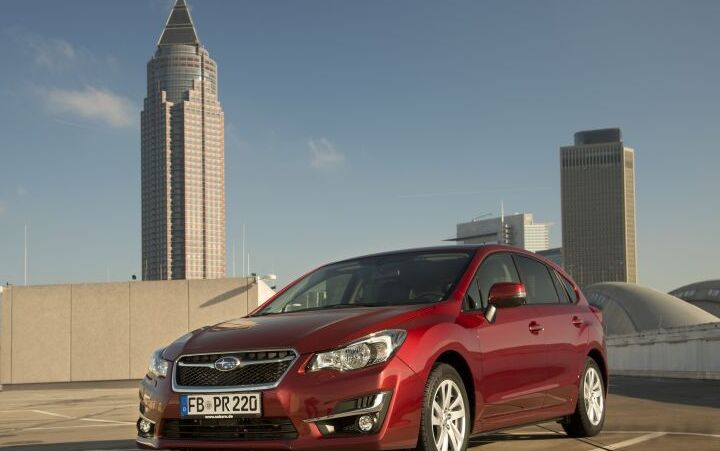
The 2015-2016 Subaru Impreza 1.6i Hatchback represented a pragmatic offering within the Impreza lineup. Following the facelift of the fourth-generation Impreza, this variant was designed to appeal to buyers seeking a fuel-efficient and practical compact car with the added security of Subaru’s renowned symmetrical all-wheel drive. It slotted into the range as the entry-level model, providing a more accessible price point compared to the 2.0-liter naturally aspirated and turbocharged options. The Impreza IV, built on the Subaru Global Platform (SGP) – though the initial versions predated the fully refined SGP – aimed to improve rigidity and handling compared to its predecessor.
Powertrain & Engine Architecture
The heart of the 1.6i is the FB16 1.6-liter horizontally-opposed (Boxer) four-cylinder engine. This engine is a key component of Subaru’s engineering philosophy, known for its low center of gravity and inherent balance. The FB16 utilizes multi-point fuel injection and features dual overhead camshafts (DOHC) with four valves per cylinder. The engine produces 114 horsepower at 5600 rpm and 150 Nm (110.63 lb-ft) of torque at 4000 rpm. The engine’s design prioritizes fuel efficiency and smooth operation over outright performance. The 1.6i was typically paired with a five-speed manual transmission, but a continuously variable transmission (CVT) was also available in some markets. The CVT aimed to further enhance fuel economy by keeping the engine operating in its most efficient range.
Driving Characteristics
The Impreza 1.6i, with its 114 hp and relatively modest torque output, offered a comfortable but not particularly exhilarating driving experience. Acceleration from 0-60 mph took around 11.7 to 12.3 seconds, making it adequate for everyday commuting but not ideal for spirited driving. The five-speed manual transmission provided a decent level of control, but the gear ratios were spaced to prioritize fuel economy rather than rapid acceleration. The CVT, while smoother, could feel somewhat sluggish under hard acceleration due to its rubber-band effect. The all-wheel drive system, however, provided excellent traction in various weather conditions, a hallmark of Subaru vehicles. The steering was light and precise, making the car easy to maneuver in urban environments.
Equipment & Trim Levels
The 1.6i trim level typically included standard features such as air conditioning, power windows and locks, a basic audio system with USB connectivity, and alloy wheels. Safety features included ABS, electronic brakeforce distribution, and multiple airbags. Higher trim levels, often denoted by additions like “SE” or “Limited,” added features such as automatic climate control, a more advanced infotainment system with a touchscreen display, and upgraded interior upholstery. Optional extras could include a sunroof, heated seats, and a rear parking camera.
Chassis & Braking
The Impreza 1.6i utilized a MacPherson strut front suspension and a double-wishbone rear suspension. The suspension was tuned for comfort, providing a relatively smooth ride over uneven surfaces. Braking duties were handled by ventilated discs at the front and solid discs at the rear. The ABS system helped to maintain steering control during emergency braking situations. The weight distribution, aided by the Boxer engine, contributed to balanced handling characteristics. Stabilizer bars were included both front and rear to reduce body roll during cornering.
Market Reception & Comparison
The Impreza 1.6i was generally well-received as a practical and affordable compact car. Critics praised its fuel efficiency, all-wheel drive system, and comfortable ride. However, some reviewers noted its lack of outright performance compared to the 2.0-liter models. Compared to the 2.0-liter Impreza, the 1.6i offered significantly lower running costs but sacrificed acceleration and overall driving engagement. The 1.6i also competed with other compact hatchbacks in the European and Asian markets, such as the Volkswagen Golf, Ford Focus, and Toyota Auris. Its all-wheel drive system was a key differentiator, setting it apart from many of its competitors.
Legacy
The FB16 engine, while not known for being a high-performance unit, proved to be relatively reliable. Common maintenance items included regular oil changes and timing belt replacements (depending on the specific market). The Impreza 1.6i has maintained a reasonable reputation for dependability in the used car market. While not a collector’s item, well-maintained examples continue to offer a practical and affordable transportation option. The 1.6i variant demonstrated Subaru’s commitment to offering a range of Impreza models to suit different budgets and driving needs, solidifying the Impreza’s position as a versatile and dependable compact car.