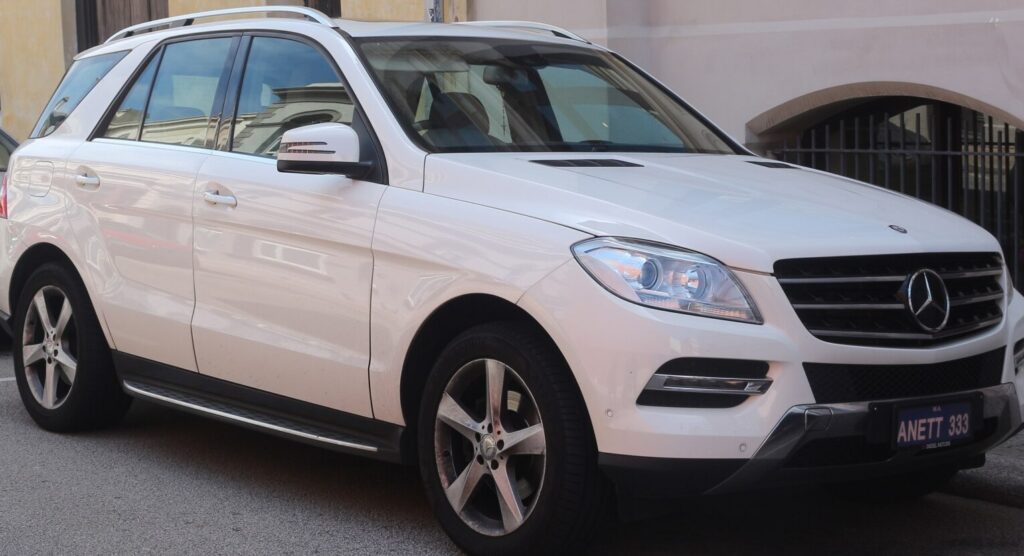
The Mercedes-Benz M-Class (W166) ML 500 V8 4MATIC, produced from February 2012 to April 2015, represented the high-performance gasoline engine option within the second generation of Mercedes’ mid-size luxury SUV. Positioned as the flagship engine choice before the introduction of the AMG variants, the ML 500 aimed to deliver a blend of power, refinement, and all-weather capability. It was a key offering in the North American market, where larger displacement engines remained popular, and competed with vehicles like the BMW X5 and Audi Q7. The W166 generation marked a significant step forward in terms of interior quality, technology, and on-road dynamics compared to its predecessor.
Technical Specifications
| Brand | Mercedes-Benz |
| Model | M-Class |
| Generation | M-Class (W166) |
| Type | ML 500 V8 (408 Hp) 4MATIC 7G-TRONIC PLUS |
| Start of production | February, 2012 |
| End of production | April, 2015 |
| Powertrain Architecture | Internal Combustion engine |
| Body type | SUV |
| Seats | 5 |
| Doors | 5 |
| Fuel consumption (urban) | 15.2-14.7 l/100 km (15.5 – 16 US mpg, 18.6 – 19.2 UK mpg, 6.6 – 6.8 km/l) |
| Fuel consumption (extra urban) | 9.5-8.9 l/100 km (24.8 – 26.4 US mpg, 29.7 – 31.7 UK mpg, 10.5 – 11.2 km/l) |
| Fuel consumption (combined) | 11.5-11.0 l/100 km (20.5 – 21.4 US mpg, 24.6 – 25.7 UK mpg, 8.7 – 9.1 km/l) |
| CO2 emissions | 269-258 g/km |
| Fuel Type | Petrol (Gasoline) |
| Acceleration 0 – 100 km/h | 5.6 sec |
| Acceleration 0 – 62 mph | 5.6 sec |
| Acceleration 0 – 60 mph | 5.3 sec |
| Maximum speed | 250 km/h (155.34 mph) |
| Emission standard | Euro 5 |
| Weight-to-power ratio | 5.5 kg/Hp, 182.6 Hp/tonne |
| Weight-to-torque ratio | 3.7 kg/Nm, 268.5 Nm/tonne |
| Power | 408 Hp @ 5000-5750 rpm |
| Power per litre | 87.5 Hp/l |
| Torque | 600 Nm @ 1600-4750 rpm (442.54 lb.-ft. @ 1600-4750 rpm) |
| Engine layout | Front, Longitudinal |
| Engine Model/Code | M278.928 |
| Engine displacement | 4663 cm3 (284.55 cu. in.) |
| Number of cylinders | 8 |
| Engine configuration | V-engine |
| Compression ratio | 10.5:1 |
| Fuel injection system | Direct injection |
| Engine aspiration | Twin-Turbo, Intercooler |
| Engine oil capacity | 8.5 l (8.98 US qt | 7.48 UK qt) |
| Coolant | 12.9 l (13.63 US qt | 11.35 UK qt) |
| Kerb Weight | 2235 kg (4927.33 lbs.) |
| Max. weight | 2950 kg (6503.64 lbs.) |
| Max load | 715 kg (1576.31 lbs.) |
| Trunk (boot) space – minimum | 690 l (24.37 cu. ft.) |
| Trunk (boot) space – maximum | 2010 l (70.98 cu. ft.) |
| Fuel tank capacity | 93 l (24.57 US gal | 20.46 UK gal) |
| Length | 4804 mm (189.13 in.) |
| Width | 1926 mm (75.83 in.) |
| Height | 1796 mm (70.71 in.) |
| Wheelbase | 2915 mm (114.76 in.) |
| Front track | 1648 mm (64.88 in.) |
| Rear (Back) track | 1663 mm (65.47 in.) |
| Minimum turning circle | 11.8 m (38.71 ft.) |
| Drive wheel | All wheel drive (4×4) |
| Number of gears | 7 |
| Gearbox type | automatic transmission G-TRONIC PLUS |
| Front suspension | Double wishbone |
| Rear suspension | Independent multi-link suspension |
| Front brakes | Ventilated discs |
| Rear brakes | Ventilated discs |
| Assisting systems | ABS (Anti-lock braking system) |
| Steering type | Steering rack and pinion |
| Power steering | Electric Steering |
| Tires size | 255/50 R19 |
| Wheel rims size | 19 |
Powertrain & Engine Architecture
The heart of the ML 500 is the M278.928 4.7-liter V8 engine. This engine is a member of Mercedes-Benz’s modular engine family, featuring direct fuel injection, twin turbochargers, and variable valve timing on both intake and exhaust sides. The direct injection system operates at a maximum pressure of 200 bar (2,900 psi), ensuring precise fuel delivery and efficient combustion. The twin-turbochargers, positioned within the V of the engine, minimize turbo lag and provide a broad torque curve. The engine produces 408 horsepower at 5000-5750 rpm and a substantial 600 Nm (442 lb-ft) of torque between 1600 and 4750 rpm. This power is channeled through a 7G-TRONIC PLUS seven-speed automatic transmission, known for its smooth shifts and efficiency. The 7G-TRONIC PLUS features a torque converter lock-up clutch that engages in most driving situations, improving fuel economy and responsiveness.
Driving Characteristics
The ML 500 offered a noticeably different driving experience compared to the more common ML 350 (with its V6 engine). The V8 provided significantly more power and torque, resulting in quicker acceleration – 0 to 60 mph in around 5.3 seconds. The 7G-TRONIC transmission was well-matched to the engine, providing smooth and timely gear changes. While not as overtly sporty as the later AMG versions, the ML 500 offered a comfortable and confident driving experience, particularly when overtaking or merging onto highways. The 4MATIC all-wheel-drive system provided excellent traction in various weather conditions. Compared to the diesel-powered ML 350 BlueTEC, the ML 500 prioritized performance over fuel economy, offering a more engaging driving experience but at the cost of higher fuel consumption.
Equipment & Trim Levels
The ML 500 typically came well-equipped as standard. Interior features included leather upholstery, heated and ventilated front seats, a premium sound system, and a large infotainment screen. Standard safety features included adaptive cruise control, lane-keeping assist, and blind-spot monitoring. Optional extras included a panoramic sunroof, rear-seat entertainment system, and various cosmetic enhancements. The trim level was generally positioned as a luxury offering, bridging the gap between the base models and the high-performance AMG variants. Interior color schemes were customizable, with a range of leather and wood trim options available.
Chassis & Braking
The W166 ML 500 utilized a fully independent suspension system, with double wishbones at the front and a multi-link setup at the rear. This suspension design provided a comfortable ride while maintaining good handling characteristics. The ML 500 featured ventilated disc brakes on all four wheels, providing ample stopping power. The braking system was enhanced by ABS (Anti-lock Braking System) and Electronic Stability Program (ESP) for improved safety. The suspension was tuned to balance comfort and handling, offering a more controlled feel than the standard ML models.
Market Reception & Comparison
The ML 500 was generally well-received by automotive critics, who praised its powerful engine, comfortable ride, and luxurious interior. However, its fuel economy was often cited as a drawback, especially compared to the diesel-powered alternatives. Compared to the ML 350, the ML 500 offered a significant performance upgrade but came with a higher price tag and increased running costs. Against competitors like the BMW X5 and Audi Q7, the ML 500 held its own in terms of performance and luxury, but some reviewers noted that its infotainment system wasn’t as intuitive as those offered by its rivals.
Legacy
The M-Class (W166) ML 500 V8 4MATIC, while not the highest-volume seller in the lineup, remains a desirable used vehicle for those seeking a blend of luxury, performance, and all-weather capability. The M278 V8 engine is generally considered reliable, although regular maintenance is crucial to prevent issues with the turbochargers and fuel injectors. The 7G-TRONIC transmission is also known for its durability, provided it is serviced according to Mercedes-Benz’s recommendations. Today, well-maintained examples of the ML 500 can be found on the used car market, offering a compelling alternative to newer SUVs with smaller, turbocharged engines.