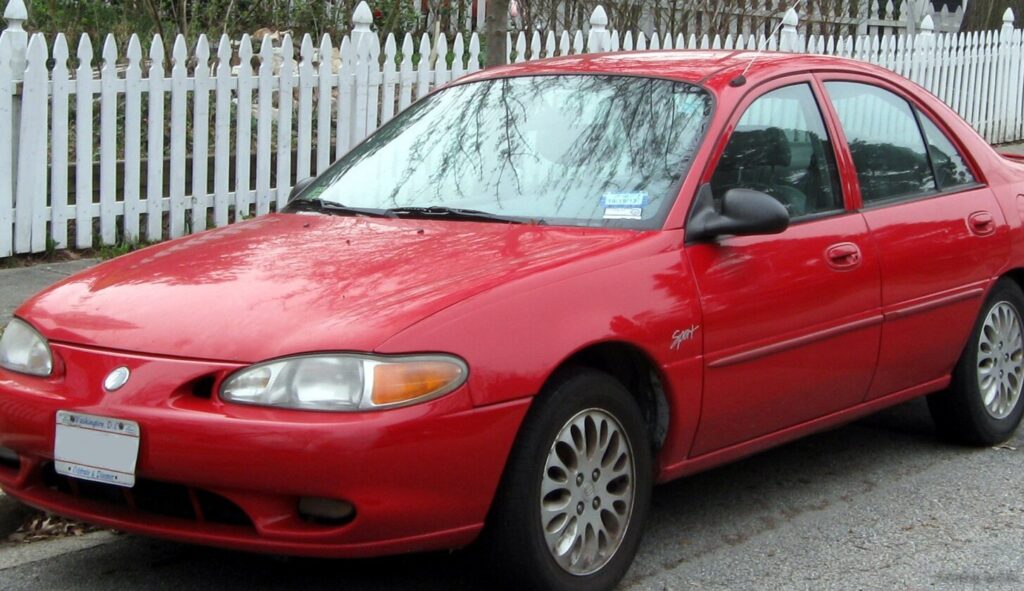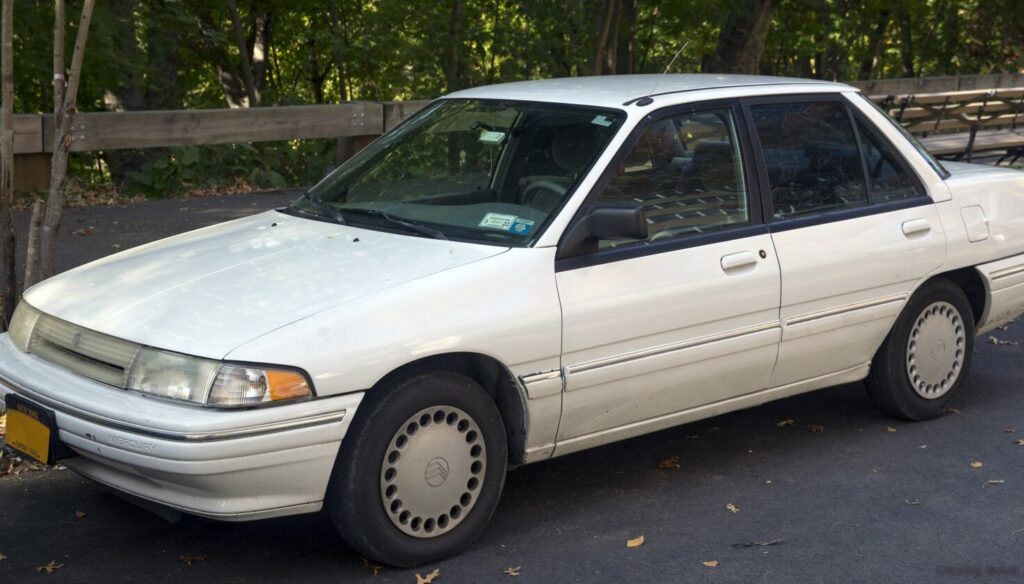
The Mercury Tracer II 1.9, produced between 1990 and 1997, represented a significant entry-level offering within the compact car segment in the North American market. Derived from the Ford Escort, the Tracer II was Mercury’s attempt to offer a more refined and value-oriented alternative. This particular variant, equipped with the 1.9-liter engine producing 88 horsepower, was positioned as the base model, prioritizing fuel efficiency and affordability over outright performance. It was part of the second generation of the Tracer, built on the Ford Escort’s platform, and aimed at buyers seeking a practical and economical sedan.
Technical Specifications
| Brand | Mercury |
| Model | Tracer |
| Generation | Tracer II |
| Type (Engine) | 1.9 (88 Hp) |
| Start of production | 1990 |
| End of production | 1997 |
| Powertrain Architecture | Internal Combustion engine |
| Body type | Sedan |
| Seats | 5 |
| Doors | 4 |
| Fuel Type | Petrol (Gasoline) |
| Maximum speed | 170 km/h (105.63 mph) |
| Weight-to-power ratio | 11.7 kg/Hp, 85.4 Hp/tonne |
| Weight-to-torque ratio | 7.1 kg/Nm, 141.7 Nm/tonne |
| Power | 88 Hp @ 4400 rpm |
| Power per litre | 47.3 Hp/l |
| Torque | 146 Nm @ 3800 rpm (107.68 lb.-ft. @ 3800 rpm) |
| Engine layout | Front, Transverse |
| Engine displacement | 1859 cm3 (113.44 cu. in.) |
| Number of cylinders | 4 |
| Engine configuration | Inline |
| Cylinder Bore | 82 mm (3.23 in.) |
| Piston Stroke | 88 mm (3.46 in.) |
| Compression ratio | 9:1 |
| Number of valves per cylinder | 2 |
| Fuel injection system | Multi-port manifold injection |
| Engine aspiration | Naturally aspirated engine |
| Valvetrain | OHC |
| Engine oil capacity | 3.8 l (4.02 US qt | 3.34 UK qt) |
| Coolant | 5 l (5.28 US qt | 4.4 UK qt) |
| Kerb Weight | 1030 kg (2270.76 lbs) |
| Trunk (boot) space – minimum | 527 l (18.61 cu. ft.) |
| Fuel tank capacity | 50 l (13.21 US gal | 11 UK gal) |
| Length | 4341 mm (170.91 in.) |
| Width | 1695 mm (66.73 in.) |
| Height | 1338 mm (52.68 in.) |
| Wheelbase | 2500 mm (98.43 in.) |
| Front track | 1435 mm (56.5 in.) |
| Rear (Back) track | 1435 mm (56.5 in.) |
| Drivetrain Architecture | The Internal combustion engine (ICE) drives the front wheels of the vehicle. |
| Drive wheel | Front wheel drive |
| Number of gears and type of gearbox | 5 gears, manual transmission |
| Front suspension | Wishbone |
| Rear suspension | Spring Strut |
| Front brakes | Ventilated discs |
| Rear brakes | Drum |
| Assisting systems | ABS (Anti-lock braking system) |
| Steering type | Steering rack and pinion |
| Power steering | Hydraulic Steering |
| Tires size | 175/70 R13 |
Powertrain & Engine Architecture
The heart of the Tracer II 1.9 was the Ford-derived 1.9-liter inline-four cylinder engine. This engine, often identified by its internal code, was a relatively simple design featuring a single overhead camshaft (OHC) and two valves per cylinder. The multi-port fuel injection system provided a reasonable balance between fuel efficiency and performance for the time. The 9:1 compression ratio was typical for naturally aspirated engines of this era. The engine’s design prioritized durability and ease of maintenance over high-revving performance. The 5-speed manual transmission was the standard offering, providing a direct connection between the engine and the front wheels. The transmission’s gear ratios were tuned for fuel economy and everyday drivability, rather than sporty acceleration.
Driving Characteristics
The 88 horsepower and 108 lb-ft of torque produced by the 1.9-liter engine translated to adequate, but not exhilarating, performance. Acceleration was best described as leisurely, with 0-60 mph times estimated around 11-12 seconds. The Tracer II 1.9 was more suited to relaxed cruising and city driving than spirited backroad adventures. The manual transmission allowed drivers to make the most of the available power, but the engine lacked the low-end grunt of larger displacement alternatives. Compared to the higher-output engines available in the Escort and Tracer II lineups, such as the 1.6L or 2.0L variants, the 1.9L felt noticeably less powerful. However, it offered a smoother and more refined driving experience than the base 1.6L engine.
Equipment & Trim Levels
The base-level Tracer II 1.9 typically came equipped with a modest array of standard features. These included cloth upholstery, a basic AM/FM radio, manual windows and locks, and a tilt steering wheel. Air conditioning was often an optional extra, as were power windows and locks. The interior design was functional and straightforward, prioritizing practicality over luxury. The dashboard layout was simple and easy to use, with clearly labeled controls. Higher trim levels offered upgrades such as upgraded audio systems, cruise control, and more comfortable seating.
Chassis & Braking
The Tracer II utilized a front-wheel-drive chassis with independent front suspension (wishbone) and a semi-independent rear suspension (spring strut). This setup provided a comfortable ride quality, although handling was not particularly sporty. The front brakes were ventilated discs, offering adequate stopping power, while the rear brakes were drums, a cost-saving measure common in this class of vehicle. ABS (Anti-lock Braking System) was available as an option, enhancing safety in emergency braking situations. The hydraulic power steering provided light and easy steering effort, making the Tracer II easy to maneuver in tight spaces.
Market Reception & Comparison
The Mercury Tracer II 1.9 was generally well-received as an affordable and reliable compact car. Critics praised its fuel efficiency and comfortable ride, but noted its lack of performance. Compared to other vehicles in its class, such as the Honda Civic or Toyota Corolla, the Tracer II offered a more spacious interior and a lower price point. However, it lacked the refinement and reputation for long-term reliability of its Japanese competitors. Within the Tracer II lineup, the 1.9-liter engine offered a good balance between fuel economy and performance, making it a popular choice for budget-conscious buyers.
Legacy
The Mercury Tracer II 1.9, while not a particularly groundbreaking vehicle, served as a dependable and affordable transportation option for many drivers in the 1990s. The 1.9-liter engine proved to be relatively durable and reliable, and many examples are still on the road today. In the used car market, the Tracer II 1.9 remains an attractive option for buyers seeking a simple, inexpensive, and fuel-efficient vehicle. Its straightforward design and readily available parts make it relatively easy to maintain and repair. While it may not offer the performance or features of more modern vehicles, the Tracer II 1.9 represents a solid and practical choice for those seeking a no-frills compact sedan.