Technical Specifications
| Brand | Toyota |
| Model | 4Runner |
| Generation | 4Runner IV |
| Type (Engine) | 4.7i V8 32V (270 Hp) Automatic |
| Start of production | 2005 |
| End of production | 2005 |
| Powertrain Architecture | Internal Combustion engine |
| Body type | SUV |
| Seats | 5 |
| Doors | 5 |
| Fuel consumption (economy) – urban | 14.7 l/100 km (16 US mpg, 19.2 UK mpg, 6.8 km/l) |
| Fuel consumption (economy) – extra urban | 11.7 l/100 km (20.1 US mpg, 24.1 UK mpg, 8.5 km/l) |
| Fuel Type | Petrol (Gasoline) |
| Weight-to-power ratio | 7.1 kg/Hp, 140.9 Hp/tonne |
| Weight-to-torque ratio | 4.4 kg/Nm, 229.6 Nm/tonne |
| Power | 270 Hp @ 5400 rpm |
| Power per litre | 57.9 Hp/l |
| Torque | 440 Nm @ 3400 rpm (324.53 lb.-ft. @ 3400 rpm) |
| Engine layout | Front, Longitudinal |
| Engine Model/Code | 2UZ-FE |
| Engine displacement | 4664 cm3 (284.61 cu. in.) |
| Number of cylinders | 8 |
| Engine configuration | V-engine |
| Cylinder Bore | 94 mm (3.7 in.) |
| Piston Stroke | 84 mm (3.31 in.) |
| Compression ratio | 9.6:1 |
| Number of valves per cylinder | 4 |
| Fuel injection system | Multi-port manifold injection |
| Engine aspiration | Naturally aspirated engine |
| Valvetrain | DOHC, VVT-i |
| Engine oil capacity | 6.2 l (6.55 US qt | 5.46 UK qt) |
| Coolant | 12.3 l (13 US qt | 10.82 UK qt) |
| Kerb Weight | 1916 kg (4224.06 lbs.) |
| Max. weight | 2490 kg (5489.51 lbs.) |
| Max load | 574 kg (1265.45 lbs.) |
| Trunk (boot) space – minimum | 1195 l (42.2 cu. ft.) |
| Trunk (boot) space – maximum | 2050 l (72.4 cu. ft.) |
| Fuel tank capacity | 87 l (22.98 US gal | 19.14 UK gal) |
| Permitted trailer load with brakes (12%) | 3311 kg (7299.51 lbs.) |
| Length | 4800 mm (188.98 in.) |
| Width | 1875 mm (73.82 in.) |
| Height | 1755 mm (69.09 in.) |
| Wheelbase | 2790 mm (109.84 in.) |
| Front track | 1575 mm (62.01 in.) |
| Rear (Back) track | 1575 mm (62.01 in.) |
| Ride height (ground clearance) | 226 mm (8.9 in.) |
| Minimum turning circle (turning diameter) | 11.1 m (36.42 ft.) |
| Approach angle | 31° |
| Departure angle | 24° |
| Ramp-over (brakeover) angle | 22° |
| Drivetrain Architecture | The Internal combustion engine (ICE) drives the rear wheels of the vehicle. |
| Drive wheel | Rear wheel drive |
| Number of gears and type of gearbox | 5 gears, automatic transmission |
| Front suspension | Double wishbone |
| Rear suspension | Independent multi-link suspension |
| Front brakes | Ventilated discs |
| Rear brakes | Ventilated discs |
| Assisting systems | ABS (Anti-lock braking system) |
| Steering type | Steering rack and pinion |
| Tires size | 265/70 R16; 265/65 R17 |
| Wheel rims size | 7.0J x 16; 7.5J x 17 |
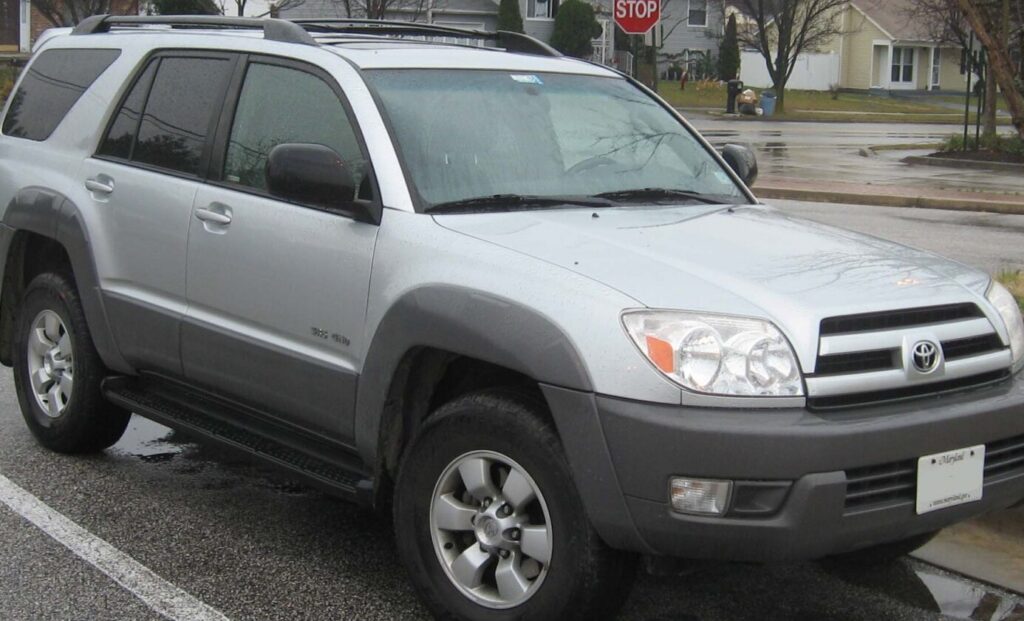
The 2005 Toyota 4Runner 4.7i V8 was a key component of the fourth-generation 4Runner (2003-2009), which transitioned from a body-on-frame construction to a more refined semi-monocoque design. This shift aimed to improve on-road comfort and handling while retaining the 4Runner’s reputation for off-road capability. The 4.7i V8 model was positioned as the premium offering, catering to buyers who prioritized power and towing capacity. It was a direct response to the growing demand for larger engines in the SUV market, particularly in the United States. The 4Runner, throughout its history, has been a consistently popular vehicle in North America, known for its reliability and durability.
Powertrain & Engine Architecture
At the heart of the 4.7i V8 4Runner lies the 2UZ-FE engine, a 4.7-liter (4664 cc) naturally aspirated V8. This engine is renowned for its robustness and longevity. It features a cast-iron block and aluminum cylinder heads, incorporating Toyota’s Variable Valve Timing-intelligent (VVT-i) system for optimized performance and fuel efficiency. The 2UZ-FE utilizes a multi-port fuel injection system, delivering fuel directly to each cylinder. The engine produces 270 horsepower at 5400 rpm and 324.53 lb-ft of torque at 3400 rpm. Paired with this engine is a five-speed automatic transmission, designed to handle the V8’s substantial torque output. This transmission offered smooth shifting and contributed to the 4Runner’s comfortable driving experience. The transmission was not known for being particularly sporty, prioritizing reliability and smooth operation over aggressive shift points.
Driving Characteristics
The 4Runner 4.7i V8 offered a noticeable performance advantage over the four-cylinder and V6 models. Acceleration was brisk, and the engine provided ample power for highway merging and passing maneuvers. The automatic transmission, while not offering manual shift control, was well-matched to the engine’s characteristics. The gear ratios were tuned for a balance of acceleration and fuel economy. Compared to the manual transmission options available on other 4Runner trims, the automatic version prioritized ease of use and convenience. However, some drivers found the automatic to be less engaging and responsive. The 4Runner’s body-on-frame construction, even with the semi-monocoque improvements, resulted in a slightly truck-like ride quality, but the suspension effectively absorbed bumps and provided a comfortable ride for passengers.
Equipment & Trim Levels
The 4.7i V8 4Runner typically came well-equipped with standard features such as air conditioning, power windows and locks, a CD player, and cloth upholstery. Higher trim levels, such as the Limited, added features like leather upholstery, heated front seats, a sunroof, and a premium sound system. Optional extras included a navigation system, a rear entertainment system, and running boards. The interior design was functional and durable, prioritizing practicality over luxury. The 4Runner’s interior offered ample space for passengers and cargo, making it a versatile vehicle for families and outdoor enthusiasts.
Chassis & Braking
The 4Runner 4.7i V8 featured a double wishbone front suspension and an independent multi-link rear suspension, providing a comfortable ride and good handling characteristics. The braking system consisted of ventilated discs on all four wheels, providing ample stopping power. An Anti-lock Braking System (ABS) was standard, enhancing safety and control during emergency braking situations. The 4Runner’s chassis was designed to withstand the rigors of off-road driving, with a robust frame and ample ground clearance (8.9 inches). The rear differential was typically open, but a limited-slip differential was available as an option for improved traction in challenging conditions.
Market Reception & Comparison
The 4Runner 4.7i V8 was generally well-received by automotive critics, who praised its powerful engine, comfortable ride, and spacious interior. However, some critics noted that its fuel economy was relatively low compared to other SUVs in its class. Compared to the V6 models, the V8 offered significantly more power and towing capacity, but at a higher price point. The four-cylinder models were more fuel-efficient but lacked the performance of the V8. The 4Runner’s reliability and durability were consistently praised, making it a popular choice among buyers seeking a long-lasting vehicle. Fuel economy averaged around 16 mpg city and 20 mpg highway.
Legacy
The 2UZ-FE engine, found in the 2005 Toyota 4Runner 4.7i V8, has earned a reputation for exceptional reliability and longevity. Many examples of this engine have surpassed 200,000 miles with proper maintenance. The 4Runner itself remains a highly sought-after vehicle in the used car market, known for its durability and off-road capability. The 4.7i V8 models, in particular, are prized for their powerful engine and towing capacity. While newer 4Runners offer more modern features and technology, the 2005 model remains a capable and reliable SUV, representing a sweet spot in the 4Runner’s history for many enthusiasts.