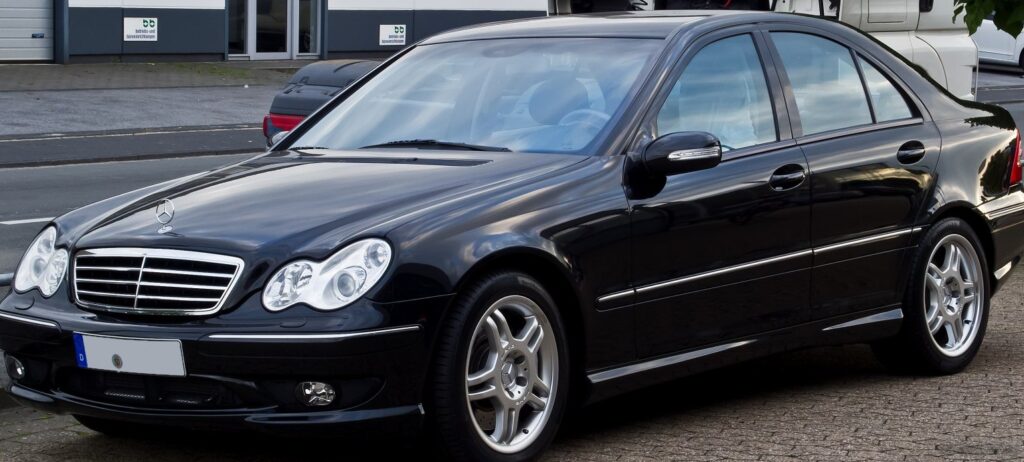
The Mercedes-Benz C-Class (W203) facelift AMG C 30 CDI Automatic, produced from April to November 2004, represented a potent blend of performance and efficiency within the compact executive car segment. This variant, powered by a 3.0-liter inline-five cylinder turbodiesel engine, occupied a unique position in the W203 lineup, bridging the gap between the more mainstream four-cylinder models and the higher-performance C 55 AMG. It was primarily marketed in Europe, where diesel engines held a significant market share, offering a compelling alternative to gasoline-powered rivals.
Technical Specifications
| Brand | Mercedes-Benz |
| Model | C-class |
| Generation | C-class (W203, facelift 2004) |
| Type (Engine) | AMG C 30 CDI (231 Hp) Automatic |
| Start of production | April, 2004 |
| End of production | November, 2004 |
| Powertrain Architecture | Internal Combustion engine |
| Body type | Sedan |
| Seats | 5 |
| Doors | 4 |
| Fuel consumption (economy) – urban (NEDC) | 10.2 l/100 km (23.1 US mpg, 27.7 UK mpg, 9.8 km/l) |
| Fuel consumption (economy) – extra urban (NEDC) | 5.9 l/100 km (39.9 US mpg, 47.9 UK mpg, 16.9 km/l) |
| Fuel consumption (economy) – combined (NEDC) | 7.6 l/100 km (30.9 US mpg, 37.2 UK mpg, 13.2 km/l) |
| CO2 emissions (NEDC) | 201 g/km |
| Fuel Type | Diesel |
| Acceleration 0 – 100 km/h | 6.8 sec |
| Acceleration 0 – 62 mph | 6.8 sec |
| Acceleration 0 – 60 mph | 6.5 sec |
| Maximum speed | 250 km/h (155.34 mph), Electronically limited |
| Emission standard | Euro 3 |
| Weight-to-power ratio | 6.8 kg/Hp, 146.2 Hp/tonne |
| Weight-to-torque ratio | 2.9 kg/Nm, 341.8 Nm/tonne |
| Power | 231 Hp @ 3800 rpm |
| Torque | 540 Nm @ 2000-2500 rpm (398.28 lb.-ft. @ 2000-2500 rpm) |
| Engine layout | Front, Longitudinal |
| Engine Model/Code | OM 612.990 |
| Engine displacement | 2950 cm3 (180.02 cu. in.) |
| Number of cylinders | 5 |
| Engine configuration | Inline |
| Cylinder Bore | 88 mm (3.46 in.) |
| Piston Stroke | 97 mm (3.82 in.) |
| Compression ratio | 16.5:1 |
| Number of valves per cylinder | 4 |
| Fuel injection system | Diesel Commonrail |
| Engine aspiration | Turbocharger, Intercooler |
| Valvetrain | DOHC |
| Engine oil capacity | 6.5 l (6.87 US qt | 5.72 UK qt) |
| Coolant | 11 l (11.62 US qt | 9.68 UK qt) |
| Kerb Weight | 1580 kg (3483.3 lbs.) |
| Max. weight | 2135 kg (4706.87 lbs.) |
| Max load | 555 kg (1223.57 lbs.) |
| Trunk (boot) space – minimum | 455 l (16.07 cu. ft.) |
| Fuel tank capacity | 62 l (16.38 US gal | 13.64 UK gal) |
| Max. roof load | 100 kg (220.46 lbs.) |
| Length | 4526 mm (178.19 in.) |
| Width | 1728 mm (68.03 in.) |
| Width including mirrors | 1980 mm (77.95 in.) |
| Height | 1412 mm (55.59 in.) |
| Wheelbase | 2715 mm (106.89 in.) |
| Front track | 1493 mm (58.78 in.) |
| Rear (Back) track | 1478 mm (58.19 in.) |
| Drag coefficient (Cd) | 0.27 |
| Minimum turning circle (turning diameter) | 10.76 m (35.3 ft.) |
| Drivetrain Architecture | The Internal combustion engine (ICE) drives the rear wheels of the vehicle. |
| Drive wheel | Rear wheel drive |
| Number of gears and type of gearbox | 5 gears, automatic transmission |
| Front suspension | Independent type McPherson, Transverse stabilizer |
| Rear suspension | Independent multi-link suspension, Transverse stabilizer |
| Front brakes | Ventilated discs |
| Rear brakes | Ventilated discs |
| Assisting systems | ABS (Anti-lock braking system) |
| Steering type | Steering rack and pinion |
| Power steering | Hydraulic Steering |
| Tires size | Front wheel tires: 225/45 R 17Rear wheel tires: 245/40 R 17 |
| Wheel rims size | Front wheel rims: 7.5 J x 17 H 2Rear wheel rims: 8.5 J x 17 H 2 |
INTRODUCTION
The W203 C-Class, launched in 2000, was Mercedes-Benz’s entry into the highly competitive compact executive segment. The 2004 facelift brought revised styling, improved interior quality, and updated engine options. The AMG C 30 CDI Automatic, introduced mid-facelift, was a performance-oriented diesel variant designed to appeal to drivers seeking strong acceleration and good fuel economy. It sat above the C 220 CDI and C 270 CDI in the diesel range, offering a significant power increase, and positioned itself as a more economical alternative to the petrol-powered C 32 AMG.
Powertrain & Engine Architecture
At the heart of the C 30 CDI was the OM 612.990, a 2,950cc inline-five cylinder diesel engine. This engine was a significant departure from the more common inline-four diesels of the time, offering a smoother and more refined driving experience. It featured a common rail direct injection system, delivering fuel at extremely high pressure for improved combustion efficiency and reduced emissions. A variable geometry turbocharger with an intercooler further enhanced performance, providing strong torque across a wide rev range. The engine utilized a double overhead camshaft (DOHC) valvetrain with four valves per cylinder. The five-speed automatic transmission, a 722.6 unit, was specifically calibrated to handle the engine’s substantial 540 Nm (398 lb-ft) of torque. This transmission offered a balance between smooth shifting and responsive performance, although it lacked the sportiness of some contemporary automatic gearboxes.
Driving Characteristics
The AMG C 30 CDI Automatic delivered a surprisingly brisk driving experience. The 231 horsepower and abundant torque allowed for a 0-60 mph time of around 6.5 seconds, making it competitive with many gasoline-powered rivals. The automatic transmission, while not particularly quick-shifting, provided smooth and predictable gear changes. The inline-five engine offered a unique sound signature, distinct from both four-cylinder and V6 diesels. Compared to the manual transmission versions of the C 30 CDI, the automatic offered greater convenience but slightly reduced responsiveness. The higher-output C 55 AMG, with its V8 engine, provided significantly more raw power, but at the expense of fuel economy. The C 30 CDI’s strength lay in its ability to deliver strong performance without sacrificing efficiency.
Equipment & Trim Levels
The AMG C 30 CDI Automatic typically came well-equipped, reflecting its position as a premium variant. Standard features included automatic climate control, power windows and mirrors, a multi-function steering wheel, and a high-quality audio system. The interior featured sports seats upholstered in a combination of leather and fabric, with AMG-specific styling cues. Optional extras included a sunroof, navigation system, premium sound system, and parking sensors. The exterior was distinguished by AMG body styling, including unique front and rear bumpers, side skirts, and alloy wheels.
Chassis & Braking
The C 30 CDI Automatic utilized the W203’s independent suspension setup, with McPherson struts at the front and a multi-link system at the rear. The suspension was tuned to provide a balance between comfort and handling. Stabilizer bars were fitted front and rear to reduce body roll. Braking duties were handled by ventilated disc brakes on all four wheels, coupled with an Anti-lock Braking System (ABS). The braking system provided ample stopping power for the car’s weight and performance.
Market Reception & Comparison
The AMG C 30 CDI Automatic was generally well-received by automotive critics. It was praised for its strong performance, good fuel economy, and refined driving experience. However, some reviewers noted that the automatic transmission could feel slightly sluggish at times. Compared to the C 220 CDI and C 270 CDI, the C 30 CDI offered a significant performance upgrade, but at a higher price point. Against gasoline-powered rivals, it provided a compelling combination of performance and efficiency.
Legacy
The OM 612 engine, while robust, is known to require diligent maintenance, particularly regarding the fuel injection system and turbocharger. The automatic transmission, if properly serviced, is generally reliable. Today, the W203 C-Class AMG C 30 CDI Automatic represents a unique and relatively rare offering in the used car market. Its combination of performance, efficiency, and Mercedes-Benz build quality makes it an appealing option for enthusiasts seeking a distinctive and capable compact executive car. Finding well-maintained examples is becoming increasingly challenging, but those that remain offer a compelling blend of classic Mercedes-Benz character and modern diesel technology.