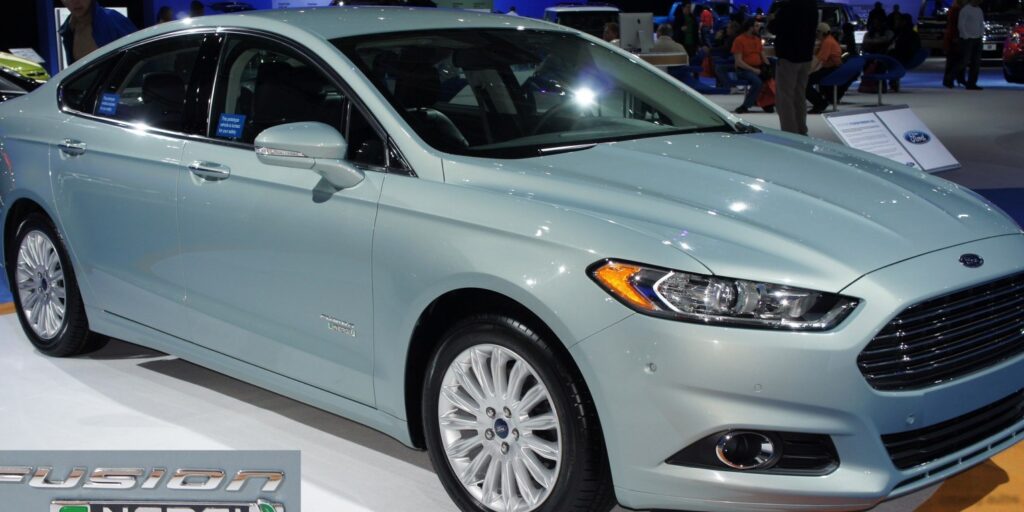
The Ford Fusion Energi, specifically the 2.0-liter (188 hp) Plug-in Hybrid variant with the eCVT transmission, was a significant offering in Ford’s lineup from 2013 to 2016. Positioned as a premium trim within the second-generation Fusion (Fusion II) range, it aimed to bridge the gap between traditional gasoline-powered sedans and fully electric vehicles. Built on the global CD290 platform shared with the Mazda Atenza and later the Lincoln MKZ, the Fusion Energi represented Ford’s commitment to fuel efficiency and electrification in the North American market. This model year range represents the first generation of the Fusion Energi, preceding a refresh in later years.
Technical Specifications
| Brand | Ford |
| Model | Fusion |
| Generation | Fusion II |
| Type (Engine) | 2.0 (188 Hp) Energi Plug-in Hybrid eCVT |
| Start of production | 2013 |
| End of production | 2016 |
| Powertrain Architecture | PHEV (Plug-in Hybrid Electric Vehicle) |
| Body type | Sedan |
| Seats | 5 |
| Doors | 4 |
| Fuel consumption (combined) | 6.2 l/100 km (37.9 US mpg, 45.6 UK mpg, 16.1 km/l) |
| Fuel Type | Petrol / electricity |
| Maximum speed | 164 km/h (101.9 mph) |
| Emission standard | AT-PZEV |
| Weight-to-power ratio | 9.4 kg/Hp, 105.9 Hp/tonne |
| Weight-to-torque ratio | 10.1 kg/Nm, 98.6 Nm/tonne |
| Gross battery capacity | 7.6 kWh |
| Battery technology | Lithium-ion (Li-Ion) |
| Battery location | Inside the trunk |
| All-electric range | 33.8 km (21 mi) |
| Average Energy consumption | 23.8 kWh/100 km (38.3 kWh/100 mi, 88 MPGe, 4.2 km/kWh, 2.6 mi/kWh) |
| Electric motor power | 118 Hp @ 6000 rpm |
| Electric motor Torque | 240 Nm (177.01 lb.-ft.) |
| Electric motor location | Integrated into the transmission |
| System power | 188 Hp |
| Internal combustion engine power | 141 Hp |
| Power per litre | 70.5 Hp/l |
| Torque | 175 Nm (129.07 lb.-ft.) |
| Engine layout | Front, Transverse |
| Engine displacement | 1999 cm3 (121.99 cu. in.) |
| Number of cylinders | 4 |
| Engine configuration | Inline |
| Cylinder Bore | 87.55 mm (3.45 in.) |
| Piston Stroke | 83.1 mm (3.27 in.) |
| Compression ratio | 12.3:1 |
| Number of valves per cylinder | 4 |
| Fuel injection system | Multi-port manifold injection |
| Engine aspiration | Naturally aspirated engine |
| Valvetrain | DOHC |
| Engine oil capacity | 4.3 l (4.54 US qt | 3.78 UK qt) |
| Coolant | 8.3 l (8.77 US qt | 7.3 UK qt) |
| Kerb Weight | 1775 kg (3913.21 lbs.) |
| Trunk (boot) space – minimum | 232 l (8.19 cu. ft.) |
| Fuel tank capacity | 53 l (14 US gal | 11.66 UK gal) |
| Length | 4872 mm (191.81 in.) |
| Width | 1852 mm (72.91 in.) |
| Height | 1473 mm (57.99 in.) |
| Wheelbase | 2850 mm (112.2 in.) |
| Front track | 1582 mm (62.28 in.) |
| Rear (Back) track | 1575 mm (62.01 in.) |
| Drive wheel | Front wheel drive |
| Number of gears and type of gearbox | automatic transmission eCVT |
| Front suspension | Independent, type McPherson with coil spring and anti-roll bar |
| Rear suspension | Independent multi-link spring suspension with stabilizer |
| Front brakes | Ventilated discs, 278×25 mm |
| Rear brakes | Disc, 280×11 mm |
| Assisting systems | ABS (Anti-lock braking system) |
| Steering type | Steering rack and pinion |
| Power steering | Electric Steering |
| Tires size | 235/50 R17 |
| Wheel rims size | 7.5J x 17 |
INTRODUCTION
The 2013-2016 Ford Fusion Energi 2.0 represented a significant step for Ford in the plug-in hybrid market. It combined a 2.0-liter four-cylinder gasoline engine with an electric motor and a 7.6 kWh lithium-ion battery pack, allowing for approximately 21 miles of all-electric range. This placed it competitively against other PHEVs of the time, such as the Toyota Prius Plug-in and the Chevrolet Volt. The Energi trim was positioned above the standard Fusion Hybrid, offering increased electric range and a more premium feature set. It was a key component of Ford’s strategy to offer a diverse range of electrified vehicles, catering to consumers seeking improved fuel economy and reduced emissions.
Powertrain & Engine Architecture
At the heart of the Fusion Energi is Ford’s 2.0-liter inline-four cylinder engine, designated as the GJ1. This engine utilizes multi-port fuel injection and a double overhead camshaft (DOHC) valvetrain. It produces 141 horsepower and 129 lb-ft of torque. The engine is paired with a 118 horsepower electric motor, drawing power from the 7.6 kWh lithium-ion battery. The combined system output is 188 horsepower. The eCVT (electronically controlled continuously variable transmission) seamlessly blends power from both the engine and the electric motor. Unlike traditional CVTs, the eCVT utilizes a planetary gearset to provide a more natural driving feel. The battery pack is located under the rear seats and extends into the trunk, reducing cargo space compared to the standard Fusion. The Energi utilizes a sophisticated power split device to manage the flow of power between the engine, motor, and battery, optimizing efficiency based on driving conditions.
Driving Characteristics
The driving experience in the Fusion Energi 2.0 is largely defined by its ability to operate in all-electric mode for shorter commutes. In EV mode, the vehicle offers quiet and smooth acceleration. Once the battery is depleted, or when additional power is needed, the gasoline engine seamlessly kicks in. The eCVT transmission provides smooth, stepless acceleration, although it lacks the sporty feel of a traditional automatic. Compared to the standard Fusion 2.0, the Energi feels slightly heavier due to the added weight of the battery pack. The Energi’s performance is adequate for everyday driving, but it doesn’t offer the same level of responsiveness as the standard 2.0-liter Fusion without the electric assist. The regenerative braking system captures energy during deceleration, helping to recharge the battery and further improve efficiency.
Equipment & Trim Levels
The Fusion Energi 2.0 typically came well-equipped, reflecting its position as a premium trim. Standard features included keyless entry and ignition, a touchscreen infotainment system with Ford’s SYNC interface, automatic climate control, and a suite of safety features like anti-lock brakes and stability control. Higher trim levels added features such as leather upholstery, heated front seats, a premium sound system, and advanced driver-assistance systems like blind-spot monitoring and rear cross-traffic alert. Optional extras included a navigation system, a sunroof, and upgraded wheels. The interior design was generally upscale, with a focus on comfort and convenience.
Chassis & Braking
The Fusion Energi utilizes an independent McPherson strut front suspension and an independent multi-link rear suspension. The suspension tuning is geared towards comfort, providing a smooth ride over most road surfaces. The Energi’s added weight necessitates a slightly firmer suspension setup compared to the standard Fusion. Braking duties are handled by ventilated discs up front and solid discs in the rear. The anti-lock braking system (ABS) provides enhanced stopping power and control. The steering is electrically assisted, offering light and precise steering feel.
Market Reception & Comparison
The Ford Fusion Energi was generally well-received by critics, who praised its fuel efficiency, comfortable ride, and well-equipped interior. However, some reviewers noted the reduced cargo space due to the battery pack and the slightly higher price compared to the standard Fusion Hybrid. Compared to the standard Fusion Hybrid, the Energi offered a significant advantage in all-electric range, making it a more attractive option for drivers with shorter commutes. Against competitors like the Toyota Prius Plug-in, the Fusion Energi offered a more conventional driving experience and a more upscale interior. Fuel economy was a strong point, with the Energi achieving an MPGe rating of 88, making it one of the most efficient plug-in hybrids on the market at the time.
Legacy
The Ford Fusion Energi 2.0 played a crucial role in establishing Ford as a leader in the plug-in hybrid market. While the Fusion itself has been discontinued, the technology and lessons learned from the Energi continue to influence Ford’s current and future electrified vehicles. The powertrain, while not without its quirks, proved to be relatively reliable, with many examples still on the road today. On the used car market, the Fusion Energi remains a viable option for buyers seeking an affordable and fuel-efficient plug-in hybrid. However, potential buyers should be aware of the battery’s age and remaining capacity, as replacement can be a significant expense.