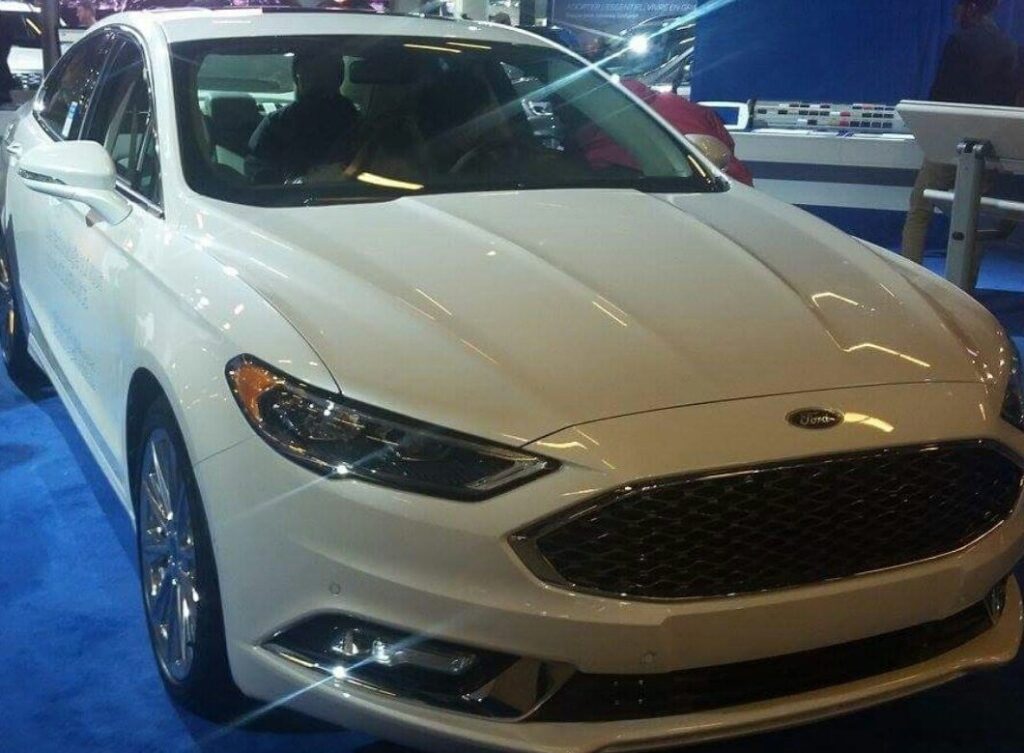
The Ford Fusion II, specifically the 1.5 EcoBoost (181 hp) SelectShift variant, was a mid-size sedan produced from 2016 to 2018 as part of the facelifted second generation of the Fusion. Positioned as a mainstream offering within the Fusion lineup, it aimed to balance fuel efficiency with respectable performance, appealing to a broad range of family car buyers in the North American market. This version represented Ford’s push towards smaller, turbocharged engines to meet increasingly stringent fuel economy standards while still delivering a satisfying driving experience. It sat between the base 2.5L naturally aspirated engine and the more powerful 2.0L EcoBoost models in terms of both price and performance.
Technical Specifications
| Brand | Ford |
| Model | Fusion |
| Generation | Fusion II (facelift 2016) |
| Type (Engine) | 1.5 EcoBoost (181 Hp) SelectShift |
| Start of production | 2016 |
| End of production | 2018 |
| Powertrain Architecture | Internal Combustion engine |
| Body type | Sedan |
| Seats | 5 |
| Doors | 4 |
| Fuel consumption (urban) | 10.2 l/100 km (23.1 US mpg) |
| Fuel consumption (extra urban) | 6.9 l/100 km (34.1 US mpg) |
| Fuel consumption (combined) | 8.7 l/100 km (27 US mpg) |
| Fuel Type | Petrol (Gasoline) |
| Acceleration 0 – 100 km/h | 8.9 sec |
| Acceleration 0 – 62 mph | 8.9 sec |
| Acceleration 0 – 60 mph | 8.5 sec |
| Maximum speed | 221 km/h (137.32 mph) |
| Weight-to-power ratio | 8.7 kg/Hp |
| Weight-to-torque ratio | 6.3 kg/Nm |
| Power | 181 Hp @ 6000 rpm |
| Torque | 251 Nm @ 4320 rpm (185.13 lb.-ft. @ 4320 rpm) |
| Engine layout | Front, Transverse |
| Engine displacement | 1499 cm3 (91.47 cu. in.) |
| Number of cylinders | 4 |
| Engine configuration | Inline |
| Cylinder Bore | 79 mm (3.11 in.) |
| Piston Stroke | 76.45 mm (3.01 in.) |
| Compression ratio | 10:1 |
| Number of valves per cylinder | 4 |
| Fuel injection system | Direct injection |
| Engine aspiration | Turbocharger, Intercooler |
| Valvetrain | DOHC, Ti-VCT |
| Engine oil capacity | 4.1 l (4.33 US qt | 3.61 UK qt) |
| Coolant capacity | 10.3 l (10.88 US qt | 9.06 UK qt) |
| Kerb Weight | 1575 kg (3472.28 lbs.) |
| Trunk (boot) space – minimum | 453 l (16 cu. ft.) |
| Fuel tank capacity | 62 l (16.38 US gal | 13.64 UK gal) |
| Length | 4872 mm (191.81 in.) |
| Width | 1852 mm (72.91 in.) |
| Width including mirrors | 2121 mm (83.5 in.) |
| Height | 1478 mm (58.19 in.) |
| Wheelbase | 2850 mm (112.2 in.) |
| Front track | 1593 mm (62.72 in.) |
| Rear track | 1585 mm (62.4 in.) |
| Drag coefficient (Cd) | 0.30 |
| Minimum turning circle | 11.5 m (37.73 ft.) |
| Drivetrain Architecture | Front wheel drive |
| Number of gears | 6 |
| Gearbox type | Automatic transmission SelectShift |
| Front suspension | Independent, McPherson with coil spring and anti-roll bar |
| Rear suspension | Independent multi-link suspension |
| Front brakes | Ventilated discs |
| Rear brakes | Disc |
| Assisting systems | ABS (Anti-lock braking system) |
| Steering type | Steering rack and pinion |
| Tires size | 235/50 R17 |
| Wheel rims size | 17 |
Powertrain & Engine Architecture
The heart of this Fusion variant is the 1.5-liter EcoBoost inline-four cylinder engine, designated with Ford engine codes likely falling within the GTDI family. This engine utilizes direct fuel injection and a single turbocharger with an integrated intercooler to boost power and efficiency. The Ti-VCT (Twin Independent Variable Camshaft Timing) system optimizes valve timing for improved performance across the rev range. The engine’s relatively small displacement, combined with turbocharging, allowed Ford to achieve a good balance between power and fuel economy. The ‘SelectShift’ automatic transmission is a six-speed unit with a manual shift mode, offering drivers some control over gear selection. This transmission was designed to provide smooth and responsive shifts, contributing to a comfortable driving experience.
Driving Characteristics
The 181 hp and 185 lb-ft of torque delivered by the 1.5 EcoBoost engine provided adequate, though not exhilarating, performance. Acceleration from 0-60 mph took around 8.5 seconds, making it competitive with other mid-size sedans in its class. The automatic transmission was tuned for fuel efficiency, meaning shifts were often smooth but not particularly aggressive. Compared to the 2.0L EcoBoost models, this variant felt noticeably less powerful, especially during highway passing maneuvers. However, it offered a more relaxed and fuel-efficient driving experience than the higher-output engine. The gear ratios were optimized for everyday driving, providing sufficient power for city commutes and highway cruising.
Equipment & Trim Levels
The 1.5 EcoBoost SelectShift trim typically included standard features such as air conditioning, power windows and locks, a basic infotainment system with a touchscreen display, and a rearview camera. Higher trim levels, such as the SE and Titanium, added features like leather upholstery, a premium sound system, and advanced safety technologies like blind-spot monitoring and lane-keeping assist. Optional extras included a sunroof, navigation system, and upgraded wheels. Interior upholstery was generally cloth on the base models, with leather available on higher trims. The dashboard layout was functional and user-friendly, with a focus on ease of use.
Chassis & Braking
The Fusion II utilized an independent front suspension with McPherson struts and a multi-link independent rear suspension. This setup provided a comfortable ride quality and decent handling characteristics. The front brakes were ventilated discs, while the rear brakes were solid discs. ABS (Anti-lock Braking System) was standard. The suspension was tuned to prioritize comfort over sporty handling, making it well-suited for everyday driving. Stabilizer bars were included to reduce body roll during cornering, but the overall handling was not as sharp as some of its competitors.
Market Reception & Comparison
Critics generally praised the 1.5 EcoBoost Fusion for its fuel efficiency and comfortable ride. However, some reviewers found the engine to be underpowered, especially when fully loaded with passengers and cargo. Compared to the 2.5L naturally aspirated engine, the 1.5 EcoBoost offered a noticeable improvement in performance and fuel economy. Against the 2.0L EcoBoost, it represented a more affordable option with slightly lower running costs, but at the expense of outright power. Reliability reports were generally positive, with few major issues reported with the engine or transmission. Fuel economy figures consistently hovered around 27 mpg combined, making it a competitive offering in its segment.
Legacy
The 1.5 EcoBoost engine proved to be a relatively reliable powertrain, with many examples still on the road today. While not known for any groundbreaking innovations, it represented a solid and dependable option for buyers seeking a fuel-efficient and comfortable mid-size sedan. In the used car market, these Fusions are often seen as a good value proposition, offering a reasonable level of features and reliability at an affordable price point. Common maintenance items include regular oil changes, spark plug replacements, and occasional turbocharger inspections. Overall, the 1.5 EcoBoost Fusion remains a practical and economical choice for those seeking a dependable used car.