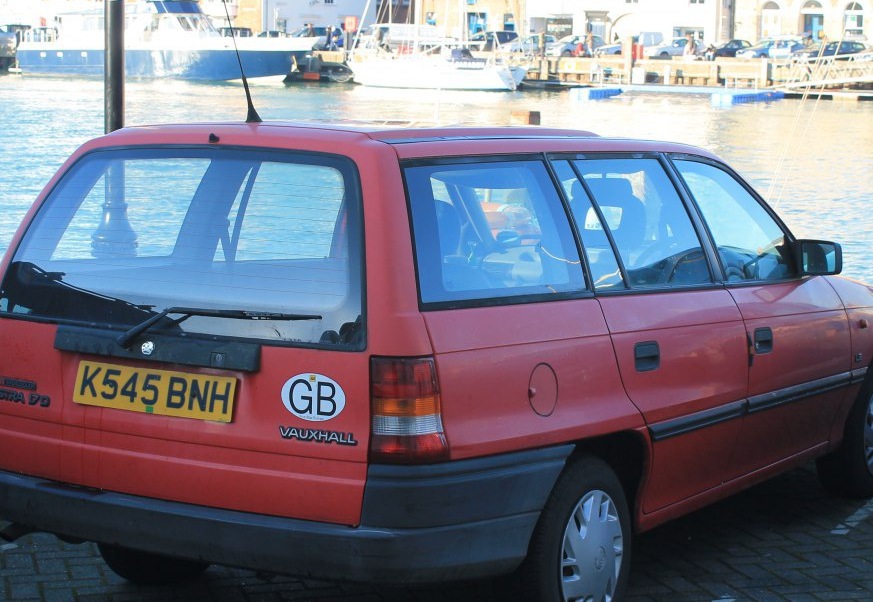
The Vauxhall Astra Mk III Estate 1.4i, producing 60 horsepower, was a mainstay of the British family car market from 1991 to 1998. Positioned as the entry-level variant of the Mk III Estate (wagon) range, it offered affordable practicality and reasonable fuel economy. This model, built on the GM T platform (internally known as the 1HX0), aimed to provide a spacious and economical vehicle for families and those needing load-carrying capacity. It represented a significant update over the Mk II Astra, offering improved styling, safety features, and a more refined driving experience, though the 1.4i remained focused on value rather than outright performance.
Technical Specifications
| Brand | Vauxhall |
| Model | Astra |
| Generation | Astra Mk III Estate |
| Type (Engine) | 1.4i (60 Hp) |
| Start of production | 1991 |
| End of production | 1998 |
| Powertrain Architecture | Internal Combustion engine |
| Body type | Station wagon (estate) |
| Seats | 5 |
| Doors | 5 |
| Fuel consumption (urban) | 10.5 l/100 km (22.4 US mpg, 26.9 UK mpg, 9.5 km/l) |
| Fuel consumption (extra urban) | 6.3 l/100 km (37.3 US mpg, 44.8 UK mpg, 15.9 km/l) |
| Fuel consumption (combined) | 7.8 l/100 km (30.2 US mpg, 36.2 UK mpg, 12.8 km/l) |
| CO2 emissions | 185 g/km |
| Fuel Type | Petrol (Gasoline) |
| Acceleration 0 – 100 km/h | 17 sec |
| Acceleration 0 – 62 mph | 17 sec |
| Acceleration 0 – 60 mph | 16.2 sec |
| Maximum speed | 154 km/h (95.69 mph) |
| Weight-to-power ratio | 17 kg/Hp, 58.8 Hp/tonne |
| Weight-to-torque ratio | 9.9 kg/Nm, 101 Nm/tonne |
| Power | 60 Hp @ 5200 rpm |
| Power per litre | 43.2 Hp/l |
| Torque | 103 Nm @ 2800 rpm (75.97 lb.-ft. @ 2800 rpm) |
| Engine layout | Front, Transverse |
| Engine Model/Code | C14NZ |
| Engine displacement | 1388 cm3 (84.7 cu. in.) |
| Number of cylinders | 4 |
| Engine configuration | Inline |
| Number of valves per cylinder | 2 |
| Fuel injection system | Single-point injection |
| Engine aspiration | Naturally aspirated |
| Engine oil capacity | 3.5 l (3.7 US qt, 3.08 UK qt) |
| Coolant capacity | 5.7 l (6.02 US qt, 5.02 UK qt) |
| Kerb Weight | 1020 kg (2248.72 lbs) |
| Max. weight | 1555 kg (3428.19 lbs) |
| Max load | 535 kg (1179.47 lbs) |
| Trunk (boot) space – minimum | 500 l (17.66 cu. ft.) |
| Fuel tank capacity | 50 l (13.21 US gal, 11 UK gal) |
| Length | 4280 mm (168.5 in) |
| Width | 1690 mm (66.54 in) |
| Height | 1480 mm (58.27 in) |
| Wheelbase | 2520 mm (99.21 in) |
| Front track | 1420 mm (55.91 in) |
| Rear track | 1420 mm (55.91 in) |
| Ride height (ground clearance) | 140 mm (5.51 in) |
| Drag coefficient (Cd) | 0.31 |
| Drivetrain Architecture | Front wheel drive |
| Number of gears | 5 |
| Gearbox type | Manual transmission |
| Front brakes | Ventilated discs |
| Rear brakes | Drum |
| Tires size | 175/70 R13 |
| Wheel rims size | 13 |
Powertrain & Engine Architecture
The heart of the Astra Mk III Estate 1.4i was the C14NZ engine, a 1.4-liter (1388cc) inline-four cylinder petrol engine. This engine was a relatively simple design, featuring two valves per cylinder and a single-point fuel injection system. Single-point injection, while cost-effective, was less efficient and offered less precise fuel delivery compared to multi-point injection systems found in higher-spec Astra models. The C14NZ produced 60 horsepower at 5200 rpm and 103 Nm (76 lb-ft) of torque at 2800 rpm. The engine was transversely mounted, driving the front wheels. The standard transmission was a five-speed manual gearbox, although a four-speed automatic transmission was also available, albeit less common. The automatic gearbox, while offering convenience, further reduced performance and increased fuel consumption.
Driving Characteristics
The 1.4i automatic version of the Astra Estate was not known for its brisk acceleration. The 0-60 mph time of around 16.2 seconds reflects its modest power output and the efficiency losses inherent in the automatic transmission. In real-world driving, the engine felt strained when accelerating, particularly when fully loaded. The gear ratios in the automatic were geared towards economy rather than performance, resulting in a somewhat sluggish response. Compared to the 1.6-liter or 2.0-liter versions of the Astra, or even the 1.4 with a manual gearbox, the 1.4i automatic felt significantly slower. However, it provided adequate performance for everyday commuting and general driving tasks.
Equipment & Trim Levels
The 1.4i Estate typically represented the base trim level. Standard equipment generally included central locking, power steering, and a basic stereo system. Interior upholstery was typically cloth, and the dashboard featured a simple, functional design. Optional extras included electric front windows, a sunroof, and upgraded stereo systems. The trim level was often badged as ‘Life’ or ‘Expression’ depending on the specific market and year. The focus was on providing essential features at an affordable price point, rather than luxury or advanced technology.
Chassis & Braking
The Astra Mk III Estate utilized a MacPherson strut front suspension and a torsion beam rear suspension. The front brakes were ventilated discs, providing adequate stopping power for the vehicle’s weight and performance. However, the rear brakes were drums, which were less effective than disc brakes, particularly under heavy braking. Stabilizer bars were fitted to both the front and rear axles, helping to reduce body roll during cornering. The suspension setup was tuned for comfort rather than sporty handling, providing a reasonably smooth ride on most road surfaces.
Market Reception & Comparison
The Astra Mk III Estate 1.4i was generally well-received as an affordable and practical family car. Critics acknowledged its spacious interior and reasonable fuel economy, but often criticized its lack of performance, especially in automatic guise. Compared to rivals like the Ford Escort Estate and the Peugeot 305 Estate, the Astra offered a competitive package in terms of price and practicality. However, the Escort often provided a more engaging driving experience, while the Peugeot was known for its comfortable ride. The 1.4i automatic was often seen as a compromise – offering convenience at the expense of performance and fuel efficiency.
Legacy
The C14NZ engine, while not renowned for its durability, proved to be reasonably reliable with regular maintenance. Common issues included oil leaks and occasional problems with the single-point fuel injection system. Today, the Astra Mk III Estate 1.4i is a relatively affordable classic car, popular with those seeking a practical and inexpensive vehicle. Parts availability is generally good, and the simple engine design makes it relatively easy to maintain. While not a performance icon, the 1.4i Estate represents a significant part of British motoring history, offering a glimpse into the family cars of the 1990s.