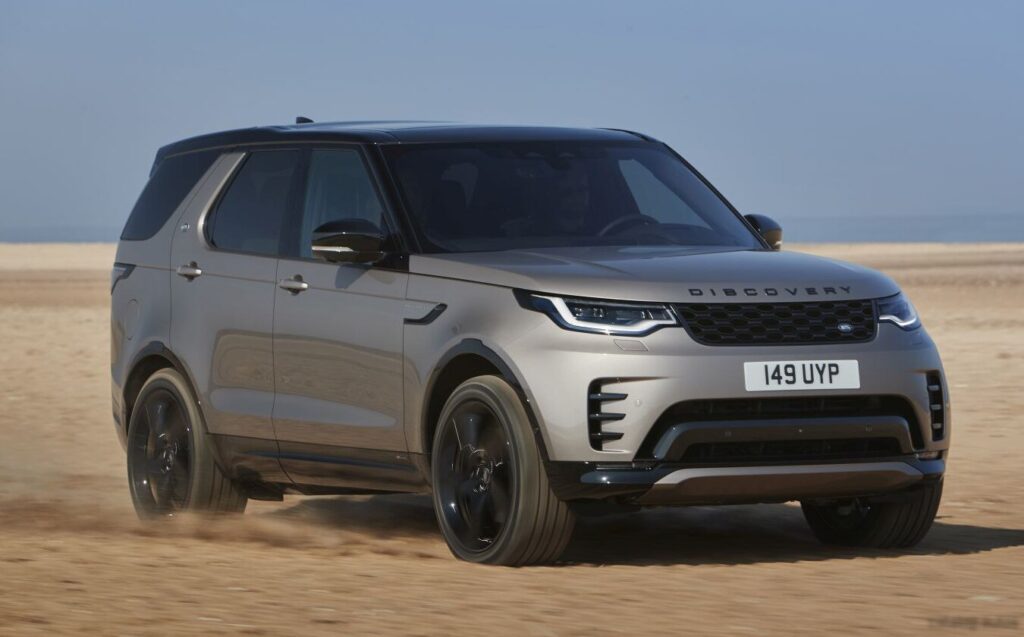
The Land Rover Discovery V, specifically the 2.0 P300 variant introduced with the 2020 facelift, represents a significant shift in the model line’s powertrain strategy. Launched in November 2020, this version combines a 2.0-liter turbocharged inline-four engine producing 300 horsepower with an eight-speed automatic transmission and standard all-wheel drive. Offered as a seven-seat SUV, the P300 aimed to broaden the Discovery’s appeal by providing a more accessible entry point into the range while still maintaining Land Rover’s reputation for off-road capability and luxury. It sits within the L663 series, the fifth generation of the Discovery, and is positioned as a mid-range offering, slotting below the more powerful six-cylinder and diesel options.
Technical Specifications
| Brand | Land Rover |
| Model | Discovery |
| Generation | Discovery V (facelift 2020) |
| Type | 2.0 P300 (300 Hp) AWD Automatic 7 Seat |
| Start of production | November, 2020 |
| Powertrain Architecture | Internal Combustion engine |
| Body type | SUV |
| Seats | 7 |
| Doors | 5 |
| Combined fuel consumption (WLTP) | 11.2-12.3 l/100 km (21 – 19.1 US mpg, 25.2 – 23 UK mpg, 8.9 – 8.1 km/l) |
| CO2 emissions (WLTP) | 251-277 g/km |
| Fuel consumption (NEDC, WLTP equivalent) | 9.1 l/100 km (25.8 US mpg, 31 UK mpg, 11 km/l) |
| CO2 emissions (NEDC, WLTP equivalent) | 208 g/km |
| Fuel Type | Petrol (Gasoline) |
| Acceleration 0 – 100 km/h | 7.3 sec |
| Acceleration 0 – 62 mph | 7.3 sec |
| Acceleration 0 – 60 mph | 6.9 sec |
| Maximum speed | 201 km/h (124.9 mph) |
| Emission standard | Euro 6d-F |
| Weight-to-power ratio | 7.4 kg/Hp, 135.8 Hp/tonne |
| Weight-to-torque ratio | 5.5 kg/Nm, 181.1 Nm/tonne |
| Power | 300 Hp @ 5500 rpm |
| Power per litre | 150.2 Hp/l |
| Torque | 400 Nm @ 1500-4500 rpm (295.02 lb.-ft. @ 1500-4500 rpm) |
| Engine layout | Front, Longitudinal |
| Engine Model/Code | Ingenium / PT204 |
| Engine displacement | 1997 cm3 (121.86 cu. in.) |
| Number of cylinders | 4 |
| Engine configuration | Inline |
| Cylinder Bore | 83 mm (3.27 in.) |
| Piston Stroke | 92.29 mm (3.63 in.) |
| Compression ratio | 9.5:1 |
| Number of valves per cylinder | 4 |
| Fuel injection system | Direct injection |
| Engine aspiration | Turbocharger, Intercooler |
| Engine oil capacity | 7 l (7.4 US qt | 6.16 UK qt) |
| Coolant | 14.7 l (15.53 US qt | 12.93 UK qt) |
| Kerb Weight | 2209 kg (4870.01 lbs.) |
| Trunk (boot) space – minimum | 258 l (9.11 cu. ft.) |
| Trunk (boot) space – maximum | 2391 l (84.44 cu. ft.) |
| Fuel tank capacity | 90 l (23.78 US gal | 19.8 UK gal) |
| Permitted trailer load with brakes (12%) | 3000 kg (6613.87 lbs.) |
| Permitted trailer load without brakes | 750 kg (1653.47 lbs.) |
| Length | 4956 mm (195.12 in.) |
| Width | 2000 mm (78.74 in.) |
| Width with mirrors folded | 2073 mm (81.61 in.) |
| Width including mirrors | 2220 mm (87.4 in.) |
| Height | 1888 mm (74.33 in.) |
| Wheelbase | 2923 mm (115.08 in.) |
| Front track | 1692 mm (66.61 in.) |
| Rear (Back) track | 1687 mm (66.42 in.) |
| Front overhang | 858 mm (33.78 in.) |
| Rear overhang | 1175 mm (46.26 in.) |
| Ride height (ground clearance) | 283 mm (11.14 in.) |
| Drag coefficient (Cd) | 0.33 |
| Minimum turning circle (turning diameter) | 12.84 m (42.13 ft.) |
| Approach angle | 26-34° |
| Departure angle | 24.8-30° |
| Ramp-over (brakeover) angle | 21.2-27.5° |
| Climb angle | 45° |
| Wading depth | 900 mm (35.43 in.) |
| Drivetrain Architecture | The Internal combustion engine (ICE) drives permanently the four wheels of the vehicle. |
| Drive wheel | All wheel drive (4×4) |
| Number of gears and type of gearbox | 8 gears, automatic transmission |
| Front suspension | Double wishbone |
| Rear suspension | Independent multi-link suspension |
| Assisting systems | ABS (Anti-lock braking system) |
| Steering type | Steering rack and pinion |
| Power steering | Electric Steering |
| Tires size | 222/60 R19; 255/55 R20; 275/45 R21; 285/40 R22 |
| Wheel rims size | 7.5J x 19; 8.5J x 20; 9.5J x 21; 9.5J x 22 |
Powertrain & Engine Architecture
The heart of the Discovery P300 is Land Rover’s Ingenium engine family, specifically the PT204 2.0-liter inline-four. This engine utilizes direct injection and is coupled with a single twin-scroll turbocharger and an intercooler to deliver 300 horsepower at 5500 rpm and 400 Nm (295 lb-ft) of torque between 1500 and 4500 rpm. The Ingenium engines are known for their modular design and use of lightweight materials like aluminum. The engine is longitudinally mounted in the front of the vehicle. The eight-speed automatic transmission, also an Ingenium design, is a key component of this powertrain. It features close gear ratios designed to optimize both acceleration and fuel efficiency. The transmission is electronically controlled and offers a manual shift mode for driver engagement.
Driving Characteristics
The 2.0 P300 Discovery offers a noticeably different driving experience compared to its six-cylinder siblings. While it doesn’t possess the same outright acceleration, it provides adequate performance for everyday driving and highway cruising. The 0-60 mph sprint takes around 6.9 seconds. The eight-speed transmission helps to keep the engine in its optimal power band, but some drivers may find it occasionally hunts for gears, particularly during uphill climbs or when fully loaded. The all-wheel-drive system provides excellent traction in various conditions, upholding Land Rover’s off-road heritage. However, the P300 is not geared towards enthusiastic driving; it prioritizes comfort and efficiency over sporty handling.
Equipment & Trim Levels
The P300 trim typically includes standard features such as leather upholstery, a touchscreen infotainment system with Apple CarPlay and Android Auto compatibility, automatic climate control, and a suite of driver-assistance systems including emergency braking and lane-keeping assist. Optional extras included features like a panoramic sunroof, premium audio systems, adaptive cruise control, and upgraded interior trim materials. The Discovery’s interior is spacious and well-appointed, offering comfortable seating for up to seven passengers. The third-row seats are best suited for children or shorter adults.
Chassis & Braking
The Discovery V utilizes a lightweight aluminum-intensive monocoque chassis. The P300 variant features double-wishbone suspension at the front and an independent multi-link suspension at the rear, providing a comfortable ride quality. Depending on the specific configuration, the rear brakes could be either discs or drums. All models are equipped with anti-lock brakes (ABS) and electronic stability control. The steering is electrically assisted, providing a light and precise feel.
Market Reception & Comparison
The 2.0 P300 Discovery was generally well-received as a more affordable and fuel-efficient option within the range. Critics praised its comfortable ride and spacious interior, but some noted that the four-cylinder engine felt underpowered for a vehicle of its size and weight. Compared to the six-cylinder models, the P300 offers lower running costs but sacrifices some performance. Fuel economy figures range from 11.2 to 12.3 l/100 km (21-19.1 US mpg), which is reasonable for a large SUV, but not class-leading.
Legacy
The Ingenium engine family has proven to be relatively reliable, although some owners have reported issues with the timing chain and oil consumption. The eight-speed automatic transmission is also generally considered durable. On the used car market, the 2.0 P300 Discovery represents a good value proposition for buyers seeking a spacious, capable, and relatively fuel-efficient SUV. However, potential buyers should be aware of the potential for oil consumption issues and ensure that the vehicle has been properly maintained.