Technical Specifications
| Brand | Volvo |
| Model | C70 |
| Generation | C70 Convertible |
| Type (Engine) | 2.5 20V (170 Hp) |
| Start of production | 1997 |
| End of production | 2005 |
| Powertrain Architecture | Internal Combustion engine |
| Body type | Cabriolet |
| Seats | 4 |
| Doors | 2 |
| Fuel consumption (urban) | 13.1 l/100 km (18 US mpg, 21.6 UK mpg) |
| Fuel consumption (extra urban) | 7.4 l/100 km (31.8 US mpg, 38.2 UK mpg) |
| Fuel Type | Petrol (Gasoline) |
| Acceleration 0 – 100 km/h | 8.9 sec |
| Acceleration 0 – 62 mph | 8.9 sec |
| Acceleration 0 – 60 mph | 8.5 sec |
| Maximum speed | 215 km/h (133.59 mph) |
| Weight-to-power ratio | 9.2 kg/Hp, 109 Hp/tonne |
| Weight-to-torque ratio | 7.1 kg/Nm, 141 Nm/tonne |
| Power | 170 Hp @ 6100 rpm |
| Power per litre | 69.8 Hp/l |
| Torque | 220 Nm @ 4700 rpm (162.26 lb.-ft. @ 4700 rpm) |
| Engine layout | Front, Transverse |
| Engine Model/Code | B5244S |
| Engine displacement | 2435 cm3 (148.59 cu. in.) |
| Number of cylinders | 5 |
| Engine configuration | Inline |
| Cylinder Bore | 83 mm (3.27 in.) |
| Piston Stroke | 90 mm (3.54 in.) |
| Compression ratio | 10.3:1 |
| Number of valves per cylinder | 4 |
| Fuel injection system | Multi-port manifold injection |
| Engine aspiration | Naturally aspirated engine |
| Valvetrain | DOHC |
| Engine oil capacity | 5.8 l (6.13 US qt | 5.1 UK qt) |
| Coolant | 7.2 l (7.61 US qt | 6.34 UK qt) |
| Kerb Weight | 1560 kg (3439.21 lbs.) |
| Max. weight | 1970 kg (4343.11 lbs.) |
| Max load | 410 kg (903.9 lbs.) |
| Trunk (boot) space – minimum | 260 l (9.18 cu. ft.) |
| Fuel tank capacity | 70 l (18.49 US gal | 15.4 UK gal) |
| Length | 4720 mm (185.83 in.) |
| Width | 1820 mm (71.65 in.) |
| Height | 1410 mm (55.51 in.) |
| Wheelbase | 2660 mm (104.72 in.) |
| Front track | 1520 mm (59.84 in.) |
| Rear (Back) track | 1520 mm (59.84 in.) |
| Drivetrain Architecture | The Internal combustion engine (ICE) drives the front wheels of the vehicle. |
| Drive wheel | Front wheel drive |
| Number of gears and type of gearbox | 5 gears, manual transmission |
| Front suspension | Wishbone |
| Rear suspension | Coil spring |
| Front brakes | Ventilated discs |
| Rear brakes | Disc |
| Assisting systems | ABS (Anti-lock braking system) |
| Steering type | Steering rack and pinion |
| Power steering | Hydraulic Steering |
| Tires size | 225/50 R17 |
| Wheel rims size | 17 |
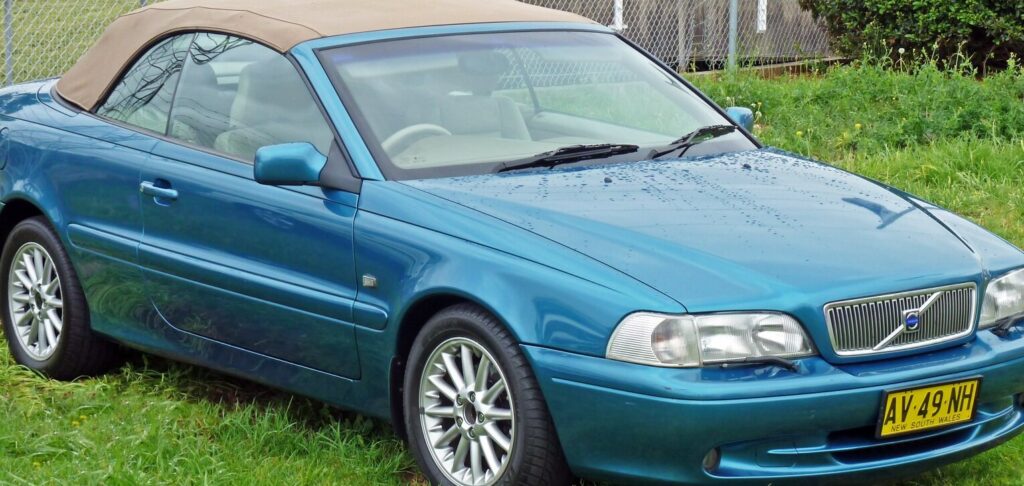
The Volvo C70 Convertible, launched in 1997, was a pivotal model for Volvo, representing a concerted effort to enter the competitive luxury convertible segment. Built on the 60-series platform, and sharing components with the S70 and V70, the C70 distinguished itself with its electrically operated retractable hardtop – a feature relatively uncommon at the time. The 2.5 20V variant, powered by the B5244S engine, was positioned as the entry-level model, offering a more accessible price point while still delivering the C70’s core appeal of stylish design and open-air motoring. Production continued until 2005, when it was replaced by a completely redesigned second-generation C70.
Powertrain & Engine Architecture
The heart of the C70 2.5 20V is the Volvo B5244S engine, a naturally aspirated, 2.435-liter inline-five cylinder powerplant. This engine, a hallmark of Volvo’s engineering during the period, features a cast iron block and an aluminum cylinder head. The “20V” designation refers to the engine’s five valves per cylinder (four intake, one exhaust) configuration, contributing to improved breathing and power delivery. Fuel delivery is managed by a multi-port fuel injection system, providing precise fuel metering for optimal combustion. The engine utilizes a double overhead camshaft (DOHC) valvetrain, further enhancing its volumetric efficiency. The standard transmission for this variant was a 5-speed manual, though a 4-speed automatic transmission was also available, and often preferred by buyers seeking a more relaxed driving experience. The automatic transmission, while providing convenience, did impact acceleration slightly compared to the manual version.
Driving Characteristics
The C70 2.5 20V, with its 170 horsepower and 162 lb-ft of torque, offered respectable, though not blistering, performance. Acceleration from 0-60 mph took approximately 8.5 to 8.9 seconds, depending on transmission and testing conditions. The engine felt responsive in the mid-range, providing adequate power for everyday driving and highway cruising. The automatic transmission, while smooth, had relatively long gear ratios, prioritizing fuel economy over outright acceleration. Compared to the turbocharged C70 T5 models, the 2.5 20V felt noticeably less powerful, but it also offered a more linear power delivery and a more forgiving driving experience. The front-wheel-drive configuration provided good traction in most conditions, but could exhibit some torque steer under hard acceleration.
Equipment & Trim Levels
The C70 2.5 20V typically came equipped with a reasonable level of standard features, including power windows, power locks, air conditioning, and a basic audio system. Upholstery was typically cloth, though leather was available as an option. Higher trim levels, or those with optional packages, could include features such as heated front seats, a premium audio system, and automatic climate control. The electrically operated retractable hardtop was a standard feature on all C70 Convertibles. Interior trim options were relatively limited, focusing on a clean and functional Scandinavian aesthetic. Optional extras included alloy wheels, fog lights, and a rear spoiler.
Chassis & Braking
The C70 Convertible utilized a MacPherson strut front suspension and a coil spring rear suspension. The suspension was tuned for a balance between comfort and handling, providing a relatively smooth ride while still offering decent body control. Braking duties were handled by ventilated discs at the front and solid discs at the rear. Anti-lock braking system (ABS) was standard, enhancing safety and stability during emergency braking. The chassis was reinforced to compensate for the lack of a fixed roof, providing adequate torsional rigidity. Stabilizer bars were fitted front and rear to reduce body roll during cornering.
Market Reception & Comparison
The C70 2.5 20V was generally well-received by automotive critics, who praised its stylish design, comfortable interior, and innovative retractable hardtop. However, some reviewers noted that the 2.5-liter engine lacked the punch of its turbocharged counterparts. Fuel economy was considered average for the class. Compared to the C70 T5, the 2.5 20V offered a lower purchase price and potentially lower maintenance costs, making it an attractive option for buyers who prioritized value and practicality over outright performance. Reliability was generally good, though the complex retractable hardtop mechanism could occasionally require maintenance.
Legacy
The Volvo C70 Convertible 2.5 20V remains a desirable classic car, particularly among Volvo enthusiasts. The B5244S engine is known for its durability and relatively simple maintenance requirements. While the automatic transmission can be prone to wear and tear with high mileage, it is generally reliable if properly maintained. Today, these C70s can be found in the used car market at relatively affordable prices, offering a stylish and enjoyable open-air driving experience. The C70’s innovative retractable hardtop continues to be a standout feature, setting it apart from many other convertibles of its era. Its blend of Scandinavian design, practicality, and open-air enjoyment has cemented its place as a significant model in Volvo’s history.