Technical Specifications
| Brand | Land Rover |
| Model | Discovery |
| Generation | Discovery V (facelift 2020) |
| Type (Engine) | 3.0 D250 (249 Hp) Mild Hybrid AWD Automatic |
| Start of production | November, 2020 |
| Powertrain Architecture | MHEV (Mild Hybrid Electric Vehicle) |
| Body type | SUV |
| Seats | 5 |
| Doors | 5 |
| Combined fuel consumption (WLTP) | 8.3-8.8 l/100 km (28.3 – 26.7 US mpg) |
| CO2 emissions (WLTP) | 216-230 g/km |
| Fuel consumption (NEDC) | 7.3 l/100 km (32.2 US mpg) |
| CO2 emissions (NEDC) | 194 g/km |
| Fuel Type | Diesel |
| Acceleration 0 – 100 km/h | 8.1 sec |
| Acceleration 0 – 62 mph | 8.1 sec |
| Acceleration 0 – 60 mph | 7.6 sec |
| Maximum speed | 194 km/h (120.55 mph) |
| Emission standard | Euro 6d-F |
| Weight-to-power ratio | 9.3 kg/Hp |
| Weight-to-torque ratio | 4.1 kg/Nm |
| Power | 249 Hp @ 4000 rpm |
| Torque | 570 Nm @ 1250-2250 rpm (420.41 lb.-ft.) |
| Engine layout | Front, Longitudinal |
| Engine Model/Code | Ingenium / DT306 |
| Engine displacement | 2996 cm3 (182.83 cu. in.) |
| Number of cylinders | 6 |
| Engine configuration | Inline |
| Cylinder Bore | 83 mm (3.27 in.) |
| Piston Stroke | 92.31 mm (3.63 in.) |
| Compression ratio | 15.5:1 |
| Number of valves per cylinder | 4 |
| Fuel injection system | Diesel Commonrail |
| Engine aspiration | Turbocharger, Intercooler |
| Engine oil capacity | 9.8 l (10.36 US qt | 8.62 UK qt) |
| Kerb Weight | 2311 kg (5094.88 lbs.) |
| Trunk (boot) space – minimum | 1231 l (43.47 cu. ft.) |
| Trunk (boot) space – maximum | 2485 l (87.76 cu. ft.) |
| Fuel tank capacity | 89 l (23.51 US gal | 19.58 UK gal) |
| AdBlue tank | 18 l (4.76 US gal | 3.96 UK gal) |
| Permitted trailer load with brakes (12%) | 3500 kg (7716.18 lbs.) |
| Permitted trailer load without brakes | 750 kg (1653.47 lbs.) |
| Length | 4956 mm (195.12 in.) |
| Width | 2000 mm (78.74 in.) |
| Width with mirrors folded | 2073 mm (81.61 in.) |
| Width including mirrors | 2220 mm (87.4 in.) |
| Height | 1888 mm (74.33 in.) |
| Wheelbase | 2923 mm (115.08 in.) |
| Front track | 1692 mm (66.61 in.) |
| Rear track | 1687 mm (66.42 in.) |
| Ride height (ground clearance) | 283 mm (11.14 in.) |
| Drag coefficient (Cd) | 0.35 |
| Minimum turning circle | 12.84 m (42.13 ft.) |
| Gears | 8, automatic transmission |
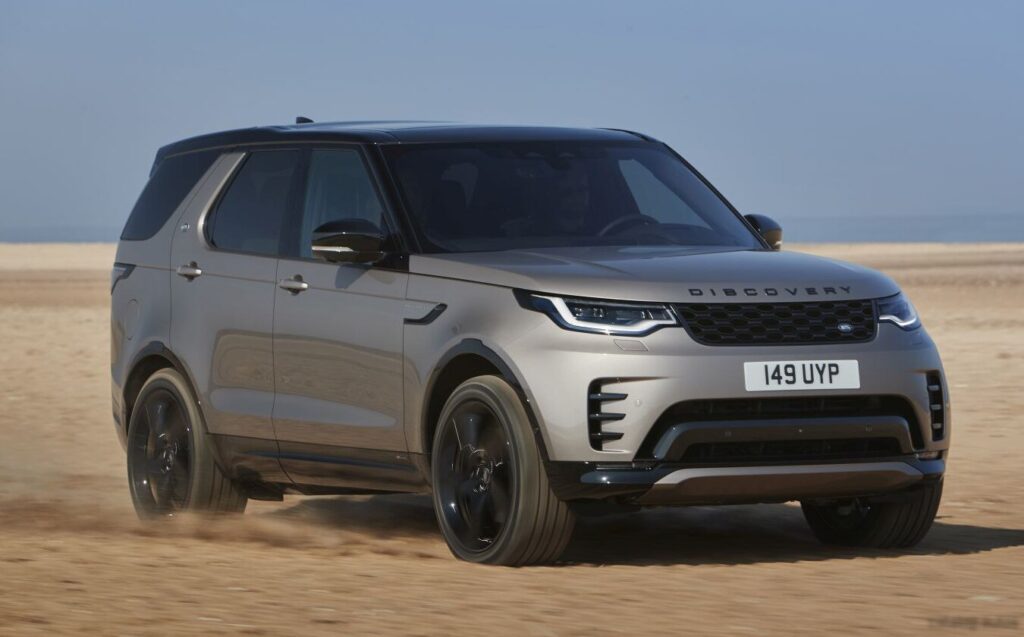
The Land Rover Discovery V, launched in 2017 and facelifted in 2020, marked a significant departure from its rugged, utilitarian roots, embracing a more refined and family-oriented approach. The 3.0 D250 variant, introduced with the facelift, aimed to provide a sweet spot in the range, offering strong performance and reasonable fuel economy. It slots in as a mid-range offering, positioned above the lower-powered D200 and below the higher-performance D300 models. The facelift brought updated styling, improved interior technology, and the introduction of mild-hybrid technology across the diesel range, enhancing efficiency and refinement.
Powertrain & Engine Architecture
At the heart of the D250 lies Land Rover’s Ingenium engine family, specifically the DT306, a 2.996-liter inline-six cylinder diesel. This engine utilizes a sophisticated common-rail direct injection system, delivering fuel at extremely high pressures for optimized combustion. The engine benefits from a single turbocharger with an intercooler, boosting power and torque. The mild-hybrid system, a 48-volt setup, incorporates a Belt-integrated Starter Generator (BiSG) that assists the engine during acceleration, captures energy during braking, and enables smoother start-stop operation. This system contributes to a reduction in emissions and a slight improvement in fuel economy. The engine produces 249 horsepower at 4,000 rpm and a substantial 570 Nm (420 lb-ft) of torque between 1,250 and 2,250 rpm. The eight-speed automatic transmission, sourced from ZF, is a key component, providing smooth and efficient gear changes. It’s calibrated to deliver a balance of responsiveness and comfort, prioritizing driveability over outright sportiness.
Driving Characteristics
The D250 offers a composed and comfortable driving experience. While not as overtly sporty as some competitors, the engine delivers ample power for everyday driving and overtaking maneuvers. The 0-60 mph sprint takes around 7.6 seconds, and the engine feels strong throughout the rev range, thanks to the broad torque curve. The eight-speed automatic transmission shifts smoothly and intelligently, rarely feeling hesitant. The mild-hybrid system provides a subtle boost during acceleration, enhancing responsiveness. Compared to the lower-powered D200, the D250 feels noticeably more capable, particularly when fully loaded or towing. Compared to the D300, the D250 offers a more relaxed driving experience, prioritizing fuel economy and refinement over outright performance. The all-wheel-drive system provides excellent traction in various conditions, making it a capable off-roader, though most owners likely utilize it primarily on paved roads.
Equipment & Trim Levels
The D250 typically comes well-equipped, reflecting the Discovery’s positioning as a premium SUV. Standard features generally include leather upholstery, heated front seats, a touchscreen infotainment system with Apple CarPlay and Android Auto compatibility, a rearview camera, and a suite of safety features such as autonomous emergency braking and lane departure warning. Higher trim levels add features like a panoramic sunroof, premium audio system, adaptive cruise control, and more luxurious interior finishes. Optional extras include air suspension, which further enhances ride comfort, and a variety of exterior styling packages.
Chassis & Braking
The Discovery V utilizes a double-wishbone front suspension and an independent multi-link rear suspension, providing a comfortable and controlled ride. The suspension is tuned to prioritize comfort over outright handling sharpness. The D250 typically features disc brakes on all four wheels, providing ample stopping power. ABS (Anti-lock Braking System) and electronic stability control are standard safety features. The steering is electrically assisted, offering a light and precise feel. The vehicle’s weight (around 2311 kg or 5094.88 lbs) is managed effectively by the suspension, minimizing body roll in corners.
Market Reception & Comparison
The Land Rover Discovery V, including the D250 variant, received generally positive reviews from automotive critics. Praise was directed towards its comfortable ride, spacious interior, and capable all-wheel-drive system. The D250 was often lauded as a sensible choice for buyers seeking a balance between performance and fuel economy. Compared to rivals like the BMW X5 and Audi Q7, the Discovery offered a more rugged aesthetic and a greater focus on off-road capability. Fuel economy figures of 8.3-8.8 l/100 km (28.3 – 26.7 US mpg) were considered competitive for a vehicle of its size and weight. Reliability has been a mixed bag for Land Rover, and the Discovery V is no exception, with some owners reporting issues with the infotainment system and electrical components.
Legacy
The Land Rover Discovery V D250 represents a significant step in the evolution of the Discovery lineage, blending luxury, capability, and efficiency. While long-term reliability remains a concern for some, the Ingenium engine has proven to be generally robust. On the used car market, the D250 offers a compelling value proposition, providing a well-equipped and capable SUV at a more accessible price point than newer models. Its blend of performance, comfort, and practicality ensures its continued appeal to buyers seeking a versatile and refined SUV.