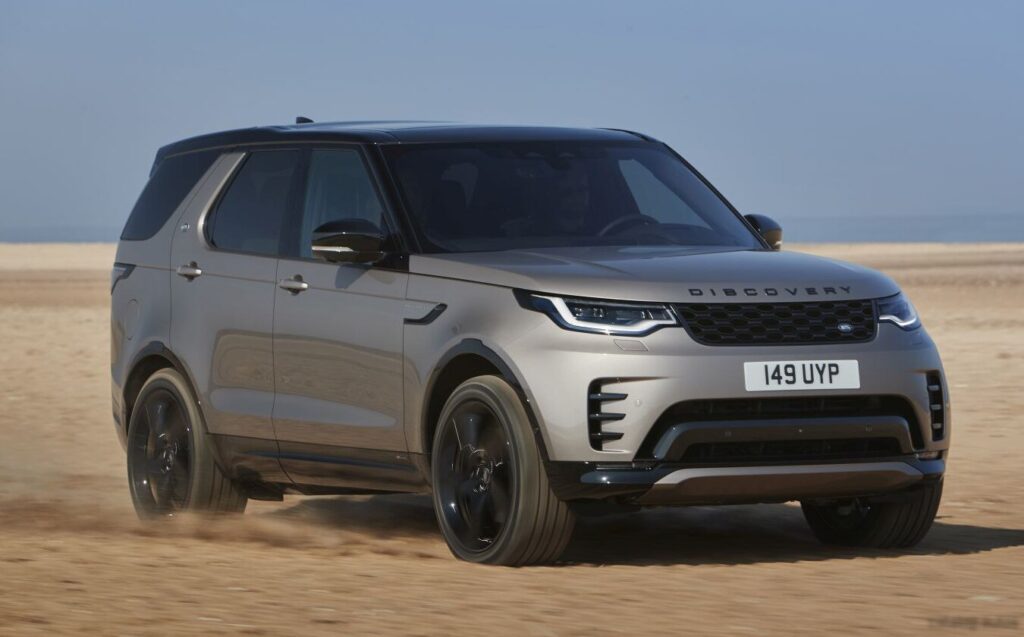
The Land Rover Discovery V, specifically the 3.0 D250 variant introduced with the 2020 facelift, represents a significant evolution of the fifth-generation Discovery (L550) model. Production began in November 2020, and this version quickly became a popular choice for buyers seeking a blend of luxury, capability, and relatively efficient diesel power. Positioned as a mid-range offering within the Discovery V lineup, the D250 bridged the gap between the entry-level D200 and the higher-performance D300 models. It’s a seven-seat SUV designed to appeal to families and those requiring a versatile vehicle for both on-road comfort and off-road adventures. The introduction of mild-hybrid technology further refined the engine’s performance and fuel economy.
Technical Specifications
| Brand | Land Rover |
| Model | Discovery |
| Generation | Discovery V (facelift 2020) |
| Type | 3.0 D250 (249 Hp) Mild Hybrid AWD Automatic 7 Seat |
| Start of production | November, 2020 |
| Powertrain Architecture | MHEV (Mild Hybrid Electric Vehicle) |
| Body type | SUV |
| Seats | 7 |
| Doors | 5 |
| Combined fuel consumption (WLTP) | 8.3-8.9 l/100 km (28.3 – 26.4 US mpg) |
| CO2 emissions (WLTP) | 218-232 g/km |
| Fuel consumption (NEDC) | 7.4 l/100 km (31.8 US mpg) |
| CO2 emissions (NEDC) | 194 g/km |
| Fuel Type | Diesel |
| Acceleration 0 – 100 km/h | 8.1 sec |
| Acceleration 0 – 62 mph | 8.1 sec |
| Acceleration 0 – 60 mph | 7.6 sec |
| Maximum speed | 194 km/h (120.55 mph) |
| Emission standard | Euro 6d-F |
| Weight-to-power ratio | 9.5 kg/Hp |
| Weight-to-torque ratio | 4.1 kg/Nm |
| Power | 249 Hp @ 4000 rpm |
| Torque | 570 Nm @ 1250-2250 rpm (420.41 lb.-ft.) |
| Engine layout | Front, Longitudinal |
| Engine Model/Code | Ingenium / DT306 |
| Engine displacement | 2996 cm3 (182.83 cu. in.) |
| Number of cylinders | 6 |
| Engine configuration | Inline |
| Cylinder Bore | 83 mm (3.27 in.) |
| Piston Stroke | 92.31 mm (3.63 in.) |
| Compression ratio | 15.5:1 |
| Number of valves per cylinder | 4 |
| Fuel injection system | Diesel Commonrail |
| Engine aspiration | Turbocharger, Intercooler |
| Engine oil capacity | 9.8 l (10.36 US qt | 8.62 UK qt) |
| Kerb Weight | 2362 kg (5207.32 lbs.) |
| Trunk (boot) space – minimum | 258 l (9.11 cu. ft.) |
| Trunk (boot) space – maximum | 2391 l (84.44 cu. ft.) |
| Fuel tank capacity | 89 l (23.51 US gal | 19.58 UK gal) |
| AdBlue tank | 18 l (4.76 US gal | 3.96 UK gal) |
| Permitted trailer load with brakes (12%) | 3500 kg (7716.18 lbs.) |
| Permitted trailer load without brakes | 750 kg (1653.47 lbs.) |
| Length | 4956 mm (195.12 in.) |
| Width | 2000 mm (78.74 in.) |
| Width with mirrors folded | 2073 mm (81.61 in.) |
| Width including mirrors | 2220 mm (87.4 in.) |
| Height | 1888 mm (74.33 in.) |
| Wheelbase | 2923 mm (115.08 in.) |
| Front track | 1692 mm (66.61 in.) |
| Rear track | 1687 mm (66.42 in.) |
| Ride height (ground clearance) | 283 mm (11.14 in.) |
| Drag coefficient (Cd) | 0.35 |
| Minimum turning circle | 12.84 m (42.13 ft.) |
| Gears | 8 |
| Gearbox type | Automatic transmission |
INTRODUCTION
The Land Rover Discovery V D250, launched in late 2020, is a key variant within the facelifted fifth-generation Discovery range. Built on the Premium Lightweight Architecture (PLA) platform – also known as the 1HX0/A3 platform – it represents a significant step forward in terms of technology, refinement, and efficiency compared to the original Discovery V introduced in 2017. The facelift brought styling updates, a revised interior, and crucially, the introduction of Ingenium diesel engines with 48V mild-hybrid technology. The D250 trim level was designed to offer a compelling balance between performance, fuel economy, and equipment, making it a popular choice for families and drivers who require a versatile and capable SUV.
Powertrain & Engine Architecture
At the heart of the D250 lies the Ingenium DT306 engine, a 3.0-liter inline-six cylinder diesel. This engine benefits from a sophisticated turbocharger and intercooler setup, delivering 249 horsepower at 4000 rpm and a substantial 570 Nm (420 lb-ft) of torque between 1250 and 2250 rpm. The engine utilizes a diesel commonrail fuel injection system for precise fuel delivery and optimized combustion. The 15.5:1 compression ratio contributes to both efficiency and power. What sets the D250 apart is its 48V mild-hybrid system. This system employs a Belt-integrated Starter Generator (BiSG) which assists the engine during acceleration, allowing for smoother starts and improved fuel economy. The BiSG also enables the engine to shut off earlier during deceleration and coasting, further reducing emissions. The engine is longitudinally mounted, driving all four wheels through an eight-speed automatic transmission. This transmission is known for its smooth shifts and intelligent gear selection, contributing to a refined driving experience.
Driving Characteristics
The D250 offers a composed and comfortable driving experience. The 249 hp and 570 Nm of torque provide ample power for everyday driving and effortless overtaking. While not as overtly sporty as the D300, the D250 delivers strong acceleration, achieving 0-60 mph in around 7.6 seconds. The eight-speed automatic transmission is well-matched to the engine, providing smooth and timely gear changes. The mild-hybrid system contributes to a responsive feel, particularly during initial acceleration. Compared to the lower-powered D200, the D250 offers a noticeable performance upgrade, while remaining more economical than the D300. The Discovery’s air suspension (standard on most D250 trims) provides a comfortable ride, absorbing bumps and imperfections in the road effectively. Off-road, the D250 benefits from Land Rover’s renowned Terrain Response system, allowing drivers to optimize the vehicle’s settings for various surfaces, including grass, gravel, snow, mud, and sand.
Equipment & Trim Levels
The D250 typically came well-equipped as standard. Key features included leather upholstery, heated front seats, a touchscreen infotainment system with Apple CarPlay and Android Auto compatibility, a rearview camera, and a suite of safety features such as autonomous emergency braking and lane departure warning. Higher trim levels, such as HSE and Edition, added features like premium leather, panoramic sunroofs, upgraded audio systems, and advanced driver-assistance technologies. Optional extras included adaptive cruise control, a head-up display, and a rear-seat entertainment system. Interior color schemes varied, with options ranging from light to dark leather finishes. The dashboard layout was refined with the facelift, featuring a more modern and intuitive design.
Chassis & Braking
The Discovery V utilizes a double-wishbone front suspension and an independent multi-link rear suspension, providing a comfortable and controlled ride. Air suspension was standard on many D250 models, offering adjustable ride height and improved off-road capability. The braking system consists of ventilated disc brakes on all four wheels, providing ample stopping power. ABS (Anti-lock Braking System) and Electronic Stability Control (ESC) are standard safety features. Wheel sizes ranged from 19 to 22 inches, depending on the trim level. The steering is electrically assisted, providing a light and precise feel.
Market Reception & Comparison
The Discovery V D250 was generally well-received by automotive critics. It was praised for its comfortable ride, spacious interior, and capable off-road performance. The mild-hybrid system was also noted for its contribution to improved fuel economy and reduced emissions. Compared to the D200, the D250 offered a worthwhile performance upgrade without significantly compromising fuel efficiency. Against the D300, it represented a more sensible option for buyers who didn’t require the ultimate in performance. Fuel economy figures typically ranged from 28.3 to 26.4 US mpg (combined WLTP), making it a relatively efficient option for a large SUV. Reliability reports have been generally positive, although some owners have reported minor issues with the infotainment system.
Legacy
The Land Rover Discovery V D250 has established itself as a reliable and versatile SUV in the used car market. The Ingenium engine has proven to be durable and relatively easy to maintain, although regular servicing is essential. The mild-hybrid system has also demonstrated good long-term reliability. As a result, the D250 continues to be a popular choice for buyers seeking a capable and comfortable family SUV with a proven track record. Its blend of luxury, performance, and efficiency ensures its continued appeal for years to come.