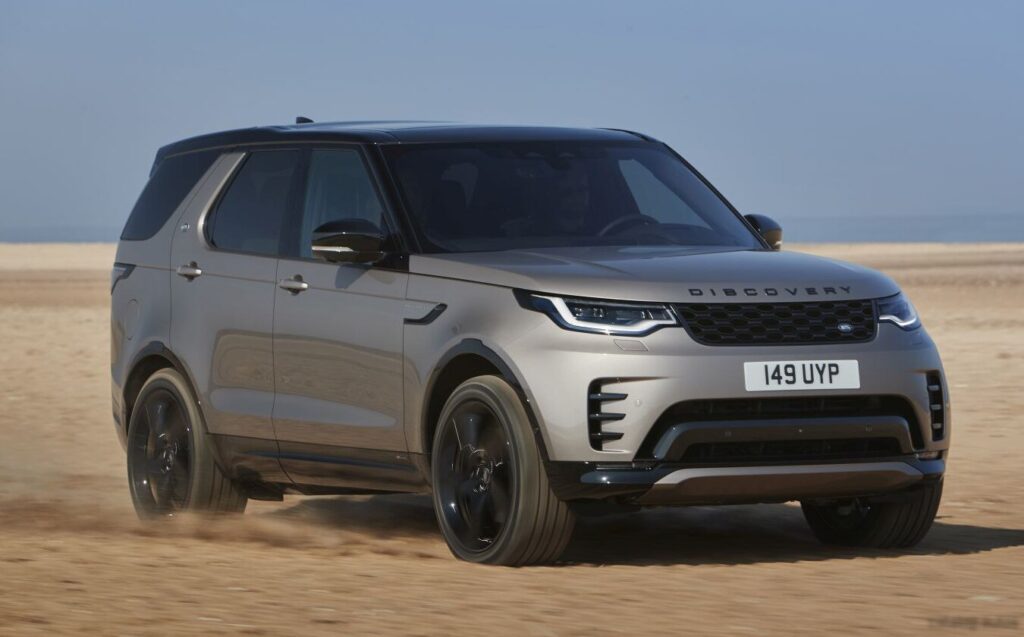
The Land Rover Discovery V, specifically the 3.0 P360 variant introduced with the 2020 facelift, represents a significant evolution of the fifth-generation Discovery (L550) model. Launched in November 2020, this version blends robust off-road capability with a more refined on-road experience, appealing to a broad spectrum of buyers seeking a premium SUV. Positioned as a mid-to-high range offering within the Discovery V lineup, the P360 distinguishes itself through its potent mild-hybrid powertrain and enhanced performance characteristics. It builds upon the foundation of the L550 platform, which debuted in 2017, incorporating updated technology and styling cues to maintain competitiveness in the luxury SUV segment.
Technical Specifications
| Brand | Land Rover |
| Model | Discovery |
| Generation | Discovery V (facelift 2020) |
| Type | 3.0 P360 (360 Hp) Mild Hybrid AWD Automatic |
| Start of production | November, 2020 |
| Powertrain Architecture | MHEV (Mild Hybrid Electric Vehicle) |
| Body type | SUV |
| Seats | 5 |
| Doors | 5 |
| Combined fuel consumption (WLTP) | 10.5-11.2 l/100 km (22.4 – 21 US mpg, 26.9 – 25.2 UK mpg, 9.5 – 8.9 km/l) |
| CO2 emissions (WLTP) | 236-252 g/km |
| Fuel consumption (NEDC) | 9.3 l/100 km (25.3 US mpg, 30.4 UK mpg, 10.8 km/l) |
| CO2 emissions (NEDC) | 210 g/km |
| Fuel Type | Petrol (Gasoline) |
| Acceleration 0 – 100 km/h | 6.5 sec |
| Acceleration 0 – 62 mph | 6.5 sec |
| Acceleration 0 – 60 mph | 6.2 sec |
| Maximum speed | 209 km/h (129.87 mph) |
| Emission standard | Euro 6d-F |
| Weight-to-power ratio | 6.4 kg/Hp, 157.1 Hp/tonne |
| Weight-to-torque ratio | 4.6 kg/Nm, 218.2 Nm/tonne |
| Power | 360 Hp @ 5500-6500 rpm |
| Power per litre | 120.2 Hp/l |
| Torque | 500 Nm @ 1750-5000 rpm (368.78 lb.-ft. @ 1750-5000 rpm) |
| Engine layout | Front, Longitudinal |
| Engine displacement | 2995 cm3 (182.77 cu. in.) |
| Number of cylinders | 6 |
| Engine configuration | Inline |
| Cylinder Bore | 83 mm (3.27 in.) |
| Piston Stroke | 92.29 mm (3.63 in.) |
| Compression ratio | 10.5:1 |
| Number of valves per cylinder | 4 |
| Fuel injection system | Direct injection |
| Engine aspiration | Twin-Turbo, Intercooler |
| Engine systems | Start & Stop System, Particulate filter |
| Kerb Weight | 2291 kg (5050.79 lbs.) |
| Trunk (boot) space – minimum | 1231 l (43.47 cu. ft.) |
| Trunk (boot) space – maximum | 2485 l (87.76 cu. ft.) |
| Fuel tank capacity | 90 l (23.78 US gal, 19.8 UK gal) |
| Permitted trailer load with brakes (12%) | 3500 kg (7716.18 lbs.) |
| Permitted trailer load without brakes | 750 kg (1653.47 lbs.) |
| Length | 4956 mm (195.12 in.) |
| Width | 2000 mm (78.74 in.) |
| Width with mirrors folded | 2073 mm (81.61 in.) |
| Width including mirrors | 2220 mm (87.4 in.) |
| Height | 1888 mm (74.33 in.) |
| Wheelbase | 2923 mm (115.08 in.) |
| Front track | 1692 mm (66.61 in.) |
| Rear track | 1687 mm (66.42 in.) |
| Front overhang | 858 mm (33.78 in.) |
| Rear overhang | 1175 mm (46.26 in.) |
| Ride height (ground clearance) | 283 mm (11.14 in.) |
| Drag coefficient (Cd) | 0.35 |
| Minimum turning circle | 12.84 m (42.13 ft.) |
| Approach angle | 26-34° |
| Departure angle | 24.8-30° |
| Ramp-over angle | 21.2-27.5° |
| Climb angle | 45° |
| Wading depth | 900 mm (35.43 in.) |
| Drivetrain Architecture | ICE and electric motor, permanent four-wheel drive |
| Drive wheel | All wheel drive (4×4) |
| Number of gears | 8 |
| Gearbox type | Automatic transmission |
| Front suspension | Double wishbone |
| Rear suspension | Independent multi-link suspension |
| Assisting systems | ABS (Anti-lock braking system) |
| Steering type | Steering rack and pinion |
| Power steering | Electric |
| Tire size | 222/60 R19; 255/55 R20; 275/45 R21; 285/40 R22 |
| Wheel rims size | 7.5J x 19; 8.5J x 20; 9.5J x 21; 9.5J x 22 |
INTRODUCTION
The Land Rover Discovery V 3.0 P360, launched in late 2020, is a facelifted version of the fifth-generation Discovery, built on the L550 platform. This iteration aimed to refine the existing model, addressing some criticisms leveled at the previous generation while enhancing its technological offerings. The P360 designation signifies the engine’s output – 360 horsepower – and highlights the inclusion of a 48-volt mild-hybrid system. This powertrain was positioned as a sweet spot in the Discovery V range, offering a compelling balance between performance, fuel efficiency, and refinement. It caters to buyers who desire a capable luxury SUV without the higher price tag of the more powerful P400 or the diesel-focused SD6 or SD7 models.
Powertrain & Engine Architecture
At the heart of the P360 lies Land Rover’s Ingenium 3.0-liter inline-six cylinder gasoline engine, specifically the P360 variant. This engine, internally designated as part of the Ingenium family, utilizes a sophisticated combination of technologies. It features direct fuel injection, a twin-scroll turbocharger, and a continuously variable valve timing system. The mild-hybrid system incorporates a Belt-integrated Starter Generator (BiSG) which assists the engine during acceleration and enables smoother start-stop operation, contributing to improved fuel economy. The engine produces 360 horsepower at 5500-6500 rpm and 500 Nm (368.78 lb-ft) of torque between 1750 and 5000 rpm. The engine is longitudinally mounted and paired with an eight-speed automatic transmission, developed in-house by Land Rover. This transmission is known for its smooth shifts and responsive operation, optimized for both on-road comfort and off-road crawling.
Driving Characteristics
The 3.0 P360 delivers a noticeably refined driving experience compared to earlier Discovery models. The mild-hybrid system provides a subtle but effective boost during acceleration, resulting in a responsive feel. While not as overtly sporty as some competitors, the P360 offers ample power for everyday driving and confident highway cruising. The eight-speed automatic transmission is well-tuned, providing smooth gear changes and contributing to a relaxed driving experience. Compared to the higher-output P400, the P360 feels slightly less urgent in its acceleration, but the difference is often negligible in real-world conditions. The gear ratios are optimized for a balance of performance and fuel efficiency, with a focus on providing strong low-end torque for off-road situations.
Equipment & Trim Levels
The Discovery V P360 typically came well-equipped as standard, reflecting its position as a mid-to-high range trim. Standard features generally included leather upholstery, a touchscreen infotainment system with Apple CarPlay and Android Auto compatibility, a panoramic sunroof, and a suite of driver-assistance systems such as lane departure warning and autonomous emergency braking. Optional extras included premium audio systems, adaptive cruise control, heated and ventilated seats, and a variety of exterior styling enhancements. Interior trim options varied, allowing buyers to personalize the cabin with different wood veneers and color schemes. The P360 was often available in SE, HSE, and R-Dynamic trims, each offering progressively more luxurious features and sporty styling cues.
Chassis & Braking
The Discovery V utilizes a robust chassis designed for both on-road comfort and off-road capability. It features double-wishbone suspension at the front and an independent multi-link suspension at the rear. Air suspension is standard on many P360 models, providing adjustable ride height and improved off-road articulation. The braking system consists of ventilated disc brakes on all four wheels, with ABS (Anti-lock Braking System) and electronic brake-force distribution. Stabilizer bars are fitted front and rear to minimize body roll during cornering. The P360’s weight (approximately 2291 kg or 5050.79 lbs) is managed effectively by the suspension system, providing a comfortable and controlled ride.
Market Reception & Comparison
The Land Rover Discovery V P360 received generally positive reviews from automotive critics. It was praised for its refined powertrain, comfortable ride, and spacious interior. However, some reviewers noted that the infotainment system could be complex to navigate and that the fuel economy, while improved by the mild-hybrid system, was not class-leading. Compared to the P400, the P360 offered a more affordable entry point into the Discovery V range without sacrificing significant performance. Against competitors such as the BMW X5, Audi Q7, and Volvo XC90, the Discovery V P360 stood out for its off-road capability and distinctive British styling.
Legacy
The Land Rover Discovery V 3.0 P360 represents a significant step forward in the evolution of the Discovery lineage. The Ingenium engine and mild-hybrid technology demonstrate Land Rover’s commitment to improving fuel efficiency and reducing emissions. While long-term reliability data is still emerging, the Ingenium engine family has generally proven to be robust. On the used car market, the P360 variant offers a compelling value proposition, providing a luxurious and capable SUV at a more accessible price point than the higher-output models. Its blend of performance, refinement, and off-road ability ensures its continued appeal to buyers seeking a versatile and sophisticated SUV.