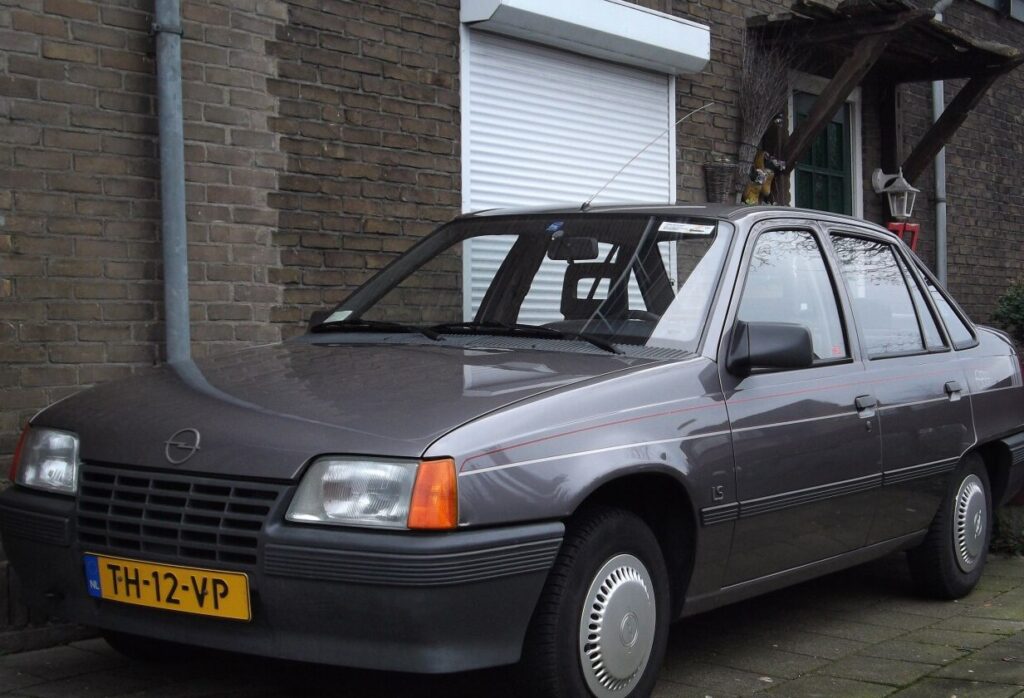
The Opel Kadett E 1.7 D, produced between 1989 and 1991, represented the diesel-powered entry point into the Kadett E range. Positioned as an economy-focused variant, it catered to buyers prioritizing fuel efficiency and practicality over outright performance. The Kadett E, launched in 1986, was a significant model for Opel, built on the GM T-platform (internally known as the 1HX0/A3 platform) and serving as a direct replacement for the Kadett D. This generation saw a substantial leap forward in terms of design, technology, and build quality, becoming a popular choice in Europe, particularly in Germany. The 1.7 D trim offered a no-frills, durable transportation solution, appealing to a broad customer base seeking a reliable and affordable family car.
Technical Specifications
| Brand | Opel |
| Model | Kadett |
| Generation | Kadett E |
| Type (Engine) | 1.7 D (57 Hp) |
| Start of production | 1989 |
| End of production | 1991 |
| Powertrain Architecture | Internal Combustion engine |
| Body type | Sedan |
| Seats | 5 |
| Doors | 4 |
| Fuel Type | Diesel |
| Acceleration 0 – 100 km/h | 18 sec |
| Acceleration 0 – 62 mph | 18 sec |
| Acceleration 0 – 60 mph | 17.1 sec |
| Maximum speed | 153 km/h (95.07 mph) |
| Weight-to-power ratio | 16.7 kg/Hp, 60 Hp/tonne |
| Weight-to-torque ratio | 9 kg/Nm, 110.5 Nm/tonne |
| Power | 57 Hp @ 4600 rpm |
| Power per litre | 33.5 Hp/l |
| Torque | 105 Nm @ 2400-2600 rpm (77.44 lb.-ft. @ 2400-2600 rpm) |
| Engine layout | Front, Transverse |
| Engine Model/Code | 17D |
| Engine displacement | 1700 cm3 (103.74 cu. in.) |
| Number of cylinders | 4 |
| Engine configuration | Inline |
| Cylinder Bore | 82.5 mm (3.25 in.) |
| Piston Stroke | 79.5 mm (3.13 in.) |
| Compression ratio | 23:1 |
| Number of valves per cylinder | 2 |
| Engine aspiration | Naturally aspirated engine |
| Valvetrain | SOHC |
| Engine oil capacity | 5 l (5.28 US qt | 4.4 UK qt) |
| Coolant | 9.1 l (9.62 US qt | 8.01 UK qt) |
| Kerb Weight | 950 kg (2094.39 lbs.) |
| Max. weight | 1445 kg (3185.68 lbs.) |
| Max load | 495 kg (1091.29 lbs.) |
| Trunk (boot) space – minimum | 550 l (19.42 cu. ft.) |
| Trunk (boot) space – maximum | 890 l (31.43 cu. ft.) |
| Fuel tank capacity | 52 l (13.74 US gal | 11.44 UK gal) |
| Length | 4218 mm (166.06 in.) |
| Width | 1658 mm (65.28 in.) |
| Height | 1400 mm (55.12 in.) |
| Wheelbase | 2520 mm (99.21 in.) |
| Front track | 1400 mm (55.12 in.) |
| Rear (Back) track | 1406 mm (55.35 in.) |
| Minimum turning circle | 10.5 m (34.45 ft.) |
| Drivetrain Architecture | The Internal combustion engine (ICE) drives the front wheels of the vehicle. |
| Drive wheel | Front wheel drive |
| Number of gears and type of gearbox | 5 gears, manual transmission |
| Front brakes | Disc |
| Rear brakes | Drum |
| Tires size | 175/70 R13 |
| Wheel rims size | 13 |
Powertrain & Engine Architecture
The heart of the Kadett E 1.7 D was the 17D engine, a naturally aspirated, inline-four cylinder diesel. This engine, a mainstay of Opel’s diesel offerings during the period, featured a simple SOHC (Single Overhead Camshaft) valvetrain operating two valves per cylinder. Indirect injection was employed, utilizing a Bosch rotary injection pump. This system, while not as refined as later direct injection diesels, provided reasonable fuel economy and durability. The 17D produced 57 horsepower at 4600 rpm and 105 Nm (77.44 lb-ft) of torque between 2400 and 2600 rpm. The engine’s robust construction and relatively low compression ratio (23:1) contributed to its longevity. The Kadett E 1.7 D was exclusively offered with a five-speed manual transmission, designed to maximize the engine’s limited power output and improve fuel efficiency. The transmission was a standard, non-synchronized unit, prioritizing cost-effectiveness over driving refinement.
Driving Characteristics
The driving experience in the Kadett E 1.7 D was decidedly utilitarian. Acceleration was slow, with a 0-60 mph time of around 17.1 seconds and a top speed of 95 mph. The engine’s torque peak at low to mid-range revs meant it was reasonably tractable in everyday driving, but overtaking required careful planning. The five-speed manual transmission helped to keep the engine in its optimal power band, but the gear ratios were widely spaced, requiring frequent shifting. Compared to the more powerful Kadett E variants, such as the 1.6 or 2.0-liter gasoline models, the 1.7 D felt significantly underpowered. However, it offered a noticeable improvement in fuel economy, making it a popular choice for high-mileage drivers. The manual transmission provided a more engaging driving experience than an automatic would have, given the engine’s characteristics.
Equipment & Trim Levels
The Kadett E 1.7 D was typically offered in a base trim level, focusing on essential features. Standard equipment included cloth upholstery, a basic dashboard layout with analog gauges, and steel wheels with hubcaps. Power steering and central locking were often optional extras. The interior was functional and durable, prioritizing practicality over luxury. Radio and upgraded speaker systems were also available as options. The exterior styling was consistent across the Kadett E range, with the 1.7 D distinguished primarily by its engine badge. The overall aim was to provide a cost-effective and reliable vehicle, and as such, the trim level reflected this philosophy.
Chassis & Braking
The Kadett E featured a MacPherson strut front suspension and a torsion beam rear suspension. The 1.7 D variant, being the entry-level model, typically had a simpler suspension setup with thinner stabilizer bars compared to higher-spec versions. Braking was accomplished via disc brakes on the front wheels and drum brakes on the rear. This configuration was common for vehicles in this class during the late 1980s and early 1990s. The braking performance was adequate for normal driving conditions, but lacked the stopping power of more advanced braking systems. The Kadett E’s chassis was designed to provide a comfortable ride and predictable handling, prioritizing stability over sporty dynamics.
Market Reception & Comparison
The Kadett E 1.7 D received mixed reviews. Critics acknowledged its fuel efficiency and affordability but criticized its lack of performance. It was often compared to other diesel-powered compact cars of the era, such as the Volkswagen Golf Diesel and the Ford Escort Diesel. The Kadett E 1.7 D generally offered a competitive price point and comparable fuel economy to its rivals. However, some reviewers found the engine to be noisy and unrefined compared to some of its competitors. Its reliability was generally praised, making it a popular choice in the used car market.
Legacy
The Opel Kadett E 1.7 D, while not a performance icon, holds a significant place in automotive history as a practical and affordable family car. The 17D engine proved to be remarkably durable, and many examples are still on the road today. In the used car market, the Kadett E 1.7 D is valued for its simplicity, reliability, and low running costs. It represents a bygone era of automotive engineering, where durability and fuel efficiency were prioritized over technological sophistication. The Kadett E, as a whole, cemented Opel’s reputation as a manufacturer of dependable and value-for-money vehicles, paving the way for its future success in the European market.