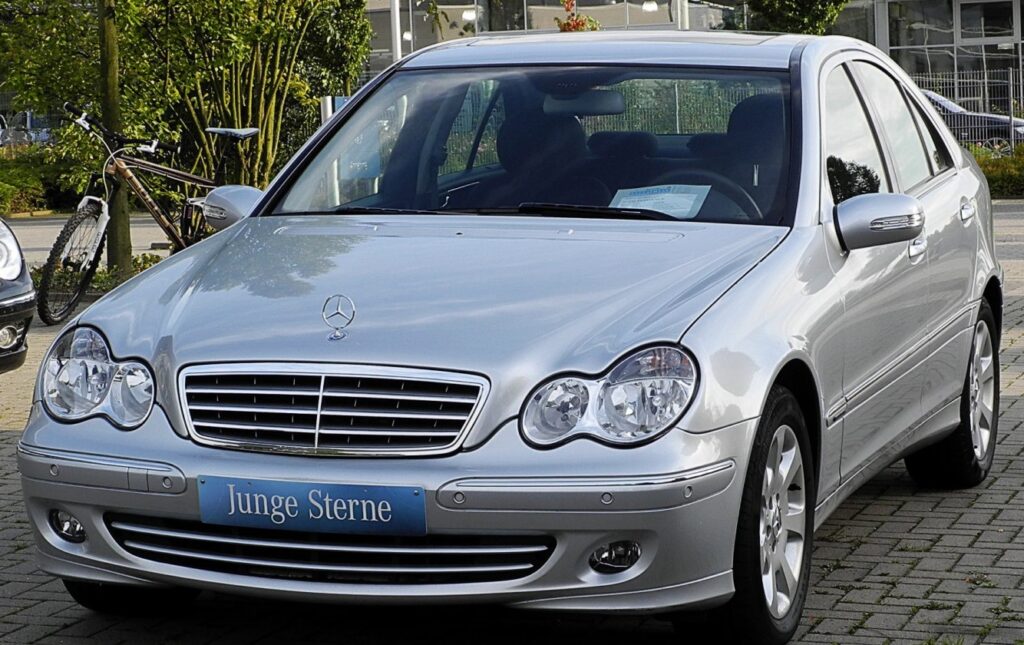
The Mercedes-Benz C 240 V6 4MATIC, produced from April 2004 to June 2005, represents a mid-range offering within the W203 C-Class facelift series. Positioned above the C 180 Kompressor and C 200 Kompressor models, but below the C 320 and C 55 AMG, the C 240 aimed to provide a balance of performance and luxury with the added security of all-wheel drive. This variant was primarily sold in European and North American markets, offering a more refined driving experience than the base models while remaining more accessible than the high-performance options. The W203 facelift, introduced in 2004, brought significant cosmetic and technological updates to the C-Class, addressing criticisms leveled at the pre-facelift models.
Technical Specifications
| Brand | Mercedes-Benz |
| Model | C-class |
| Generation | C-class (W203, facelift 2004) |
| Type (Engine) | C 240 V6 (170 Hp) 4MATIC Automatic |
| Start of production | April, 2004 |
| End of production | June, 2005 |
| Powertrain Architecture | Internal Combustion engine |
| Body type | Sedan |
| Seats | 5 |
| Doors | 4 |
| Fuel consumption (economy) – urban (NEDC) | 16 l/100 km (14.7 US mpg, 17.7 UK mpg, 6.3 km/l) |
| Fuel consumption (economy) – extra urban (NEDC) | 8.2 l/100 km (28.7 US mpg, 34.4 UK mpg, 12.2 km/l) |
| Fuel consumption (economy) – combined (NEDC) | 11.2 l/100 km (21 US mpg, 25.2 UK mpg, 8.9 km/l) |
| CO2 emissions (NEDC) | 252 g/km |
| Fuel Type | Petrol (Gasoline) |
| Acceleration 0 – 100 km/h | 10 sec |
| Acceleration 0 – 62 mph | 10 sec |
| Acceleration 0 – 60 mph | 9.5 sec |
| Maximum speed | 228 km/h (141.67 mph) |
| Emission standard | Euro 4 |
| Weight-to-power ratio | 9.2 kg/Hp, 108.6 Hp/tonne |
| Weight-to-torque ratio | 6.5 kg/Nm, 153.4 Nm/tonne |
| Power | 170 Hp @ 5500 rpm |
| Power per litre | 65.5 Hp/l |
| Torque | 240 Nm @ 4500 rpm (177.01 lb.-ft. @ 4500 rpm) |
| Engine layout | Front, Longitudinal |
| Engine Model/Code | M 112.916 |
| Engine displacement | 2597 cm3 (158.48 cu. in.) |
| Number of cylinders | 6 |
| Engine configuration | V-engine |
| Cylinder Bore | 89.9 mm (3.54 in.) |
| Piston Stroke | 68.2 mm (2.69 in.) |
| Compression ratio | 10.5:1 |
| Number of valves per cylinder | 3 |
| Fuel injection system | Multi-port manifold injection |
| Engine aspiration | Naturally aspirated engine |
| Valvetrain | SOHC |
| Engine oil capacity | 8 l (8.45 US qt | 7.04 UK qt) |
| Coolant | 10 l (10.57 US qt | 8.8 UK qt) |
| Kerb Weight | 1565 kg (3450.23 lbs.) |
| Max. weight | 2120 kg (4673.8 lbs.) |
| Max load | 555 kg (1223.57 lbs.) |
| Trunk (boot) space – minimum | 455 l (16.07 cu. ft.) |
| Fuel tank capacity | 62 l (16.38 US gal | 13.64 UK gal) |
| Max. roof load | 100 kg (220.46 lbs.) |
| Permitted trailer load with brakes (12%) | 1800 kg (3968.32 lbs.) |
| Permitted trailer load without brakes | 750 kg (1653.47 lbs.) |
| Length | 4526 mm (178.19 in.) |
| Width | 1728 mm (68.03 in.) |
| Width including mirrors | 1980 mm (77.95 in.) |
| Height | 1432 mm (56.38 in.) |
| Wheelbase | 2715 mm (106.89 in.) |
| Front track | 1493 mm (58.78 in.) |
| Rear (Back) track | 1464 mm (57.64 in.) |
| Drag coefficient (Cd) | 0.27 |
| Minimum turning circle (turning diameter) | 10.76 m (35.3 ft.) |
| Drivetrain Architecture | The Internal combustion engine (ICE) drives permanently the four wheels of the vehicle. |
| Drive wheel | All wheel drive (4×4) |
| Number of gears and type of gearbox | 5 gears, automatic transmission |
| Front suspension | Independent type McPherson, Transverse stabilizer |
| Rear suspension | Independent multi-link suspension, Transverse stabilizer |
| Front brakes | Ventilated discs |
| Rear brakes | Disc |
| Assisting systems | ABS (Anti-lock braking system) |
| Steering type | Steering rack and pinion |
| Power steering | Hydraulic Steering |
| Tires size | 205/55 R 16 91 V |
| Wheel rims size | 7 J x 16 H 2 |
INTRODUCTION
The C 240 V6 4MATIC, introduced as part of the W203 facelift in 2004, aimed to bridge the gap between the more economical C-Class variants and the higher-performance models. The facelift brought revised styling, including new headlights and taillights, a redesigned front fascia, and interior upgrades focused on improving perceived quality. The 4MATIC all-wheel-drive system was a key selling point, particularly in regions experiencing inclement weather. This model year represented a refinement of the W203 platform, addressing earlier criticisms regarding build quality and refinement. The C 240 V6 4MATIC was intended to appeal to buyers seeking a comfortable, capable, and relatively powerful sedan with a premium badge.
Powertrain & Engine Architecture
At the heart of the C 240 V6 4MATIC lies the M112.916 engine, a 2.6-liter naturally aspirated V6. This engine is a member of Mercedes-Benz’s M112 family, known for its smooth operation and relatively high output for its displacement. The engine utilizes a single overhead camshaft (SOHC) design with three valves per cylinder (two intake, one exhaust). Fuel delivery is managed by a multi-port fuel injection system. The engine produces 170 horsepower at 5500 rpm and 240 Nm (177 lb-ft) of torque at 4500 rpm. The engine’s longitudinal mounting and rear-wheel-drive bias, coupled with the 4MATIC system, contribute to balanced handling. The 4MATIC system is a full-time all-wheel-drive system, distributing power between the front and rear axles based on available traction. The transmission is a 5-speed automatic, designed to provide smooth shifts and optimize fuel efficiency. This transmission, while reliable, lacks the responsiveness of some contemporary automatic gearboxes.
Driving Characteristics
The C 240 V6 4MATIC offers a comfortable and refined driving experience. While not a sports sedan, the V6 engine provides adequate power for everyday driving and highway cruising. Acceleration from 0-60 mph takes approximately 9.5 seconds, and the top speed is electronically limited to 141.67 mph. The automatic transmission, while smooth, can feel somewhat hesitant during quick acceleration. The 4MATIC system provides enhanced traction, particularly in slippery conditions, inspiring confidence in various weather scenarios. Compared to the C 200 Kompressor, the C 240 offers noticeably more power and torque, resulting in a more relaxed driving experience. However, it lacks the punch of the C 320 or the outright performance of the C 55 AMG. The steering is precise but lacks significant feedback, and the suspension provides a comfortable ride without being overly sporty.
Equipment & Trim Levels
The C 240 V6 4MATIC came reasonably well-equipped as standard. Typical features included automatic climate control, power windows and locks, a multi-function steering wheel, and an audio system. Upholstery was typically a cloth or leatherette combination, with full leather available as an option. Optional extras included a sunroof, navigation system, premium sound system, and heated seats. The interior design was generally conservative, reflecting Mercedes-Benz’s focus on understated luxury. The dashboard layout was functional and well-organized, with clear instrumentation. Trim levels were relatively limited, with most customization options available through individual selections.
Chassis & Braking
The W203 C-Class utilizes an independent suspension system at all four wheels. The front suspension employs a McPherson strut design with a transverse stabilizer bar, while the rear suspension features a multi-link setup, also with a stabilizer bar. This configuration provides a good balance of ride comfort and handling. The C 240 V6 4MATIC is equipped with ventilated disc brakes at the front and solid disc brakes at the rear. Anti-lock braking system (ABS) is standard. The chassis is relatively rigid, contributing to good handling characteristics. The 4MATIC system adds weight compared to rear-wheel-drive models, but the added traction often compensates for this.
Market Reception & Comparison
The C 240 V6 4MATIC was generally well-received by automotive critics. It was praised for its smooth engine, comfortable ride, and the added security of all-wheel drive. However, some critics noted that the automatic transmission could be more responsive and that the interior, while well-built, lacked the visual flair of some competitors. Fuel economy was considered average for its class, with combined consumption around 21 US mpg. Compared to the C 200 Kompressor, the C 240 offered a significant performance upgrade, but at a higher price point. The C 320 provided even more power but was considerably more expensive. Reliability was generally good, although some owners reported issues with the electronic systems and the automatic transmission over the long term.
Legacy
The M112 engine family, including the M112.916 found in the C 240 V6 4MATIC, is known for its durability and longevity. While not without its potential issues (such as occasional oil leaks and timing chain wear), the engine is generally considered reliable if properly maintained. Today, the W203 C-Class, including the C 240 V6 4MATIC, represents an affordable entry point into Mercedes-Benz ownership. These cars are often found in good condition, and parts availability is generally good. The 4MATIC system remains a desirable feature, particularly in regions with harsh winters. The C 240 V6 4MATIC is remembered as a well-rounded and capable sedan that offered a good balance of performance, luxury, and practicality.