
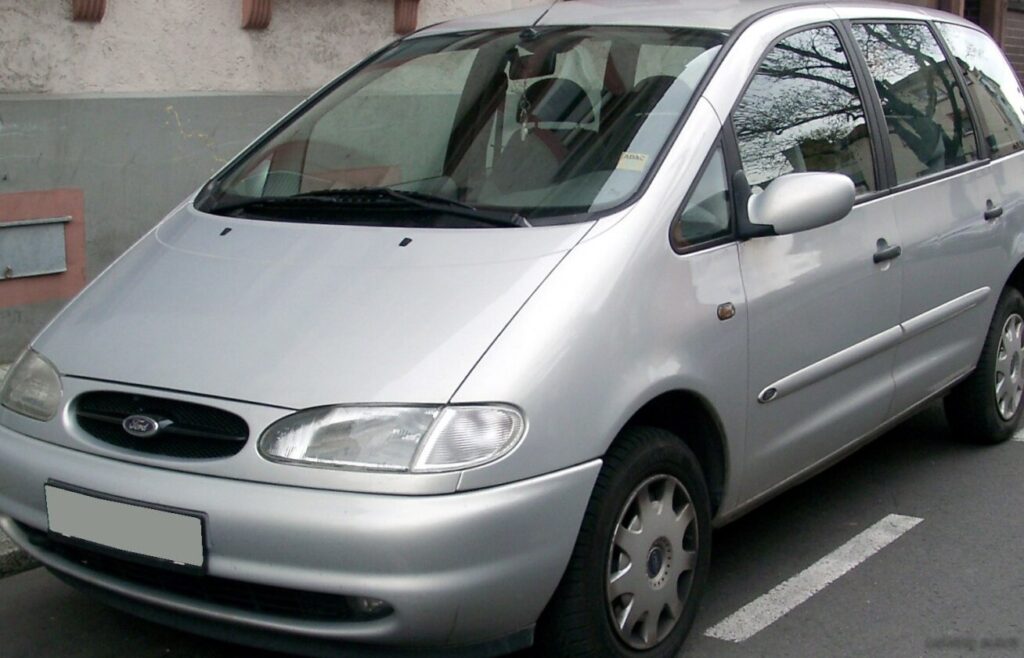
The Ford Galaxy I 1.9 TDI Automatic, produced between 1997 and 2000, represents a significant entry in Ford’s foray into the European minivan market. Sharing a platform with the Volkswagen Sharan and SEAT Alhambra (the 1HX0/A3 platform), the Galaxy aimed to provide a spacious, practical, and relatively affordable seven-seater option for families. This particular variant, equipped with the 1.9-liter turbocharged diesel engine and a four-speed automatic transmission, was positioned as a mid-range offering, prioritizing comfort and ease of use over outright performance. It was a popular choice for those seeking a versatile vehicle for long journeys and everyday family transport.
Technical Specifications
| Brand | Ford |
| Model | Galaxy |
| Generation | Galaxy I |
| Type (Engine) | 1.9 TDI (110 Hp) Automatic |
| Start of production | 1997 |
| End of production | 2000 |
| Powertrain Architecture | Internal Combustion engine |
| Body type | Minivan |
| Seats | 7 |
| Doors | 5 |
| Fuel consumption (urban) | 10.5 l/100 km (22.4 US mpg, 26.9 UK mpg, 9.5 km/l) |
| Fuel consumption (extra urban) | 6.5 l/100 km (36.2 US mpg, 43.5 UK mpg, 15.4 km/l) |
| Fuel consumption (combined) | 8.5 l/100 km (27.7 US mpg, 33.2 UK mpg, 11.8 km/l) |
| Fuel Type | Diesel |
| Acceleration 0 – 100 km/h | 14.7 sec |
| Acceleration 0 – 62 mph | 14.7 sec |
| Acceleration 0 – 60 mph | 14 sec |
| Maximum speed | 169 km/h (105.01 mph) |
| Weight-to-power ratio | 14.9 kg/Hp, 67.1 Hp/tonne |
| Weight-to-torque ratio | 7 kg/Nm, 143.3 Nm/tonne |
| Power | 110 Hp @ 4150 rpm |
| Power per litre | 58 Hp/l |
| Torque | 235 Nm @ 1900 rpm (173.33 lb.-ft. @ 1900 rpm) |
| Engine layout | Front, Transverse |
| Engine Model/Code | AFN, AVG |
| Engine displacement | 1896 cm3 (115.7 cu. in.) |
| Number of cylinders | 4 |
| Engine configuration | Inline |
| Cylinder Bore | 79.5 mm (3.13 in.) |
| Piston Stroke | 95.5 mm (3.76 in.) |
| Compression ratio | 19.5:1 |
| Number of valves per cylinder | 2 |
| Fuel injection system | Direct injection |
| Engine aspiration | Turbocharger, Intercooler |
| Valvetrain | SOHC |
| Engine oil capacity | 4.3 l (4.54 US qt | 3.78 UK qt) |
| Kerb Weight | 1640 kg (3615.58 lbs.) |
| Max. weight | 2400 kg (5291.09 lbs.) |
| Max load | 760 kg (1675.51 lbs.) |
| Trunk (boot) space – minimum | 266 l (9.39 cu. ft.) |
| Trunk (boot) space – maximum | 2610 l (92.17 cu. ft.) |
| Fuel tank capacity | 75 l (19.81 US gal | 16.5 UK gal) |
| Length | 4641 mm (182.72 in.) |
| Width | 1810 mm (71.26 in.) |
| Height | 1730 mm (68.11 in.) |
| Wheelbase | 2835 mm (111.61 in.) |
| Front track | 1530 mm (60.24 in.) |
| Rear (Back) track | 1524 mm (60 in.) |
| Drivetrain Architecture | The Internal combustion engine (ICE) drives the front wheels of the vehicle. |
| Drive wheel | Front wheel drive |
| Number of gears and type of gearbox | 4 gears, automatic transmission |
| Front suspension | Wishbone |
| Rear suspension | Coil spring |
| Front brakes | Ventilated discs |
| Rear brakes | Disc |
| Assisting systems | ABS (Anti-lock braking system) |
| Steering type | Steering rack and pinion |
| Power steering | Hydraulic Steering |
| Tires size | 195/65 R15 |
| Wheel rims size | 15 |
Powertrain & Engine Architecture
The heart of this Galaxy variant is the 1.9-liter (1896 cc) inline four-cylinder diesel engine, typically identified by the engine codes AFN or AVG. This engine utilizes direct fuel injection, a technology that significantly improved fuel efficiency and reduced emissions compared to older indirect injection systems. A turbocharger with an intercooler further enhances performance by forcing more air into the cylinders. The engine features a single overhead camshaft (SOHC) valvetrain with two valves per cylinder. The four-speed automatic transmission, while providing convenience, was a relatively conventional unit for the time. It wasn’t known for particularly quick shifts or advanced features, but it was generally reliable. The transmission’s gear ratios were geared towards fuel economy and smooth cruising rather than spirited acceleration.
Driving Characteristics
The 1.9 TDI Automatic Galaxy wasn’t designed to be a performance vehicle. With 110 horsepower and 235 Nm (173 lb-ft) of torque, acceleration was adequate but not brisk. The 0-60 mph time of around 14 seconds reflects this. The automatic transmission, while smooth, did sap some power compared to the available five-speed manual version. However, the engine’s strong low-end torque made it well-suited for carrying a full load of passengers and luggage. The Galaxy felt stable and comfortable on the highway, and the automatic transmission made it a relaxing choice for long journeys. The gear ratios were spaced to prioritize fuel efficiency, meaning the engine often operated at lower RPMs during cruising.
Equipment & Trim Levels
The 1.9 TDI Automatic typically fell into the mid-range of the Galaxy lineup. Standard equipment generally included power windows, central locking, power steering, and an ABS anti-lock braking system. Interior upholstery was usually a durable cloth material, and the dashboard featured a functional, if somewhat basic, design. Optional extras included air conditioning, alloy wheels, a sunroof, and upgraded audio systems. Higher trim levels offered features like leather upholstery and wood trim, but the 1.9 TDI Automatic was often seen as a practical and well-equipped option without the added expense of premium features.
Chassis & Braking
The Galaxy I utilized a front-wheel-drive layout with independent wishbone suspension at the front and a coil spring setup at the rear. The suspension was tuned for comfort, providing a relatively smooth ride even on uneven surfaces. Braking duties were handled by ventilated discs at the front and solid discs at the rear. The ABS system helped to maintain control during emergency braking situations. Stabilizer bars were fitted to both the front and rear axles to reduce body roll during cornering.
Market Reception & Comparison
The Ford Galaxy, and specifically the 1.9 TDI Automatic variant, was generally well-received by automotive critics. It was praised for its spacious interior, versatility, and relatively affordable price. However, the automatic transmission was sometimes criticized for being somewhat sluggish and less responsive than the manual gearbox. Compared to the higher-powered 2.8-liter VR6 version, the 1.9 TDI Automatic offered significantly lower fuel consumption and a more relaxed driving experience, but at the expense of performance. Against the 1.9 TDI manual, the automatic traded some efficiency and responsiveness for convenience.
Legacy
The Ford Galaxy I 1.9 TDI Automatic has proven to be a reasonably reliable vehicle, particularly the engine and transmission combination. While age and mileage inevitably lead to wear and tear, these powertrains are known for their durability. In the used car market, these Galaxies represent a good value for those seeking a spacious and practical family vehicle. However, potential buyers should be aware of common issues such as corrosion, wear in the suspension components, and potential problems with the electrical system. The 1.9 TDI engine, in particular, is generally considered robust, but regular maintenance is crucial to ensure its longevity. The Galaxy I helped establish Ford as a serious contender in the European minivan segment, paving the way for subsequent generations of the model.
