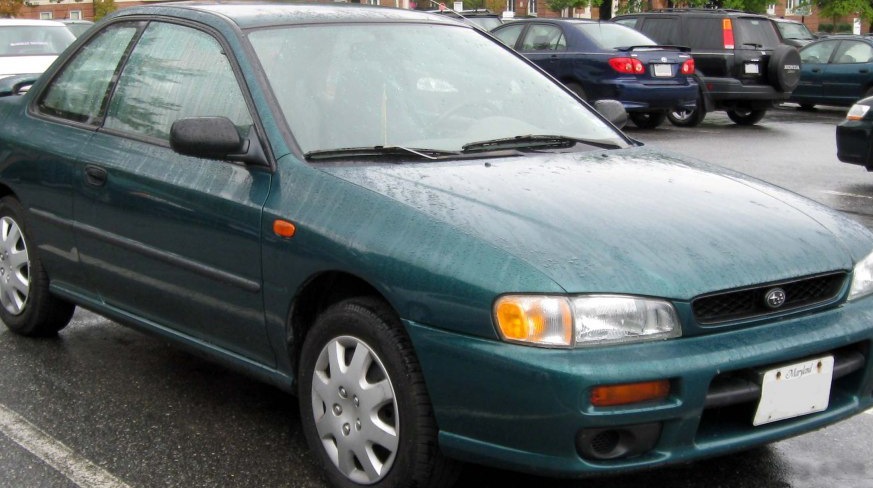
The Subaru Impreza VI Hatchback RS 2.5, introduced in 2023, represents the latest iteration of Subaru’s long-standing compact car, continuing a lineage known for its standard all-wheel drive and practical design. This particular variant, equipped with a 2.5-liter naturally aspirated boxer engine producing 182 horsepower and paired with a continuously variable transmission (CVT), occupies a mid-range position within the Impreza VI lineup. It aims to balance performance with fuel efficiency and ease of driving, appealing to a broad spectrum of consumers seeking a versatile and reliable vehicle. The Impreza VI builds upon the foundation of previous generations, incorporating updated styling, enhanced safety features, and improved interior technology.
Technical Specifications
| Brand | Subaru |
| Model | Impreza |
| Generation | Impreza VI Hatchback |
| Type (Engine) | RS 2.5 (182 Hp) AWD CVT |
| Start of production | 2023 |
| Powertrain Architecture | Internal Combustion engine |
| Body type | Hatchback |
| Seats | 5 |
| Doors | 5 |
| Fuel consumption (economy) – urban (EPA) | 9 l/100 km (26.1 US mpg, 31.4 UK mpg, 11.1 km/l) |
| Fuel consumption (economy) – extra urban (EPA) | 7.1 l/100 km (33.1 US mpg, 39.8 UK mpg, 14.1 km/l) |
| Fuel consumption (economy) – combined (EPA) | 8.1 l/100 km (29 US mpg, 34.9 UK mpg, 12.3 km/l) |
| Fuel Type | Petrol (Gasoline) |
| Weight-to-power ratio | 8.2 kg/Hp, 122.5 Hp/tonne |
| Weight-to-torque ratio | 6.2 kg/Nm, 162.2 Nm/tonne |
| Power | 182 Hp @ 5800 rpm |
| Power per litre | 72.9 Hp/l |
| Torque | 241 Nm @ 3700 rpm (177.75 lb.-ft. @ 3700 rpm) |
| Engine layout | Front, Longitudinal |
| Engine Model/Code | FB25D |
| Engine displacement | 2498 cm3 (152.44 cu. in.) |
| Number of cylinders | 4 |
| Engine configuration | Boxer |
| Cylinder Bore | 94 mm (3.7 in.) |
| Piston Stroke | 90 mm (3.54 in.) |
| Compression ratio | 12:1 |
| Number of valves per cylinder | 4 |
| Fuel injection system | Direct injection |
| Engine aspiration | Naturally aspirated engine |
| Valvetrain | DOHC, DAVCS |
| Engine oil capacity | 4.4 l (4.65 US qt | 3.87 UK qt) |
| Kerb Weight | 1486-1507 kg (3276.07 – 3322.37 lbs.) |
| Trunk (boot) space – minimum | 578 l (20.41 cu. ft.) |
| Trunk (boot) space – maximum | 1586 l (56.01 cu. ft.) |
| Fuel tank capacity | 63 l (16.64 US gal | 13.86 UK gal) |
| Length | 4475 mm (176.18 in.) |
| Width | 1781 mm (70.12 in.) |
| Width including mirrors | 2017 mm (79.41 in.) |
| Height | 1481 mm (58.31 in.) |
| Wheelbase | 2670 mm (105.12 in.) |
| Front track | 1539 mm (60.59 in.) |
| Rear (Back) track | 1544 mm (60.79 in.) |
| Ride height (ground clearance) | 130 mm (5.12 in.) |
| Minimum turning circle (turning diameter) | 10.6 m (34.78 ft.) |
| Drivetrain Architecture | The Internal combustion engine (ICE) drives permanently the four wheels of the vehicle. |
| Drive wheel | All wheel drive (4×4) |
| Number of gears and type of gearbox | automatic transmission CVT |
| Front suspension | Independent, type McPherson with coil spring and anti-roll bar |
| Rear suspension | Double wishbone, Transverse stabilizer, Coil spring |
| Front brakes | Ventilated discs, 314.96 mm |
| Rear brakes | Ventilated discs, 284.48 mm |
| Assisting systems | ABS (Anti-lock braking system) |
| Steering type | Steering rack and pinion |
| Power steering | Electric Steering |
| Tires size | 225/40 R18 98V |
| Wheel rims size | 7J x 18 |
Powertrain & Engine Architecture
At the heart of the Impreza RS 2.5 lies the FB25D 2.5-liter horizontally-opposed (boxer) four-cylinder engine. This engine is a hallmark of Subaru engineering, known for its inherent balance and smooth operation. The FB25D utilizes direct fuel injection, optimizing combustion efficiency and contributing to improved fuel economy and power output. The engine also incorporates Subaru’s Dynamic Active Valve Control System (DAVCS) on both the intake and exhaust camshafts, allowing for precise control of valve timing to enhance performance across the rev range. The engine produces 182 horsepower at 5800 rpm and 177.75 lb-ft of torque at 3700 rpm. Paired with this engine is a continuously variable transmission (CVT). Subaru’s Lineartronic CVT is designed to provide smooth, seamless acceleration and optimized fuel efficiency by continuously adjusting the gear ratio to keep the engine operating in its most efficient range. Unlike traditional automatic transmissions with fixed gear ratios, the CVT offers an infinite number of ratios within its operating range.
Driving Characteristics
The Impreza RS 2.5 with the CVT delivers a comfortable and predictable driving experience. While not as overtly sporty as versions equipped with a manual transmission, the CVT provides smooth and linear acceleration. The CVT is programmed to simulate gear changes, offering a more familiar feel for drivers accustomed to traditional automatics. The all-wheel-drive system provides excellent traction in various weather conditions, enhancing stability and confidence. Compared to lower-trim Impreza models with smaller engines, the RS 2.5 offers noticeably more power for merging onto highways and overtaking. However, the CVT does slightly diminish the sense of direct connection to the engine, and the engine can sometimes feel strained under hard acceleration. The gear ratios are optimized for fuel efficiency, prioritizing smooth cruising over rapid acceleration.
Equipment & Trim Levels
The RS 2.5 trim level of the Impreza VI Hatchback typically includes a comprehensive suite of standard features. These commonly include automatic climate control, a touchscreen infotainment system with Apple CarPlay and Android Auto compatibility, Subaru’s EyeSight driver-assist technology (including adaptive cruise control, lane departure warning, and automatic emergency braking), and a suite of safety features like multiple airbags and stability control. Interior upholstery is typically cloth, with options for leather upgrades. Optional extras often include a premium sound system, a power sunroof, and keyless access with push-button start. The RS 2.5 aims to provide a balance of comfort, convenience, and safety features without the higher price tag of the top-tier trims.
Chassis & Braking
The Impreza VI Hatchback utilizes a McPherson strut front suspension and a double-wishbone rear suspension, providing a comfortable ride and responsive handling. Stabilizer bars are fitted to both the front and rear axles to reduce body roll during cornering. The RS 2.5 variant typically features ventilated disc brakes on all four wheels, providing ample stopping power. The braking system is augmented by ABS (Anti-lock Braking System) and electronic brake-force distribution. The suspension tuning is geared towards everyday comfort, prioritizing ride quality over outright sportiness. The all-wheel-drive system contributes to enhanced stability and braking performance, particularly on slippery surfaces.
Market Reception & Comparison
The Impreza RS 2.5 AWD CVT has generally been well-received by automotive critics for its practicality, standard all-wheel drive, and comprehensive safety features. The CVT transmission has been a point of discussion, with some reviewers praising its smoothness and fuel efficiency, while others have noted its lack of engagement compared to a manual transmission. Compared to other trims in the Impreza lineup, the RS 2.5 offers a significant performance upgrade over the base models while remaining more affordable than the higher-spec trims. Fuel economy is competitive within the compact car segment, and the Impreza’s reputation for reliability is a strong selling point.
Legacy
The FB25D engine, in various iterations, has proven to be a durable and reliable powerplant in Subaru vehicles. While the CVT transmission requires regular maintenance (fluid changes are crucial), it has also demonstrated reasonable longevity when properly cared for. The Impreza VI Hatchback RS 2.5 is expected to hold its value well in the used car market due to its all-wheel-drive system, reputation for reliability, and practical hatchback body style. As with any vehicle, regular maintenance and adherence to recommended service intervals are essential for ensuring long-term reliability and performance.