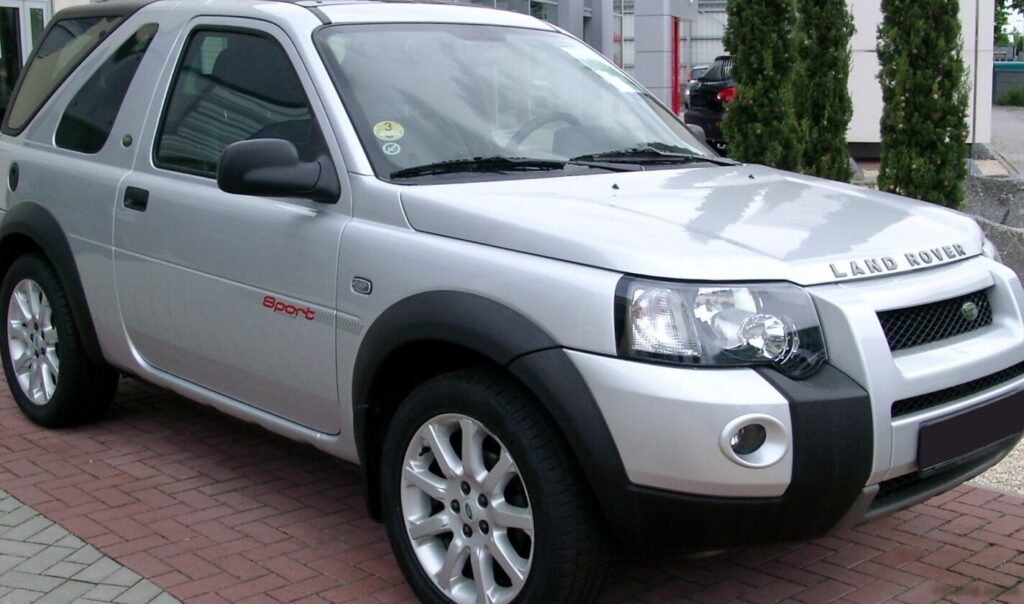
The Land Rover Freelander I Hard Top 2.5 i V6 24V, produced from 1998 to 2006, represented a significant step for Land Rover into the more accessible compact SUV market. This three-door variant, often referred to simply as the “Hard Top” due to its lack of a sunroof and fixed rear quarter windows, was designed to offer a more utilitarian and robust alternative to the five-door model. It was positioned as a practical, go-anywhere vehicle appealing to those needing a capable 4×4 without the luxury appointments of larger Land Rovers. The Freelander I series, built on the 1HX0/A3 platform, aimed to blend Land Rover’s off-road heritage with contemporary design and technology.
Technical Specifications
| Brand | Land Rover |
| Model | Freelander |
| Generation | Freelander I Hard Top |
| Type (Engine) | 2.5 i V6 24V (177 Hp) |
| Start of production | 1998 |
| End of production | 2006 |
| Powertrain Architecture | Internal Combustion engine |
| Body type | SUV |
| Seats | 5 |
| Doors | 3 |
| Fuel consumption (urban) | 17.2 l/100 km (13.7 US mpg) |
| Fuel consumption (extra urban) | 9.7 l/100 km (24.2 US mpg) |
| Fuel Type | Petrol (Gasoline) |
| Acceleration 0 – 100 km/h | 11.1 sec |
| Acceleration 0 – 62 mph | 11.1 sec |
| Acceleration 0 – 60 mph | 10.5 sec |
| Maximum speed | 182 km/h (113.09 mph) |
| Weight-to-power ratio | 8.8 kg/Hp |
| Weight-to-torque ratio | 6.5 kg/Nm |
| Power | 177 Hp @ 6500 rpm |
| Power per litre | 70.9 Hp/l |
| Torque | 240 Nm @ 4000 rpm (177.01 lb.-ft. @ 4000 rpm) |
| Engine layout | Front, Transverse |
| Engine Model/Code | 25K4F |
| Engine displacement | 2497 cm3 (152.38 cu. in.) |
| Number of cylinders | 6 |
| Engine configuration | V-engine |
| Cylinder Bore | 80 mm (3.15 in.) |
| Piston Stroke | 82.8 mm (3.26 in.) |
| Compression ratio | 10.5:1 |
| Number of valves per cylinder | 4 |
| Fuel injection system | Multi-port manifold injection |
| Engine aspiration | Naturally aspirated engine |
| Valvetrain | DOHC |
| Engine oil capacity | 5.2 l (5.49 US qt | 4.58 UK qt) |
| Kerb Weight | 1550 kg (3417.17 lbs.) |
| Max. weight | 2060 kg (4541.52 lbs.) |
| Max load | 510 kg (1124.36 lbs.) |
| Trunk (boot) space – minimum | 311 l (10.98 cu. ft.) |
| Trunk (boot) space – maximum | 1194 l (42.17 cu. ft.) |
| Fuel tank capacity | 60 l (15.85 US gal | 13.2 UK gal) |
| Length | 4433 mm (174.53 in.) |
| Width | 1809 mm (71.22 in.) |
| Height | 1709 mm (67.28 in.) |
| Wheelbase | 2557 mm (100.67 in.) |
| Front track | 1534 mm (60.39 in.) |
| Rear (Back) track | 1545 mm (60.83 in.) |
| Drive wheel | All wheel drive (4×4) |
| Number of gears and type of gearbox | 4 gears, automatic transmission |
| Front suspension | Coil spring |
| Rear suspension | Coil spring |
| Front brakes | Ventilated discs |
| Rear brakes | Disc |
| Assisting systems | ABS (Anti-lock braking system) |
| Steering type | Steering rack and pinion |
| Power steering | Hydraulic Steering |
| Tires size | 215/65 R16 |
Powertrain & Engine Architecture
The heart of the Freelander I Hard Top 2.5 i V6 was the 25K4F engine, a 2.5-liter naturally aspirated V6. This engine, a product of Rover’s K-series family, featured a 60-degree V-angle and a DOHC (Dual Overhead Camshaft) valvetrain with four valves per cylinder. It utilized a multi-port fuel injection system, delivering fuel directly into the intake ports. The 24-valve configuration contributed to a respectable 177 horsepower at 6500 rpm and 240 Nm (177 lb-ft) of torque at 4000 rpm. The engine’s transverse mounting within the engine bay, coupled with the automatic transmission, contributed to a compact powertrain layout. The automatic transmission was a Jatco unit, a four-speed automatic known for its relative smoothness but not particularly for its efficiency or sportiness.
Driving Characteristics
The 2.5-liter V6 with the four-speed automatic transmission provided adequate, but not exhilarating, performance. Acceleration from 0-60 mph took around 10.5 seconds, and top speed was approximately 113 mph. The automatic transmission, while convenient, resulted in some power loss compared to the available five-speed manual. Gear ratios were tuned for everyday usability rather than outright performance. The engine delivered a relatively smooth power delivery, making it suitable for both on-road cruising and moderate off-road excursions. However, the automatic transmission could feel somewhat sluggish when attempting quicker overtaking maneuvers. Compared to the later 2.0-liter four-cylinder models, the V6 offered significantly more power and refinement, but at the cost of increased fuel consumption.
Equipment & Trim Levels
The Hard Top variant generally occupied a mid-range position within the Freelander I lineup. Standard equipment typically included air conditioning, power steering, ABS brakes, and a basic audio system. Interior upholstery was usually cloth, with a durable and practical design. Optional extras included leather upholstery, heated front seats, a sunroof (though less common on the Hard Top), and upgraded audio systems. The three-door configuration meant rear passenger access was less convenient than the five-door model, and rear seat space was somewhat limited. The Hard Top’s interior was generally functional and well-built, reflecting Land Rover’s commitment to quality, though it lacked some of the more luxurious touches found in higher-end SUVs.
Chassis & Braking
The Freelander I Hard Top utilized a monocoque chassis construction, providing a good balance of strength and weight. Suspension consisted of coil springs all around, offering a comfortable ride on paved roads while maintaining reasonable off-road capability. Front brakes were ventilated discs, providing ample stopping power, while rear brakes were solid discs. The vehicle’s all-wheel-drive system, featuring electronic traction control, enhanced its off-road performance. Stabilizer bars were fitted front and rear to reduce body roll during cornering. The Hard Top’s relatively compact size and shorter wheelbase contributed to its maneuverability in tight spaces.
Market Reception & Comparison
The Freelander I Hard Top received mixed reviews. Critics praised its off-road capability, robust construction, and distinctive styling. However, the 2.5-liter V6 engine was often criticized for its relatively high fuel consumption – around 17.2 l/100km (13.7 US mpg) in urban driving. Compared to the 2.0-liter four-cylinder models, the V6 offered superior performance but significantly lower fuel economy. The automatic transmission was also seen as a compromise, lacking the responsiveness of the manual gearbox. Despite these criticisms, the Hard Top proved popular with buyers seeking a practical and capable 4×4 that could handle both on-road and off-road conditions.
Legacy
The Land Rover Freelander I Hard Top 2.5 i V6, while not without its flaws, remains a popular choice among enthusiasts and those seeking a classic British 4×4. The 25K4F engine, while known for potential head gasket issues if not properly maintained, is generally considered reliable when serviced regularly. Today, well-maintained examples command reasonable prices in the used car market. The Hard Top’s rugged construction and capable all-wheel-drive system ensure its continued appeal to those seeking a versatile and durable vehicle. It represents a pivotal moment in Land Rover’s history, marking its entry into a more accessible segment of the SUV market.