
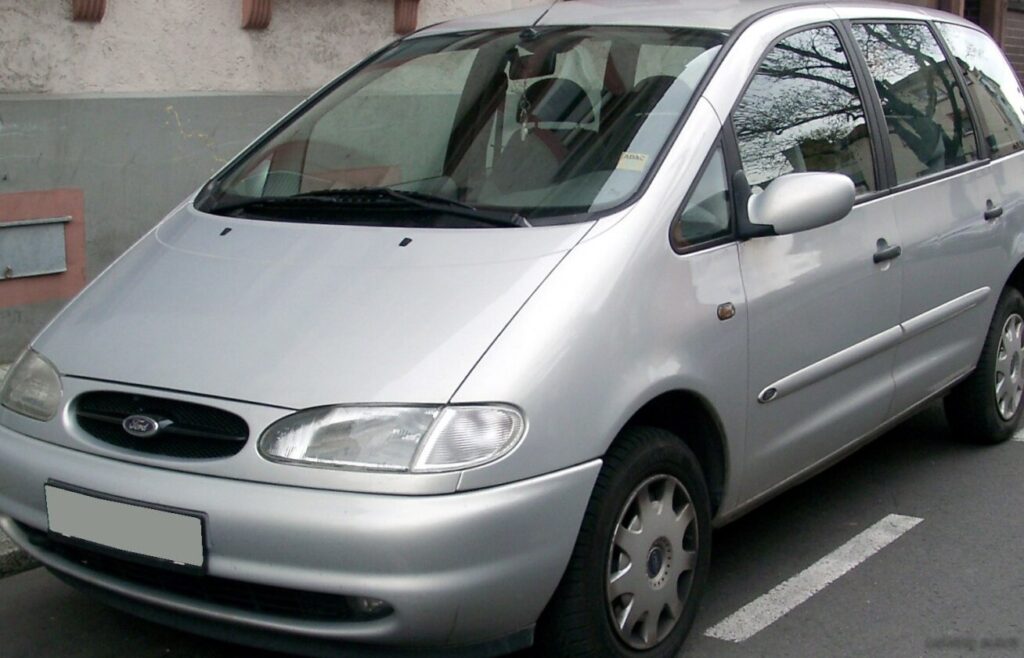
The Ford Galaxy I 2.3 16V, produced from 1997 to 2006, represents a significant entry in Ford’s foray into the European minivan market. Developed in collaboration with Volkswagen (sharing a platform with the VW Sharan and SEAT Alhambra), the Galaxy aimed to provide a spacious, comfortable, and practical vehicle for families. This particular variant, powered by a 2.3-liter 16-valve gasoline engine producing 145 horsepower, occupied a mid-range position within the Galaxy lineup, offering a balance between performance and affordability. It was a key model for Ford in Europe, competing with established players like the Renault Espace and Citroën Evasion.
Technical Specifications
| Brand | Ford |
| Model | Galaxy |
| Generation | Galaxy I |
| Type (Engine) | 2.3 16V (145 Hp) |
| Start of production | 1997 |
| End of production | 2006 |
| Powertrain Architecture | Internal Combustion engine |
| Body type | Minivan |
| Seats | 7 |
| Doors | 5 |
| Fuel consumption (urban) | 14 l/100 km (16.8 US mpg, 20.2 UK mpg, 7.1 km/l) |
| Fuel consumption (extra urban) | 7.8 l/100 km (30.2 US mpg, 36.2 UK mpg, 12.8 km/l) |
| Fuel consumption (combined) | 10.1 l/100 km (23.3 US mpg, 28 UK mpg, 9.9 km/l) |
| Fuel Type | Petrol (Gasoline) |
| Acceleration 0 – 100 km/h | 12.7 sec |
| Acceleration 0 – 62 mph | 12.7 sec |
| Acceleration 0 – 60 mph | 12.1 sec |
| Maximum speed | 191 km/h (118.68 mph) |
| Weight-to-power ratio | 11.1 kg/Hp, 90.1 Hp/tonne |
| Weight-to-torque ratio | 7.9 kg/Nm, 126.1 Nm/tonne |
| Power | 145 Hp @ 5500 rpm |
| Power per litre | 63.2 Hp/l |
| Torque | 203 Nm @ 2500 rpm (149.73 lb.-ft. @ 2500 rpm) |
| Engine layout | Front, Transverse |
| Engine Model/Code | E5SA, Y5B |
| Engine displacement | 2295 cm3 (140.05 cu. in.) |
| Number of cylinders | 4 |
| Engine configuration | Inline |
| Cylinder Bore | 89.6 mm (3.53 in.) |
| Piston Stroke | 91 mm (3.58 in.) |
| Compression ratio | 10:1 |
| Number of valves per cylinder | 4 |
| Fuel injection system | Multi-port manifold injection |
| Engine aspiration | Naturally aspirated engine |
| Engine oil capacity | 4 l (4.23 US qt | 3.52 UK qt) |
| Coolant | 8.6 l (9.09 US qt | 7.57 UK qt) |
| Kerb Weight | 1610 kg (3549.44 lbs.) |
| Max. weight | 2420 kg (5335.19 lbs.) |
| Max load | 810 kg (1785.74 lbs.) |
| Trunk (boot) space – minimum | 330 l (11.65 cu. ft.) |
| Trunk (boot) space – maximum | 2600 l (91.82 cu. ft.) |
| Fuel tank capacity | 70 l (18.49 US gal | 15.4 UK gal) |
| Length | 4641 mm (182.72 in.) |
| Width | 1810 mm (71.26 in.) |
| Height | 1732 mm (68.19 in.) |
| Wheelbase | 2835 mm (111.61 in.) |
| Front track | 1532 mm (60.31 in.) |
| Rear (Back) track | 1518 mm (59.76 in.) |
| Drivetrain Architecture | The Internal combustion engine (ICE) drives the front wheels of the vehicle. |
| Drive wheel | Front wheel drive |
| Number of gears and type of gearbox | 5 gears, manual transmission |
| Front suspension | Wishbone |
| Rear suspension | Coil spring |
| Front brakes | Disc |
| Rear brakes | Disc |
| Assisting systems | ABS (Anti-lock braking system) |
| Steering type | Steering rack and pinion |
| Power steering | Hydraulic Steering |
| Tires size | 215/65 R16 |
INTRODUCTION
The first-generation Ford Galaxy, launched in 1995, was a pivotal model for Ford, marking its serious commitment to the multi-purpose vehicle (MPV) segment. Built under the ‘Project Galaxy’ collaboration with Volkswagen, the Galaxy shared its underpinnings with the VW Sharan and SEAT Alhambra. The 2.3 16V variant, introduced shortly after the initial launch, offered a step up in performance from the base 1.9-liter engine. Positioned as a practical and family-oriented vehicle, the Galaxy I aimed to provide a spacious interior, flexible seating arrangements, and a comfortable driving experience. This model ran until 2006, when it was replaced by the second-generation Galaxy.
Powertrain & Engine Architecture
The heart of the Galaxy I 2.3 16V is the Ford E5SA or Y5B engine, a 2.3-liter inline-four cylinder gasoline engine. This engine utilizes a multi-port fuel injection system, delivering fuel directly into the intake ports just before the intake valves. The 16-valve cylinder head, with four valves per cylinder, enhances breathing and contributes to the engine’s power output. The engine’s architecture is relatively simple and robust, contributing to its overall reliability. The 2.3-liter engine produces 145 horsepower at 5500 rpm and 203 Nm (149.73 lb-ft) of torque at 2500 rpm. The Galaxy 2.3 16V was typically paired with a five-speed manual transmission, although a four-speed automatic transmission was also available, albeit less common. The automatic transmission, while offering convenience, did impact acceleration and fuel economy compared to the manual version.
Driving Characteristics
The Galaxy I 2.3 16V offered a reasonably refined driving experience for a minivan of its era. The 145 hp engine provided adequate power for everyday driving and highway cruising, although it wasn’t particularly sporty. Acceleration from 0 to 60 mph took around 12.1 seconds, and the top speed was approximately 118.68 mph. The five-speed manual transmission allowed drivers to keep the engine in its optimal power band, while the optional automatic transmission provided smoother gear changes but at the expense of responsiveness. The Galaxy’s relatively long wheelbase and soft suspension setup prioritized ride comfort over sharp handling. Compared to the lower-powered 1.9-liter version, the 2.3 16V offered noticeably improved acceleration and felt less strained when fully loaded with passengers and luggage. However, it didn’t match the performance of the more expensive and less common VR6-powered variants available in some markets.
Equipment & Trim Levels
The Galaxy I 2.3 16V was generally well-equipped for its time, offering a range of features designed to enhance comfort and convenience. Standard equipment typically included power steering, central locking, electric front windows, and an adjustable steering column. Higher trim levels added features such as air conditioning, alloy wheels, a radio/cassette player, and upgraded interior trim. The interior was designed with practicality in mind, featuring durable materials and a flexible seating configuration. The rear seats could be folded flat or removed entirely to create a large cargo area. Optional extras included a sunroof, rear parking sensors, and upgraded audio systems.
Chassis & Braking
The Galaxy I utilized a front-wheel-drive layout with an independent wishbone suspension at the front and a coil spring suspension at the rear. This setup provided a comfortable ride and decent handling characteristics. The braking system consisted of disc brakes on all four wheels, providing adequate stopping power. An Anti-lock Braking System (ABS) was standard equipment, enhancing safety by preventing wheel lockup during hard braking. The Galaxy’s chassis was designed to accommodate the vehicle’s spacious interior and flexible seating arrangements, resulting in a relatively high center of gravity. Stabilizer bars were fitted to both the front and rear axles to reduce body roll during cornering.
Market Reception & Comparison
The Ford Galaxy I 2.3 16V was generally well-received by automotive critics and consumers alike. It was praised for its spacious interior, comfortable ride, and practical features. However, some critics noted that the engine could feel underpowered when the vehicle was fully loaded. Compared to the base 1.9-liter version, the 2.3 16V offered a significant improvement in performance, making it a more appealing option for drivers who frequently carried passengers or luggage. Fuel economy was reasonable for a vehicle of its size and type, averaging around 23.3 US mpg in combined driving. The Galaxy competed directly with other MPVs such as the Renault Espace, Citroën Evasion, and Opel Zafira. It offered a compelling alternative to these models, particularly for buyers who valued practicality and affordability.
Legacy
The Ford Galaxy I 2.3 16V has proven to be a relatively reliable vehicle over the long term, with many examples still on the road today. The 2.3-liter engine is known for its durability and relatively simple maintenance requirements. However, like any older vehicle, Galaxies of this era can be prone to age-related issues such as corrosion and wear and tear on suspension components. In the used car market, the Galaxy I 2.3 16V represents a good value proposition for buyers seeking a spacious and practical family vehicle. While it may not offer the latest technology or features, it remains a capable and comfortable MPV that is well-suited for everyday use. The collaborative design with Volkswagen proved successful, establishing the Galaxy as a significant player in the European minivan segment and paving the way for subsequent generations of the model.
