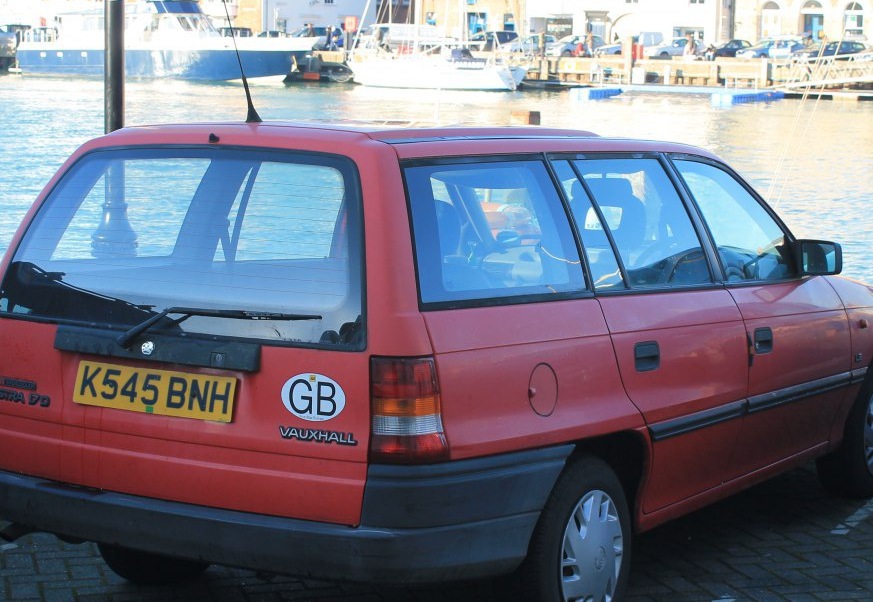
The Vauxhall Astra Mk III Estate 2.0i (116 hp) was a variant of the popular Astra Mk III, produced between 1992 and 1994. Positioned as a mid-range offering within the estate (station wagon) body style, it provided a balance between practicality, performance, and fuel economy for family buyers. This model occupied a space between the more economical 1.4 and 1.6-liter versions and the sportier, though less common, 2.0 16V variant. The Mk III Astra, based on the GM T platform (internally known as the 1HX0), represented a significant step forward in terms of design and technology compared to its predecessor, and the estate version further enhanced its appeal with increased cargo capacity.
Technical Specifications
| Brand | Vauxhall |
| Model | Astra |
| Generation | Astra Mk III Estate |
| Type (Engine) | 2.0i (116 Hp) |
| Start of production | 1992 |
| End of production | 1994 |
| Powertrain Architecture | Internal Combustion engine |
| Body type | Station wagon (estate) |
| Seats | 5 |
| Doors | 5 |
| Fuel consumption (combined) | 8 l/100 km (29.4 US mpg, 35.3 UK mpg, 12.5 km/l) |
| CO2 emissions | 190 g/km |
| Fuel Type | Petrol (Gasoline) |
| Acceleration 0 – 100 km/h | 9.5 sec |
| Acceleration 0 – 62 mph | 9.5 sec |
| Acceleration 0 – 60 mph | 9 sec |
| Maximum speed | 200 km/h (124.27 mph) |
| Weight-to-power ratio | 9.1 kg/Hp, 109.4 Hp/tonne |
| Weight-to-torque ratio | 6.3 kg/Nm, 159.4 Nm/tonne |
| Power | 116 Hp @ 5400 rpm |
| Power per litre | 58.1 Hp/l |
| Torque | 169 Nm @ 2600 rpm (124.65 lb.-ft. @ 2600 rpm) |
| Engine layout | Front, Transverse |
| Engine Model/Code | C20NE |
| Engine displacement | 1998 cm3 (121.93 cu. in.) |
| Number of cylinders | 4 |
| Engine configuration | Inline |
| Fuel injection system | Multi-port manifold injection |
| Engine aspiration | Naturally aspirated engine |
| Engine oil capacity | 4 l (4.23 US qt | 3.52 UK qt) |
| Coolant | 6.5 l (6.87 US qt | 5.72 UK qt) |
| Kerb Weight | 1060 kg (2336.9 lbs.) |
| Max. weight | 1555 kg (3428.19 lbs.) |
| Max load | 495 kg (1091.29 lbs.) |
| Trunk (boot) space – minimum | 500 l (17.66 cu. ft.) |
| Fuel tank capacity | 50 l (13.21 US gal | 11 UK gal) |
| Length | 4280 mm (168.5 in.) |
| Width | 1688 mm (66.46 in.) |
| Height | 1481 mm (58.31 in.) |
| Wheelbase | 2520 mm (99.21 in.) |
| Drivetrain Architecture | The Internal combustion engine (ICE) drives the front wheels of the vehicle. |
| Drive wheel | Front wheel drive |
| Number of gears and type of gearbox | 5 gears, manual transmission |
| Front brakes | Ventilated discs |
| Rear brakes | Disc |
| Tires size | 185/60 R14 |
| Wheel rims size | 14 |
Powertrain & Engine Architecture
The heart of the Astra Mk III Estate 2.0i was the C20NE engine, a 1998cc inline-four cylinder petrol engine. This engine was a mainstay of Vauxhall/Opel’s mid-range offerings during the early 1990s. It featured a cast iron block and an aluminum cylinder head, employing multi-port fuel injection for improved efficiency and power delivery. The C20NE utilized a single overhead camshaft (SOHC) valvetrain, operating two valves per cylinder. The engine’s 116 horsepower output at 5400 rpm and 169 Nm (124.65 lb-ft) of torque at 2600 rpm provided adequate performance for typical family motoring. The engine was paired with a five-speed manual transmission, which was the most common configuration. While an automatic transmission was available on some Astra Mk III models, it was less frequently paired with the 2.0i engine due to the potential for reduced fuel economy and performance.
Driving Characteristics
The 2.0i Estate offered a noticeable step up in performance compared to the lower-displacement Astra variants. Acceleration to 60 mph in around 9 seconds was respectable for the time, and the engine provided sufficient power for overtaking maneuvers and carrying a full load. The five-speed manual transmission allowed drivers to keep the engine in its optimal power band, resulting in a more responsive driving experience. Compared to the 1.6-liter models, the 2.0i felt more relaxed at highway speeds, with less need for frequent gear changes. However, it wasn’t a particularly sporty car; the focus was on providing comfortable and practical transportation. The suspension, while adequate, was tuned for comfort rather than handling precision.
Equipment & Trim Levels
The 2.0i Estate typically came with a reasonable level of standard equipment. This included central locking, power steering, and an adjustable steering column. Interior upholstery was generally cloth, with options for upgraded materials available. Dashboard configuration was fairly standard for the era, with analog gauges for speed, tachometer, fuel level, and coolant temperature. Optional extras included electric windows, a sunroof, and an upgraded stereo system. The trim level often dictated the availability of these options, with higher trims offering more features as standard.
Chassis & Braking
The Astra Mk III Estate utilized a MacPherson strut front suspension and a torsion beam rear suspension. This setup provided a good balance between ride comfort and handling. The 2.0i models typically featured ventilated disc brakes on the front wheels and disc brakes on the rear, providing adequate stopping power. Stabilizer bars were fitted to both the front and rear axles to reduce body roll during cornering. The 185/60 R14 tires offered a reasonable level of grip in most conditions.
Market Reception & Comparison
The Astra Mk III Estate 2.0i was generally well-received by automotive critics as a practical and reliable family car. It offered a good compromise between performance, fuel economy, and space. Compared to the 1.6-liter models, the 2.0i provided a noticeable performance boost, while remaining relatively affordable to run. However, it wasn’t as fuel-efficient as the smaller-engined variants, and the higher-performance 2.0 16V models offered a more engaging driving experience. The 2.0i was often seen as a sensible choice for buyers who needed a spacious and reliable estate car without the expense of a more powerful or luxurious model.
Legacy
The C20NE engine, found in the Astra Mk III 2.0i, is known for its durability and relative simplicity. With proper maintenance, these engines can reliably reach high mileages. Today, the Astra Mk III Estate 2.0i is becoming increasingly sought after by classic car enthusiasts, particularly those looking for a practical and affordable classic. Parts availability is generally good, and the car’s relatively simple mechanicals make it a relatively easy vehicle to maintain and repair. While not a particularly rare or valuable classic, the 2.0i Estate represents a solid and dependable example of 1990s family motoring.