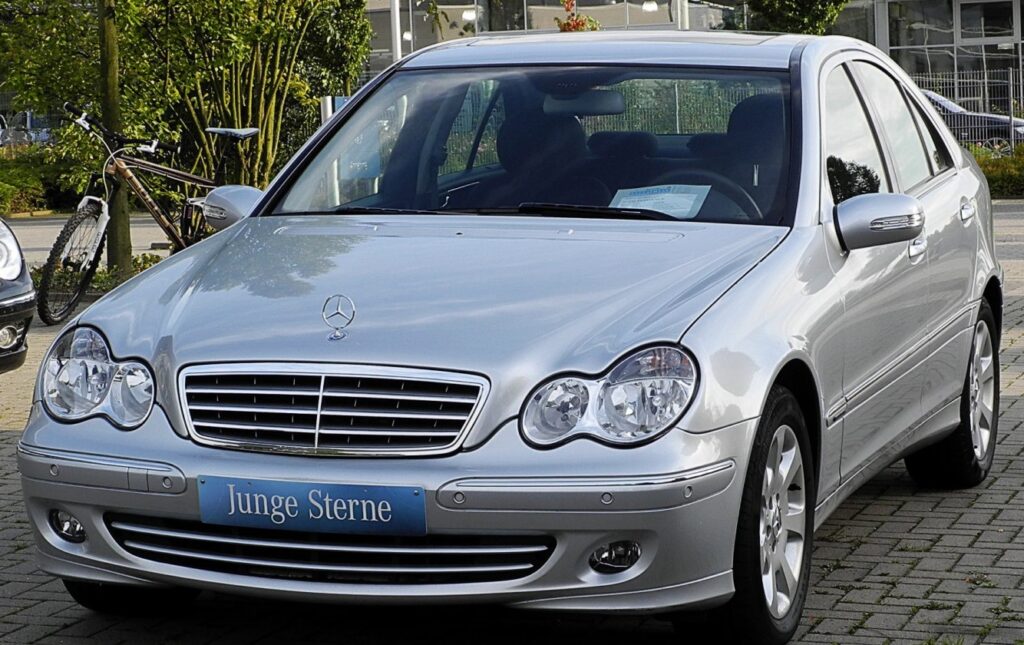
The Mercedes-Benz C 320 CDI, produced from March 2005 to February 2007, was a variant of the W203 C-Class sedan following the 2004 facelift. Positioned as a premium offering within the C-Class range, it combined a powerful diesel engine with a sophisticated automatic transmission. This model aimed to deliver a blend of performance, refinement, and fuel efficiency, appealing to buyers seeking a luxury sedan with strong torque and long-distance comfort. It was a key part of Mercedes-Benz’s strategy to offer compelling diesel options in the North American and European markets, where diesel passenger cars were increasingly popular.
Technical Specifications
| Brand | Mercedes-Benz |
| Model | C-class |
| Generation | C-class (W203, facelift 2004) |
| Type (Engine) | C 320 CDI V6 (224 Hp) 7G-TRONIC |
| Start of production | March, 2005 |
| End of production | February, 2007 |
| Powertrain Architecture | Internal Combustion engine |
| Body type | Sedan |
| Seats | 5 |
| Doors | 4 |
| Fuel consumption (economy) – urban (NEDC) | 10.1-10.5 l/100 km (23.3 – 22.4 US mpg, 28 – 26.9 UK mpg, 9.9 – 9.5 km/l) |
| Fuel consumption (economy) – extra urban (NEDC) | 5.7-5.9 l/100 km (41.3 – 39.9 US mpg, 49.6 – 47.9 UK mpg, 17.5 – 16.9 km/l) |
| Fuel consumption (economy) – combined (NEDC) | 7.3-7.6 l/100 km (32.2 – 30.9 US mpg, 38.7 – 37.2 UK mpg, 13.7 – 13.2 km/l) |
| CO2 emissions (NEDC) | 192-201 g/km |
| Fuel Type | Diesel |
| Acceleration 0 – 100 km/h | 7.2 sec |
| Acceleration 0 – 62 mph | 7.2 sec |
| Acceleration 0 – 60 mph | 6.8 sec |
| Maximum speed | 250 km/h (155.34 mph), Electronically limited |
| Emission standard | Euro 4 |
| Weight-to-power ratio | 7 kg/Hp, 142.2 Hp/tonne |
| Weight-to-torque ratio | 3.1 kg/Nm, 323.8 Nm/tonne |
| Power | 224 Hp @ 3800 rpm |
| Power per litre | 75 Hp/l |
| Torque | 510 Nm @ 1600-2800 rpm (376.16 lb.-ft. @ 1600-2800 rpm) |
| Engine layout | Front, Longitudinal |
| Engine Model/Code | OM 642.910 |
| Engine displacement | 2987 cm3 (182.28 cu. in.) |
| Number of cylinders | 6 |
| Engine configuration | V-engine |
| Cylinder Bore | 83 mm (3.27 in.) |
| Piston Stroke | 92 mm (3.62 in.) |
| Compression ratio | 17.7:1 |
| Number of valves per cylinder | 4 |
| Fuel injection system | Diesel Commonrail |
| Engine aspiration | Turbocharger, Intercooler |
| Valvetrain | SOHC |
| Engine oil capacity | 8.5 l (8.98 US qt | 7.48 UK qt) |
| Coolant | 7.6 l (8.03 US qt | 6.69 UK qt) |
| Kerb Weight | 1575 kg (3472.28 lbs.) |
| Max. weight | 2110 kg (4651.75 lbs.) |
| Max load | 535 kg (1179.47 lbs.) |
| Trunk (boot) space – minimum | 455 l (16.07 cu. ft.) |
| Fuel tank capacity | 62 l (16.38 US gal | 13.64 UK gal) |
| Max. roof load | 100 kg (220.46 lbs.) |
| Permitted trailer load with brakes (12%) | 1500 kg (3306.93 lbs.) |
| Permitted trailer load without brakes | 750 kg (1653.47 lbs.) |
| Length | 4526 mm (178.19 in.) |
| Width | 1728 mm (68.03 in.) |
| Width including mirrors | 1980 mm (77.95 in.) |
| Height | 1426 mm (56.14 in.) |
| Wheelbase | 2715 mm (106.89 in.) |
| Front track | 1493 mm (58.78 in.) |
| Rear (Back) track | 1464 mm (57.64 in.) |
| Front overhang | 755 mm (29.72 in.) |
| Rear overhang | 1056 mm (41.57 in.) |
| Drag coefficient (Cd) | 0.27 |
| Minimum turning circle (turning diameter) | 10.76 m (35.3 ft.) |
| Drivetrain Architecture | The Internal combustion engine (ICE) drives the rear wheels of the vehicle. |
| Drive wheel | Rear wheel drive |
| Number of gears and type of gearbox | 7 gears, automatic transmission |
| Front suspension | Independent type McPherson, Transverse stabilizer |
| Rear suspension | Independent multi-link suspension, Transverse stabilizer |
| Front brakes | Ventilated discs |
| Rear brakes | Disc |
| Assisting systems | ABS (Anti-lock braking system) |
| Steering type | Steering rack and pinion |
| Power steering | Hydraulic Steering |
| Tires size | Front wheel tires: 225/45 R 17Rear wheel tires: 225/45 R 17 |
| Wheel rims size | 7.5 J x 17 H 2 |
Powertrain & Engine Architecture
The C 320 CDI was powered by the OM 642.910, a 3.0-liter V6 diesel engine. This engine was a significant advancement for Mercedes-Benz, featuring common-rail direct injection and a variable geometry turbocharger. The common-rail system, operating at extremely high pressures, allowed for precise fuel metering and optimized combustion. The turbocharger, with its adjustable vanes, provided a broad torque curve and minimized turbo lag. The engine also incorporated an intercooler to further enhance performance by cooling the intake air. The engine produced 224 horsepower at 3800 rpm and a substantial 510 Nm (376 lb-ft) of torque between 1600 and 2800 rpm. This torque output was a defining characteristic of the C 320 CDI, providing effortless acceleration and strong pulling power. The engine was longitudinally mounted in the front of the vehicle, driving the rear wheels.
The engine was paired with Mercedes-Benz’s 7G-TRONIC automatic transmission, a seven-speed unit known for its smooth shifting and efficiency. This transmission offered a wide range of gear ratios, allowing the engine to operate in its optimal power band more frequently. The 7G-TRONIC also featured a manual shift mode, giving drivers more control over gear selection.
Driving Characteristics
The C 320 CDI offered a distinctly different driving experience compared to its gasoline-powered counterparts. The abundant torque meant strong acceleration from low speeds, making it ideal for everyday driving and overtaking maneuvers. While not as outright quick as the C 320 petrol variant, the diesel offered a more relaxed and effortless feel. The 7G-TRONIC transmission contributed to a smooth and refined driving experience, with seamless gear changes. The gear ratios were tuned to prioritize fuel efficiency and comfortable cruising, rather than outright performance. Compared to the manual transmission options available on other C-Class models, the automatic version prioritized convenience and ease of use.
Equipment & Trim Levels
The C 320 CDI typically came well-equipped, reflecting its position as a premium model. Standard features included leather upholstery, automatic climate control, a multi-function steering wheel, and a high-end audio system. Optional extras included a sunroof, navigation system, and upgraded wheels. The interior trim was generally finished in wood or aluminum, adding to the luxurious feel. Safety features such as ABS, traction control, and multiple airbags were standard.
Chassis & Braking
The C 320 CDI utilized a McPherson strut front suspension and a multi-link independent rear suspension. This setup provided a good balance between ride comfort and handling. The suspension was tuned to be slightly softer than the sportier C-Class variants, prioritizing comfort over aggressive handling. The braking system consisted of ventilated discs at the front and solid discs at the rear, providing adequate stopping power. ABS (Anti-lock Braking System) was standard.
Market Reception & Comparison
The C 320 CDI was generally well-received by automotive critics. It was praised for its powerful engine, smooth transmission, and comfortable ride. Fuel economy was also a strong point, with the diesel engine offering significantly better mileage than the gasoline alternatives. However, some critics noted that the diesel engine was slightly noisier than the gasoline engines. Compared to the C 320 petrol version, the CDI offered superior fuel economy and torque, but slightly less outright horsepower. Compared to the smaller C 220 CDI, the C 320 CDI provided a noticeable performance upgrade.
Legacy
The OM 642 engine family, including the OM 642.910 found in the C 320 CDI, proved to be remarkably durable and reliable. Properly maintained examples continue to provide years of service. The 7G-TRONIC transmission is also known for its longevity. In the used car market, the C 320 CDI remains a popular choice for buyers seeking a comfortable, fuel-efficient, and reliable luxury sedan. However, potential buyers should be aware of the potential maintenance costs associated with diesel engines, such as diesel particulate filter (DPF) maintenance and injector servicing.