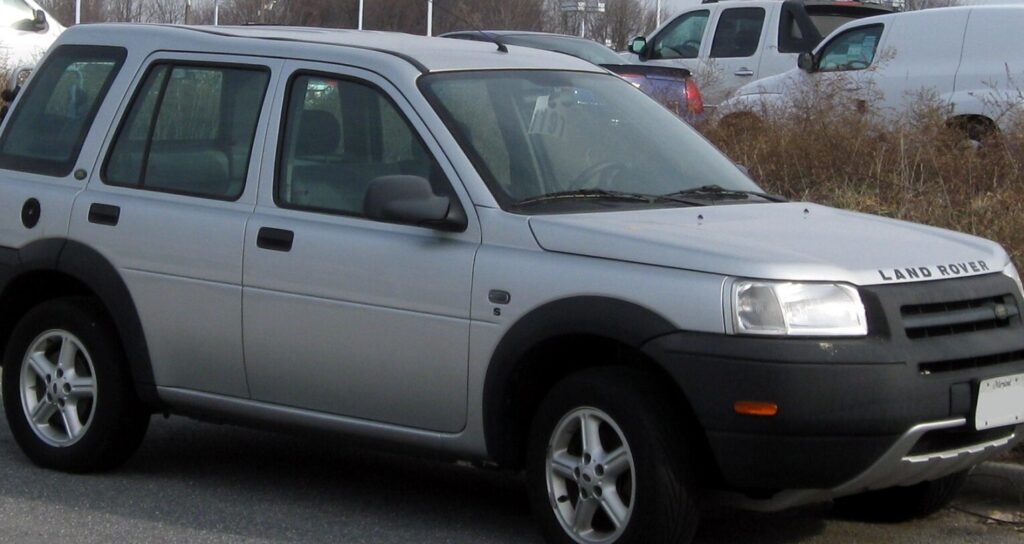
The Land Rover Freelander I, specifically the 2.0 TD4 variant with the automatic transmission, was produced between 2001 and 2006. This model represented Land Rover’s entry into the compact SUV segment, aiming to provide a more affordable and accessible option than the larger Discovery. The 2.0 TD4 Automatic occupied a middle ground within the Freelander I lineup, offering a balance between fuel efficiency, usability, and off-road capability. It was positioned below the more powerful 2.5-liter V6 models and above the base 1.8-liter petrol versions, targeting buyers who prioritized diesel economy and the convenience of an automatic gearbox.
Technical Specifications
| Brand | Land Rover |
| Model | Freelander |
| Generation | Freelander I (LN) |
| Type (Engine) | 2.0 TD4 (112 Hp) Automatic |
| Start of production | 2001 |
| End of production | 2006 |
| Powertrain Architecture | Internal Combustion engine |
| Body type | SUV |
| Seats | 5 |
| Doors | 5 |
| Fuel consumption (urban) | 11.2 l/100 km (21 US mpg, 25.2 UK mpg, 8.9 km/l) |
| Fuel consumption (extra urban) | 7.1 l/100 km (33.1 US mpg, 39.8 UK mpg, 14.1 km/l) |
| Fuel consumption (combined) | 8.6 l/100 km (27.4 US mpg, 32.8 UK mpg, 11.6 km/l) |
| Fuel Type | Diesel |
| Acceleration 0 – 100 km/h | 15.3 sec |
| Acceleration 0 – 62 mph | 15.3 sec |
| Acceleration 0 – 60 mph | 14.5 sec |
| Maximum speed | 156 km/h (96.93 mph) |
| Weight-to-power ratio | 14.7 kg/Hp, 68.1 Hp/tonne |
| Weight-to-torque ratio | 6.3 kg/Nm, 158.1 Nm/tonne |
| Power | 112 Hp @ 4000 rpm |
| Power per litre | 57.4 Hp/l |
| Torque | 260 Nm @ 1750 rpm (191.77 lb.-ft. @ 1750 rpm) |
| Engine layout | Front, Transverse |
| Engine Model/Code | 204D3 |
| Engine displacement | 1950 cm3 (119 cu. in.) |
| Number of cylinders | 4 |
| Engine configuration | Inline |
| Cylinder Bore | 84 mm (3.31 in.) |
| Piston Stroke | 88 mm (3.46 in.) |
| Compression ratio | 18:1 |
| Number of valves per cylinder | 4 |
| Fuel injection system | Diesel Commonrail |
| Engine aspiration | Turbocharger, Intercooler |
| Valvetrain | DOHC |
| Engine oil capacity | 6.8 l (7.19 US qt | 5.98 UK qt) |
| Coolant | 7.25 l (7.66 US qt | 6.38 UK qt) |
| Kerb Weight | 1645 kg (3626.6 lbs.) |
| Max. weight | 2080 kg (4585.62 lbs.) |
| Max load | 435 kg (959.01 lbs.) |
| Trunk (boot) space – minimum | 354 l (12.5 cu. ft.) |
| Trunk (boot) space – maximum | 1319 l (46.58 cu. ft.) |
| Fuel tank capacity | 60 l (15.85 US gal | 13.2 UK gal) |
| Length | 4368 mm (171.97 in.) |
| Width | 1809 mm (71.22 in.) |
| Height | 1708 mm (67.24 in.) |
| Wheelbase | 2557 mm (100.67 in.) |
| Front track | 1534 mm (60.39 in.) |
| Rear (Back) track | 1545 mm (60.83 in.) |
| Drive wheel | All wheel drive (4×4) |
| Number of gears and type of gearbox | 5 gears, automatic transmission |
| Front suspension | Coil spring |
| Rear suspension | Coil spring |
| Front brakes | Ventilated discs |
| Rear brakes | Drum |
| Assisting systems | ABS (Anti-lock braking system) |
| Steering type | Steering rack and pinion |
| Power steering | Hydraulic Steering |
| Tires size | 195/80 R15 S |
| Wheel rims size | 15 |
Powertrain & Engine Architecture
The heart of the Freelander 2.0 TD4 Automatic is the 204D3 engine, a 1.998-liter inline-four cylinder diesel. This engine, developed in collaboration with BMW (sharing similarities with their M47 series), utilizes a common rail direct injection system, delivering fuel at high pressure for improved combustion efficiency and reduced emissions. The engine is turbocharged and intercooled, boosting power output to 112 horsepower at 4000 rpm and 260 Nm (192 lb-ft) of torque at 1750 rpm. The automatic transmission is a Jatco unit, a five-speed torque converter automatic, chosen for its smoothness and ease of use. This transmission was not known for being particularly sporty, prioritizing comfort over rapid shifts.
Driving Characteristics
The 2.0 TD4 Automatic offered a comfortable, if not particularly exhilarating, driving experience. Acceleration was modest, taking around 15.3 seconds to reach 60 mph. The automatic transmission, while smooth, could feel somewhat sluggish, especially when attempting quicker overtaking maneuvers. The gear ratios were geared towards fuel economy rather than performance. Compared to the manual transmission version of the same engine, the automatic suffered a slight performance penalty due to the transmission’s inherent losses. The 2.5-liter V6 models offered significantly more power and quicker acceleration, but at the cost of considerably higher fuel consumption. The TD4’s strength lay in its usability and relaxed cruising ability, making it well-suited for everyday driving and longer journeys.
Equipment & Trim Levels
The 2.0 TD4 Automatic typically came equipped with air conditioning, power steering, electric windows, and an RDS radio. Higher trim levels, such as the ‘SE’ and ‘HSE’ variants, added features like alloy wheels, leather upholstery, climate control, and upgraded audio systems. Optional extras included a sunroof, parking sensors, and heated seats. Interior upholstery was generally cloth on the base models, with leather becoming standard on the higher-spec versions. The dashboard layout was functional and straightforward, typical of Land Rover’s design philosophy at the time.
Chassis & Braking
The Freelander I utilized a monocoque chassis construction, providing a good balance between strength and weight. Suspension consisted of coil springs all around, offering a comfortable ride quality. Front brakes were ventilated discs, providing adequate stopping power, while the rear brakes were drums, a cost-saving measure. Anti-lock Braking System (ABS) was standard. The vehicle’s all-wheel-drive system, a permanent four-wheel-drive setup, provided enhanced traction in slippery conditions, making it capable of tackling moderate off-road terrain. Stabilizer bars were fitted front and rear to reduce body roll during cornering.
Market Reception & Comparison
The Freelander 2.0 TD4 Automatic was generally well-received by critics as a practical and capable compact SUV. It was praised for its fuel efficiency, comfortable ride, and all-weather capability. However, the automatic transmission was sometimes criticized for its lack of responsiveness. Compared to rivals like the Honda CR-V and Toyota RAV4, the Freelander offered a more rugged image and superior off-road performance, but it was generally less refined and had a slightly lower reliability record. Fuel economy was competitive for its class, averaging around 27.4 US mpg in combined driving.
Legacy
The Freelander I, including the 2.0 TD4 Automatic variant, established Land Rover in the increasingly popular compact SUV market. While not without its flaws – early models were prone to electrical issues and cooling system problems – the 204D3 engine proved to be relatively durable when properly maintained. Today, the Freelander I represents an affordable entry point into Land Rover ownership. The 2.0 TD4 Automatic models are sought after by those looking for a comfortable and economical SUV with genuine off-road capability. However, potential buyers should be aware of the potential for age-related issues and ensure a thorough inspection before purchase, paying particular attention to the cooling system and electrical components.