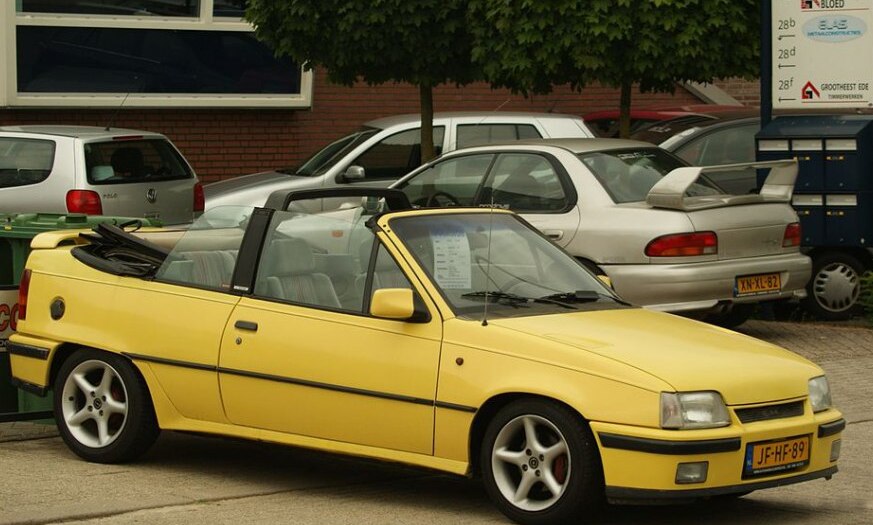
The Opel Kadett E Cabrio 1.6i, producing 82 horsepower, was a short-lived but significant variant of the Kadett E Cabriolet range. Produced between 1992 and 1993, it represented an entry-level offering in the convertible lineup, positioned below the more powerful 2.0-liter versions. The Kadett E itself was a popular compact car in Europe, and the Cabriolet version, introduced in 1986, aimed to provide affordable open-top motoring. This particular 1.6i model was designed to broaden the Cabriolet’s appeal to buyers seeking a more economical and accessible option. It was built on the T-Platform (1HX0/A3) shared with other GM vehicles of the era, including the Astra and Vectra.
Technical Specifications
| Brand | Opel |
| Model | Kadett |
| Generation | Kadett E Cabrio |
| Type (Engine) | 1.6i (82 Hp) |
| Start of production | 1992 |
| End of production | 1993 |
| Powertrain Architecture | Internal Combustion engine |
| Body type | Cabriolet |
| Seats | 5 |
| Doors | 2 |
| Fuel Type | Petrol (Gasoline) |
| Acceleration 0 – 100 km/h | 13 sec |
| Acceleration 0 – 62 mph | 13 sec |
| Acceleration 0 – 60 mph | 12.4 sec |
| Maximum speed | 172 km/h (106.88 mph) |
| Weight-to-power ratio | 12.1 kg/Hp, 82.4 Hp/tonne |
| Weight-to-torque ratio | 7.7 kg/Nm, 130.7 Nm/tonne |
| Power | 82 Hp @ 5400 rpm |
| Power per litre | 51.3 Hp/l |
| Torque | 130 Nm @ 2600 rpm (95.88 lb.-ft. @ 2600 rpm) |
| Engine layout | Front, Transverse |
| Engine Model/Code | 16SV |
| Engine displacement | 1598 cm3 (97.52 cu. in.) |
| Number of cylinders | 4 |
| Engine configuration | Inline |
| Cylinder Bore | 80 mm (3.15 in.) |
| Piston Stroke | 79.5 mm (3.13 in.) |
| Compression ratio | 10:1 |
| Number of valves per cylinder | 2 |
| Fuel injection system | Carburettor |
| Engine aspiration | Naturally aspirated engine |
| Valvetrain | SOHC |
| Engine oil capacity | 3.5 l (3.7 US qt | 3.08 UK qt) |
| Coolant | 6.4 l (6.76 US qt | 5.63 UK qt) |
| Kerb Weight | 995 kg (2193.6 lbs) |
| Max. weight | 1405 kg (3097.49 lbs) |
| Max load | 410 kg (903.9 lbs) |
| Trunk (boot) space – minimum | 290 l (10.24 cu. ft.) |
| Trunk (boot) space – maximum | 620 l (21.9 cu. ft.) |
| Fuel tank capacity | 52 l (13.74 US gal | 11.44 UK gal) |
| Length | 3998 mm (157.4 in.) |
| Width | 1663 mm (65.47 in.) |
| Height | 1385 mm (54.53 in.) |
| Wheelbase | 2520 mm (99.21 in.) |
| Front track | 1406 mm (55.35 in.) |
| Rear (Back) track | 1406 mm (55.35 in.) |
| Minimum turning circle | 10.5 m (34.45 ft.) |
| Drivetrain Architecture | The Internal combustion engine (ICE) drives the front wheels of the vehicle. |
| Drive wheel | Front wheel drive |
| Number of gears and type of gearbox | 5 gears, manual transmission |
| Front brakes | Disc |
| Rear brakes | Drum |
| Tires size | 175/70 R13 |
| Wheel rims size | 13 |
Powertrain & Engine Architecture
The heart of the Kadett E Cabrio 1.6i was the 16SV engine, a 1.6-liter inline-four cylinder unit. This engine, part of Opel’s family of SOHC (Single Overhead Camshaft) engines, utilized a two-valve-per-cylinder configuration. Unlike later Kadett E models that adopted fuel injection, the 1.6i retained a carburetor for fuel delivery, a cost-saving measure for the entry-level trim. This carburetor setup, while simpler, resulted in slightly lower performance and fuel efficiency compared to injected counterparts. The engine produced 82 horsepower at 5400 rpm and 130 Nm (95.88 lb-ft) of torque at 2600 rpm. The engine’s relatively low compression ratio of 10:1 was typical for the era and allowed it to run on lower octane fuel. The engine was transversely mounted, driving the front wheels.
Driving Characteristics
The 1.6i Cabriolet offered a relaxed driving experience. Acceleration was modest, taking around 13 seconds to reach 60 mph, making it noticeably slower than the 2.0-liter versions. The five-speed manual transmission was standard, and the gear ratios were tuned for fuel economy rather than outright performance. The carburetor’s response wasn’t as crisp as fuel injection, requiring a bit more throttle input for quick acceleration. However, the engine was reasonably smooth and provided adequate power for everyday driving. The front-wheel-drive configuration offered predictable handling, although it wasn’t particularly sporty. The relatively light weight of the car (around 995 kg or 2193.6 lbs) helped to mitigate the engine’s power deficit.
Equipment & Trim Levels
The 1.6i Cabriolet was generally equipped with basic features. Standard equipment typically included cloth upholstery, a simple dashboard layout, and manual windows and door locks. Power steering was often an optional extra. The interior was functional and durable, prioritizing practicality over luxury. Optional extras could include upgraded audio systems, alloy wheels, and a more refined interior trim. The trim level was generally considered the base model for the Cabriolet range, appealing to buyers who prioritized affordability and open-top motoring over performance and luxury.
Chassis & Braking
The Kadett E Cabriolet utilized a MacPherson strut front suspension and a torsion beam rear suspension. The front suspension provided decent handling and ride comfort, while the torsion beam rear setup was a cost-effective solution. Braking was handled by disc brakes at the front and drum brakes at the rear. The braking system was adequate for the car’s weight and performance, but it lacked the stopping power of the larger-braked 2.0-liter models. Stabilizer bars were typically fitted to both the front and rear axles to reduce body roll during cornering.
Market Reception & Comparison
The Kadett E Cabrio 1.6i was generally well-received as an affordable entry point into the convertible market. Critics acknowledged its modest performance but praised its value for money and enjoyable open-top driving experience. Compared to the 2.0-liter versions, the 1.6i offered significantly lower running costs, making it attractive to budget-conscious buyers. However, the carburetor-equipped engine was seen as a drawback by some, as it offered less refinement and fuel efficiency than fuel-injected alternatives. The 1.9 TDI diesel Cabriolet, while not directly comparable in terms of driving experience, offered even better fuel economy but lacked the 1.6i’s free-revving nature.
Legacy
The Kadett E Cabrio 1.6i, despite its short production run, remains a popular choice among classic car enthusiasts. The 16SV engine is known for its relative reliability, although carburetor maintenance is required. Parts availability is generally good, as many components are shared with other Opel/Vauxhall models of the era. Today, these cars are often sought after as affordable and stylish classic convertibles. While not a performance icon, the 1.6i Cabriolet represents a charming and accessible entry point into the world of classic open-top motoring, offering a nostalgic driving experience and a connection to a bygone era of automotive design.