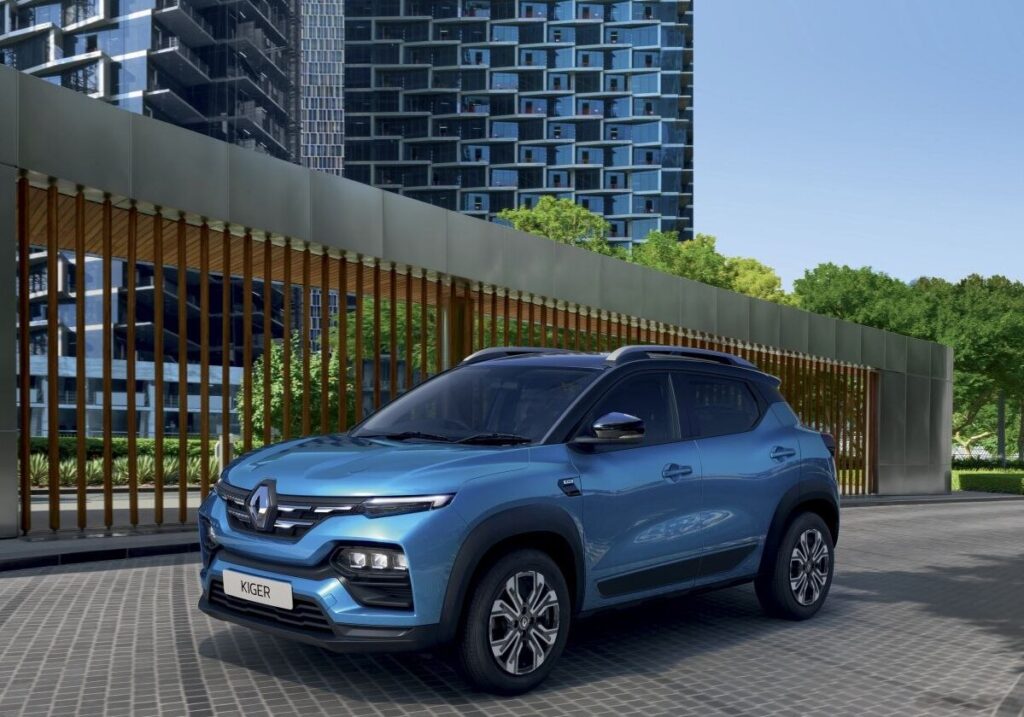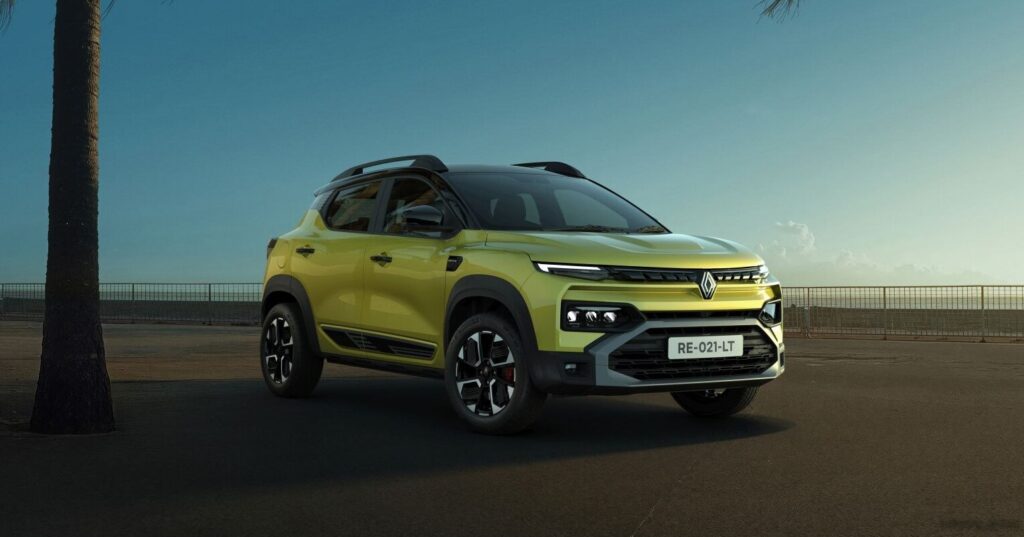
The Renault Kiger (facelift 2025) 1.0, producing 72 horsepower, represents the entry point into the Kiger crossover SUV range. Introduced in August 2025, this variant is designed for the price-conscious consumer seeking an affordable and fuel-efficient vehicle within the subcompact SUV segment. The Kiger itself is a product of Renault’s expansion into the rapidly growing Indian market, and subsequently, other emerging economies. The 2025 facelift brings styling updates and minor technological enhancements to the original Kiger, which debuted in 2021. This 1.0-liter engine option is positioned below the more powerful turbocharged variants, offering a balance between cost and practicality.
Technical Specifications
| Brand | Renault |
| Model | Kiger |
| Generation | Kiger (facelift 2025) |
| Type (Engine) | 1.0 (72 Hp) |
| Start of production | August, 2025 |
| Powertrain Architecture | Internal Combustion engine |
| Body type | SUV, Crossover |
| Seats | 5 |
| Doors | 5 |
| Fuel Type | Petrol (Gasoline) |
| Power | 72 Hp @ 6250 rpm |
| Power per litre | 72.1 Hp/l |
| Torque | 96 Nm @ 3400-3600 rpm / 70.81 lb.-ft. @ 3400-3600 rpm |
| Engine layout | Front, Transverse |
| Engine displacement | 999 cm3 / 60.96 cu. in. |
| Number of cylinders | 3 |
| Engine configuration | Inline |
| Cylinder Bore | 71 mm / 2.8 in. |
| Piston Stroke | 84 mm / 3.31 in. |
| Number of valves per cylinder | 4 |
| Fuel injection system | Multi-port manifold injection |
| Engine aspiration | Naturally aspirated engine |
| Valvetrain | DOHC |
| Trunk (boot) space – minimum | 405 l / 14.3 cu. ft. |
| Fuel tank capacity | 40 l / 10.57 US gal | 8.8 UK gal |
| Max. roof load | 50 kg / 110.23 lbs. |
| Length | 3990 mm / 157.09 in. |
| Width | 1750 mm / 68.9 in. |
| Width including mirrors | 1912 mm / 75.28 in. |
| Height | 1605 mm / 63.19 in. |
| Wheelbase | 2500 mm / 98.43 in. |
| Front track | 1536 mm / 60.47 in. |
| Rear (Back) track | 1535 mm / 60.43 in. |
| Front overhang | 806 mm / 31.73 in. |
| Rear overhang | 684 mm / 26.93 in. |
| Ride height (ground clearance) | 205 mm / 8.07 in. |
| Minimum turning circle (turning diameter) | 10.5 m / 34.45 ft. |
| Drivetrain Architecture | The Internal combustion engine (ICE) drives the front wheels of the vehicle. |
| Drive wheel | Front wheel drive |
| Number of gears and type of gearbox | 5 gears, manual transmission |
| Front suspension | Independent, type McPherson with coil spring and anti-roll bar |
| Rear suspension | Semi-independent, coil spring, Elastic beam |
| Front brakes | Disc |
| Rear brakes | Drum |
| Assisting systems | ABS (Anti-lock braking system) |
| Steering type | Steering rack and pinion |
| Power steering | Electric Steering |
| Tires size | 195/60 R16 |
| Wheel rims size | 16 |
Powertrain & Engine Architecture
The Renault Kiger 1.0 utilizes a naturally aspirated 999cc inline-three cylinder engine. This engine, internally designated as the B4D, is a relatively simple design, employing a multi-point fuel injection system and a double overhead camshaft (DOHC) valvetrain with four valves per cylinder. This configuration helps to optimize breathing and improve efficiency. The engine is known for its robustness and relatively low maintenance requirements. The 5-speed manual transmission is a standard unit, chosen for its affordability and ease of operation. It’s geared towards providing adequate acceleration in urban environments, rather than outright performance. The engine’s relatively low output necessitates careful gear selection, particularly when overtaking or climbing hills.
Driving Characteristics
The 72 horsepower and 96 Nm (70.81 lb-ft) of torque delivered by the 1.0-liter engine translate to modest, but adequate, performance. Acceleration from 0 to 60 mph is estimated to be around 14-15 seconds. The Kiger 1.0 is best suited for city driving and shorter commutes. The 5-speed manual transmission is well-matched to the engine’s characteristics, offering a reasonable spread of gears. However, drivers will find themselves shifting frequently to maintain momentum, especially when fully loaded. Compared to the turbocharged variants, the 1.0-liter feels noticeably less powerful, particularly at higher speeds. The gear ratios are optimized for fuel economy rather than spirited driving.
Equipment & Trim Levels
The base-level Kiger 1.0 typically comes equipped with essential features such as air conditioning, power steering, and a basic audio system. Safety features include dual airbags, ABS, and rear parking sensors. Higher trim levels add features like alloy wheels, a touchscreen infotainment system with Apple CarPlay and Android Auto compatibility, and automatic climate control. Interior upholstery is typically cloth, with a focus on durability rather than luxury. Optional extras may include a rear camera, and additional safety features.
Chassis & Braking
The Kiger utilizes a McPherson strut front suspension and a semi-independent elastic beam rear suspension. This setup provides a comfortable ride quality, particularly on smoother roads. The front brakes are discs, while the rear brakes are drums, a cost-saving measure common in this segment. The electric power steering provides light and easy steering, making it ideal for maneuvering in tight spaces. The ride height of 205mm (8.07 inches) provides good ground clearance for navigating rough roads and speed bumps.
Market Reception & Comparison
The Renault Kiger 1.0 has been well-received in markets where affordability is a key consideration. Critics have praised its fuel efficiency and comfortable ride. However, the engine’s lack of power has been a common criticism. Compared to the turbocharged variants, the 1.0-liter offers significantly lower performance, but also a lower purchase price and potentially lower running costs. In terms of fuel economy, the 1.0-liter variant typically achieves around 5.4-5.7 liters per 100 kilometers (43-49 mpg) in combined driving conditions. Reliability has been generally good, with few reported issues with the engine or transmission.
Legacy
The Renault Kiger 1.0 is likely to remain a popular choice in the used car market due to its affordability and fuel efficiency. The simple engine design and readily available parts should contribute to relatively low maintenance costs. While it may not offer the performance of its more powerful siblings, the 1.0-liter variant provides a practical and economical transportation solution for budget-conscious buyers. Its role in establishing Renault’s presence in emerging markets, particularly India, is significant, and the Kiger as a whole has become a recognizable name in the subcompact SUV segment.