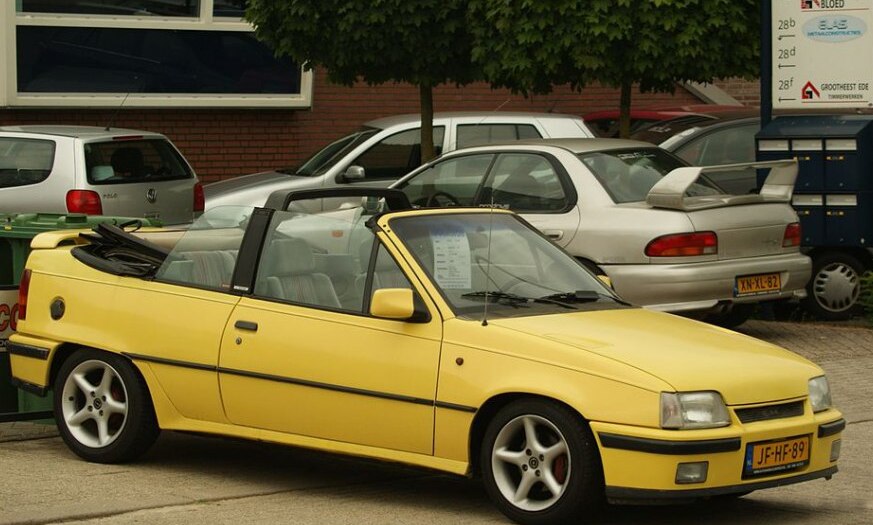
The Opel Kadett E Cabrio 1.6i (82 hp) Automatic, produced between 1992 and 1993, represented a relatively accessible entry point into the world of open-top motoring for European buyers. Positioned within the Kadett E Cabrio range, it offered a blend of practicality and style, albeit with a focus on economy rather than outright performance. This variant was built upon the Kadett E platform (1HX0/A3), a popular compact car known for its reliability and affordability. The Kadett E Cabrio, in general, aimed to capitalize on the growing demand for affordable convertibles, offering a more attainable alternative to more expensive rivals.
Technical Specifications
| Brand | Opel |
| Model | Kadett |
| Generation | Kadett E Cabrio |
| Type (Engine) | 1.6i (82 Hp) Automatic |
| Start of production | 1992 |
| End of production | 1993 |
| Powertrain Architecture | Internal Combustion engine |
| Body type | Cabriolet |
| Seats | 5 |
| Doors | 2 |
| Fuel Type | Petrol (Gasoline) |
| Maximum speed | 167 km/h (103.77 mph) |
| Weight-to-power ratio | 12.1 kg/Hp, 82.4 Hp/tonne |
| Weight-to-torque ratio | 7.7 kg/Nm, 130.7 Nm/tonne |
| Power | 82 Hp @ 5400 rpm |
| Power per litre | 51.3 Hp/l |
| Torque | 130 Nm @ 2600 rpm (95.88 lb.-ft. @ 2600 rpm) |
| Engine layout | Front, Transverse |
| Engine Model/Code | 16SV |
| Engine displacement | 1598 cm3 (97.52 cu. in.) |
| Number of cylinders | 4 |
| Engine configuration | Inline |
| Cylinder Bore | 80 mm (3.15 in.) |
| Piston Stroke | 79.5 mm (3.13 in.) |
| Compression ratio | 10:1 |
| Number of valves per cylinder | 2 |
| Fuel injection system | Carburettor |
| Engine aspiration | Naturally aspirated engine |
| Valvetrain | SOHC |
| Engine oil capacity | 3.5 l (3.7 US qt | 3.08 UK qt) |
| Coolant | 6.2 l (6.55 US qt | 5.46 UK qt) |
| Kerb Weight | 995 kg (2193.6 lbs) |
| Max. weight | 1405 kg (3097.49 lbs) |
| Max load | 410 kg (903.9 lbs) |
| Trunk (boot) space – minimum | 290 l (10.24 cu. ft.) |
| Trunk (boot) space – maximum | 620 l (21.9 cu. ft.) |
| Fuel tank capacity | 52 l (13.74 US gal | 11.44 UK gal) |
| Length | 3998 mm (157.4 in.) |
| Width | 1663 mm (65.47 in.) |
| Height | 1385 mm (54.53 in.) |
| Wheelbase | 2520 mm (99.21 in.) |
| Front track | 1406 mm (55.35 in.) |
| Rear (Back) track | 1406 mm (55.35 in.) |
| Minimum turning circle (turning diameter) | 10.5 m (34.45 ft.) |
| Drivetrain Architecture | The Internal combustion engine (ICE) drives the front wheels of the vehicle. |
| Drive wheel | Front wheel drive |
| Number of gears and type of gearbox | 3 gears, automatic transmission |
| Front brakes | Disc |
| Rear brakes | Drum |
| Tires size | 175/70 R13 |
| Wheel rims size | 13 |
Powertrain & Engine Architecture
The heart of the Kadett E Cabrio 1.6i Automatic was the 16SV engine, a 1.6-liter inline-four cylinder unit. This engine, while not particularly powerful by modern standards, was known for its durability and relative simplicity. It utilized a single overhead camshaft (SOHC) valvetrain with two valves per cylinder. Notably, this variant employed a carburetor fuel injection system, a technology becoming less common in the early 1990s as multi-point fuel injection gained prominence. The carburetor, while less efficient than fuel injection, contributed to the engine’s lower cost and ease of maintenance. The engine produced 82 horsepower at 5400 rpm and 130 Nm (95.88 lb-ft) of torque at 2600 rpm. The automatic transmission was a three-speed unit, designed for smooth, if not particularly sporty, operation. This transmission was chosen to appeal to drivers prioritizing comfort and ease of use over performance.
Driving Characteristics
The 1.6i Automatic Kadett Cabrio offered a relaxed driving experience. Acceleration was modest, with the 0-60 mph time estimated to be around 13-14 seconds. The three-speed automatic transmission, while providing smooth shifts, lacked the responsiveness of a manual gearbox or a more modern automatic with additional gears. The gear ratios were optimized for fuel economy and cruising comfort rather than spirited driving. Compared to the more powerful Kadett E Cabrio variants, such as those equipped with larger engines, the 1.6i Automatic felt noticeably slower. However, it offered a more forgiving and less demanding driving experience, particularly in urban environments. The front-wheel-drive configuration provided predictable handling, but the relatively narrow tires (175/70 R13) limited grip during cornering.
Equipment & Trim Levels
The Kadett E Cabrio 1.6i Automatic typically came with a fairly basic level of equipment, reflecting its position as an entry-level model. Standard features generally included cloth upholstery, a basic stereo system, and manual windows and door locks. Power steering was often an optional extra. The dashboard layout was functional and straightforward, with clearly labeled controls. Optional extras could include upgraded stereo systems, alloy wheels, and a more luxurious interior trim. The convertible top was manually operated, adding to the car’s simplicity and reducing its overall cost.
Chassis & Braking
The Kadett E Cabrio utilized a MacPherson strut front suspension and a torsion beam rear suspension. This setup provided a reasonable balance between ride comfort and handling. The front brakes were disc brakes, offering adequate stopping power, while the rear brakes were drum brakes, a cost-saving measure common in this class of vehicle. The car’s relatively light weight (995 kg / 2193.6 lbs) helped to offset the limitations of the braking system. Stabilizer bars were fitted to both the front and rear axles to reduce body roll during cornering.
Market Reception & Comparison
The Kadett E Cabrio 1.6i Automatic was generally well-received as an affordable and stylish convertible. Critics praised its practicality and ease of use, but noted its lack of performance. Compared to other Kadett E Cabrio variants, such as those with larger engines or manual transmissions, the 1.6i Automatic offered lower running costs and a more relaxed driving experience. However, it sacrificed performance and driver engagement. Fuel economy was a strong point, with combined fuel consumption figures typically around 30-35 mpg. Reliability was generally good, although the carburetor fuel injection system required periodic maintenance.
Legacy
The Opel Kadett E Cabrio 1.6i Automatic, while not a performance icon, holds a place in automotive history as a representative of affordable 1990s convertibles. Today, these cars are relatively rare and are sought after by enthusiasts and collectors. The 16SV engine, while simple, is known for its durability, and well-maintained examples can still provide reliable transportation. The automatic transmission, while not particularly sophisticated, is generally robust. The Kadett E Cabrio 1.6i Automatic remains a charming and accessible classic car, offering a nostalgic glimpse into a bygone era of motoring. Finding parts can be challenging, but a dedicated community of owners and enthusiasts helps to keep these cars on the road.