
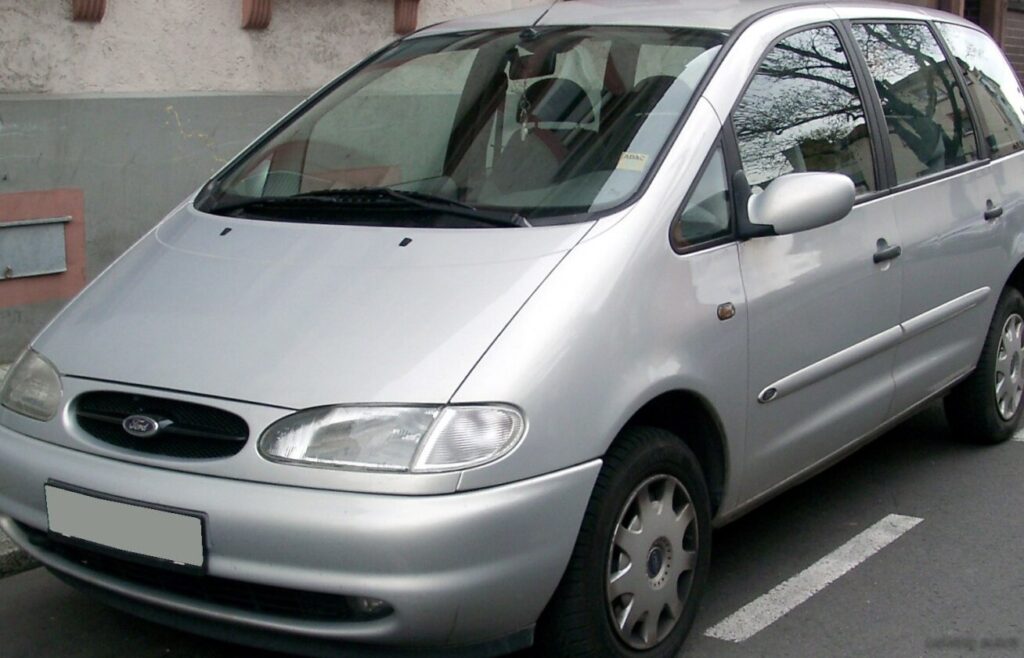
The Ford Galaxy I 2.8i V6, produced between 1995 and 2000, represents a significant entry for Ford into the European minivan market. Developed in collaboration with Volkswagen (resulting in the shared Volkswagen Sharan and SEAT Alhambra), the Galaxy I aimed to provide a spacious, comfortable, and versatile vehicle for families. This particular 2.8i V6 variant, boasting 174 horsepower, occupied a mid-to-upper position within the Galaxy lineup, offering a performance upgrade over the base four-cylinder models while remaining more accessible than potential future high-performance trims. The Galaxy I, built on the Ford 1HX0/A3 platform, quickly became a popular choice for those needing seven-passenger capacity combined with Ford’s established reputation for reliability.
Technical Specifications
| Brand | Ford |
| Model | Galaxy |
| Generation | Galaxy I |
| Type (Engine) | 2.8i V6 (174 Hp) |
| Start of production | 1995 |
| End of production | 2000 |
| Powertrain Architecture | Internal Combustion engine |
| Body type | Minivan |
| Seats | 7 |
| Doors | 5 |
| Fuel consumption (urban) | 16.4 l/100 km (14.3 US mpg) |
| Fuel consumption (extra urban) | 8.7 l/100 km (27 US mpg) |
| Fuel Type | Petrol (Gasoline) |
| Acceleration 0 – 100 km/h | 10.5 sec |
| Acceleration 0 – 62 mph | 10.5 sec |
| Acceleration 0 – 60 mph | 10 sec |
| Maximum speed | 199 km/h (123.65 mph) |
| Weight-to-power ratio | 10.3 kg/Hp |
| Weight-to-torque ratio | 7.6 kg/Nm |
| Power | 174 Hp @ 5800 rpm |
| Torque | 235 Nm @ 4200 rpm (173.33 lb.-ft. @ 4200 rpm) |
| Engine layout | Front, Transverse |
| Engine Model/Code | AAA, AMY |
| Engine displacement | 2792 cm3 (170.38 cu. in.) |
| Number of cylinders | 6 |
| Engine configuration | V-engine |
| Cylinder Bore | 81 mm (3.19 in.) |
| Piston Stroke | 90.3 mm (3.56 in.) |
| Compression ratio | 10:1 |
| Number of valves per cylinder | 2 |
| Fuel injection system | Multi-port manifold injection |
| Engine aspiration | Naturally aspirated engine |
| Valvetrain | DOHC |
| Engine oil capacity | 5.5 l (5.81 US qt | 4.84 UK qt) |
| Coolant | 9 l (9.51 US qt | 7.92 UK qt) |
| Kerb Weight | 1785 kg (3935.25 lbs.) |
| Max. weight | 2440 kg (5379.28 lbs.) |
| Max load | 655 kg (1444.03 lbs.) |
| Trunk (boot) space – minimum | 266 l (9.39 cu. ft.) |
| Trunk (boot) space – maximum | 2610 l (92.17 cu. ft.) |
| Fuel tank capacity | 75 l (19.81 US gal | 16.5 UK gal) |
| Length | 4641 mm (182.72 in.) |
| Width | 1810 mm (71.26 in.) |
| Height | 1730 mm (68.11 in.) |
| Wheelbase | 2835 mm (111.61 in.) |
| Front track | 1530 mm (60.24 in.) |
| Rear (Back) track | 1524 mm (60 in.) |
| Drivetrain Architecture | The Internal combustion engine (ICE) drives the front wheels of the vehicle. |
| Drive wheel | Front wheel drive |
| Number of gears and type of gearbox | 5 gears, manual transmission |
| Front suspension | Wishbone |
| Rear suspension | Coil spring |
| Front brakes | Ventilated discs |
| Rear brakes | Disc |
| Assisting systems | ABS (Anti-lock braking system) |
| Steering type | Steering rack and pinion |
| Power steering | Hydraulic Steering |
| Tires size | 205/60 R15 |
Powertrain & Engine Architecture
The heart of the Galaxy I 2.8i V6 is the Ford AAA or AMY engine, a 2.8-liter, naturally aspirated V6. This engine, part of Ford’s Cologne V6 family, features a 60-degree V-angle and a dual overhead camshaft (DOHC) valvetrain with two valves per cylinder. The engine utilizes multi-port fuel injection, delivering fuel directly into the intake ports for improved combustion efficiency. The 2792cc displacement is achieved with a bore of 81mm and a stroke of 90.3mm. While not a cutting-edge design by the late 1990s, the engine was known for its relatively smooth operation and decent power output. The 5-speed manual transmission paired with this engine was a standard offering, providing adequate gear ratios for both highway cruising and acceleration. Automatic transmission options were available, but less common and often criticized for diminishing the engine’s performance.
Driving Characteristics
The 2.8i V6 Galaxy offered a noticeable performance improvement over the base 1.8L and 2.0L four-cylinder models. Acceleration to 60 mph took approximately 10 seconds, making it reasonably quick for a large minivan. The V6 provided ample torque for carrying a full load of passengers and luggage, and the manual transmission allowed drivers to maintain control and optimize power delivery. However, the Galaxy I was a relatively heavy vehicle, and the 2.8i V6 wasn’t a particularly fuel-efficient engine. Real-world fuel economy often fell short of the manufacturer’s claims, especially with a full cabin. Compared to the diesel options available in Europe, the 2.8i V6 prioritized performance over economy.
Equipment & Trim Levels
The 2.8i V6 Galaxy typically came with a fairly comprehensive equipment list, positioning it as a mid-to-upper trim level. Standard features included power windows and locks, central locking, air conditioning, and an AM/FM radio. Higher-spec models offered options such as alloy wheels, upgraded upholstery, a sunroof, and a more sophisticated audio system. Interior trim generally consisted of cloth upholstery, with leather options available as an upgrade. The dashboard layout was functional and straightforward, prioritizing usability over stylistic flair.
Chassis & Braking
The Galaxy I utilized a front-wheel-drive layout with independent wishbone suspension at the front and a coil spring setup at the rear. This suspension configuration provided a comfortable ride, although it wasn’t particularly sporty. Braking duties were handled by ventilated discs at the front and solid discs at the rear. Anti-lock Braking System (ABS) was standard, enhancing safety and control during emergency braking situations. The steering was rack and pinion, providing reasonably precise handling for a vehicle of its size.
Market Reception & Comparison
The Ford Galaxy I 2.8i V6 was generally well-received by automotive critics. It was praised for its spacious interior, comfortable ride, and the added performance offered by the V6 engine. However, some reviewers noted the relatively high fuel consumption and the somewhat dated interior design. Compared to the four-cylinder models, the 2.8i V6 offered a significant performance boost, but at a higher price point. Against competitors like the Renault Espace and Citroën Evasion, the Galaxy I offered a compelling combination of practicality, comfort, and performance.
Legacy
The Ford Galaxy I 2.8i V6, while not a particularly rare or collectible vehicle, remains a popular choice among those seeking a spacious and reliable family minivan. The Cologne V6 engine, while not known for exceptional longevity, is generally considered durable with proper maintenance. Today, well-maintained examples can still be found on the used car market, offering an affordable and practical transportation solution. The Galaxy I laid the foundation for subsequent generations of the Galaxy, establishing Ford as a major player in the European minivan segment. Its collaborative development with Volkswagen also demonstrated the benefits of shared engineering and platform development within the automotive industry.
