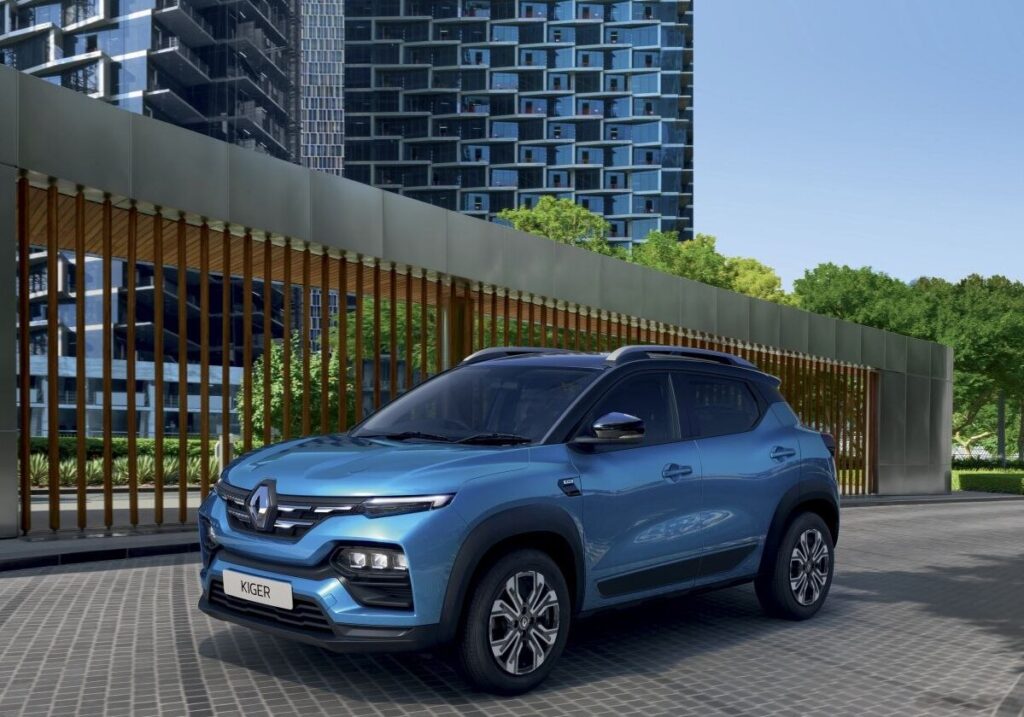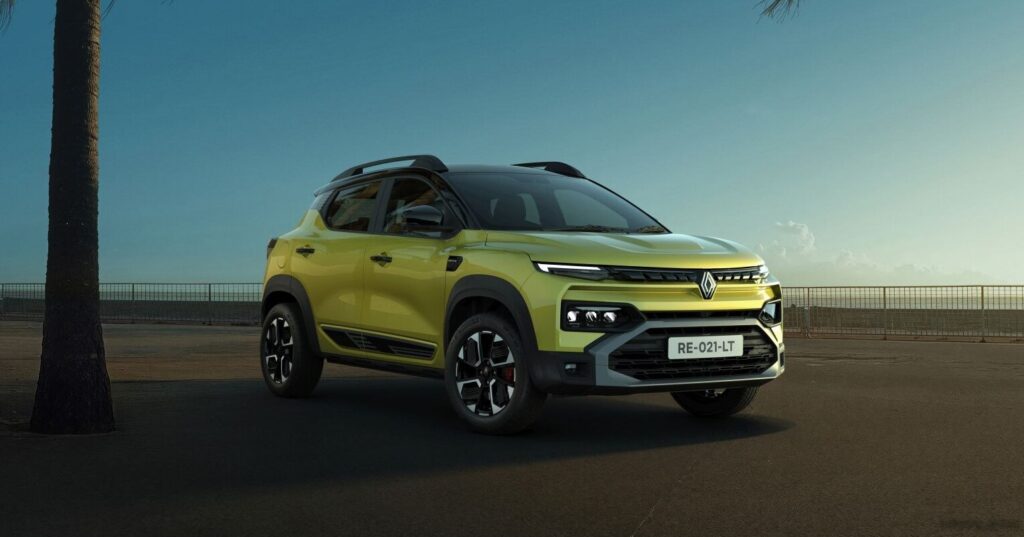
The Renault Kiger (facelift 2025) 1.0 Turbo, producing 100 horsepower, represents a significant iteration of Renault’s entry-level crossover SUV, primarily targeted towards the Indian and emerging markets. Introduced in August 2025, this facelift builds upon the original Kiger launched in 2021, aiming to enhance its appeal with updated styling, improved features, and a refined powertrain. Positioned as a competitive offering in the sub-4 meter SUV segment, the 1.0 Turbo variant serves as a mid-range option, bridging the gap between the base engine and potentially higher-spec turbocharged versions. It’s built on the CMFA+ platform, a modular architecture designed for cost-effectiveness and adaptability to various market needs.
Technical Specifications
| Brand | Renault |
| Model | Kiger |
| Generation | Kiger (facelift 2025) |
| Type (Engine) | 1.0 Turbo (100 Hp) |
| Start of production | August, 2025 |
| Powertrain Architecture | Internal Combustion engine |
| Body type | SUV, Crossover |
| Seats | 5 |
| Doors | 5 |
| Fuel Type | Petrol (Gasoline) |
| Power | 100 Hp @ 5000 rpm |
| Power per litre | 100.1 Hp/l |
| Torque | 160 Nm @ 2800-3600 rpm / 118.01 lb.-ft. @ 2800-3600 rpm |
| Engine layout | Front, Transverse |
| Engine displacement | 999 cm3 / 60.96 cu. in. |
| Number of cylinders | 3 |
| Engine configuration | Inline |
| Cylinder Bore | 72.2 mm / 2.84 in. |
| Piston Stroke | 81.3 mm / 3.2 in. |
| Number of valves per cylinder | 4 |
| Fuel injection system | Multi-port manifold injection |
| Engine aspiration | Turbocharger, Intercooler |
| Valvetrain | DOHC |
| Trunk (boot) space – minimum | 405 l / 14.3 cu. ft. |
| Fuel tank capacity | 40 l / 10.57 US gal | 8.8 UK gal |
| Max. roof load | 50 kg / 110.23 lbs. |
| Length | 3990 mm / 157.09 in. |
| Width | 1750 mm / 68.9 in. |
| Width including mirrors | 1912 mm / 75.28 in. |
| Height | 1605 mm / 63.19 in. |
| Wheelbase | 2500 mm / 98.43 in. |
| Front track | 1536 mm / 60.47 in. |
| Rear (Back) track | 1535 mm / 60.43 in. |
| Front overhang | 806 mm / 31.73 in. |
| Rear overhang | 684 mm / 26.93 in. |
| Ride height (ground clearance) | 205 mm / 8.07 in. |
| Minimum turning circle (turning diameter) | 10.5 m / 34.45 ft. |
| Drivetrain Architecture | The Internal combustion engine (ICE) drives the front wheels of the vehicle. |
| Drive wheel | Front wheel drive |
| Number of gears and type of gearbox | 5 gears, manual transmission |
| Front suspension | Independent, type McPherson with coil spring and anti-roll bar |
| Rear suspension | Semi-independent, coil spring, Elastic beam |
| Front brakes | Disc |
| Rear brakes | Drum |
| Assisting systems | ABS (Anti-lock braking system) |
| Steering type | Steering rack and pinion |
| Power steering | Electric Steering |
| Tires size | 195/60 R16 |
| Wheel rims size | 16 |
Powertrain & Engine Architecture
The heart of the Kiger 1.0 Turbo is the HR10 1.0-liter, three-cylinder turbocharged petrol engine. This engine is part of Renault’s broader range of downsized, turbocharged units designed for efficiency and responsiveness. The engine utilizes a single-scroll turbocharger with an intercooler to boost power output. Fuel delivery is managed by a multi-point fuel injection system, ensuring precise fuel metering for optimal combustion. The engine features a Double Overhead Camshaft (DOHC) valvetrain with four valves per cylinder, contributing to improved breathing and higher engine speeds. The 5-speed manual transmission is the sole gearbox option for this variant, chosen for its simplicity and cost-effectiveness in the target markets. The transmission is geared towards providing a balance between fuel economy and acceptable acceleration.
Driving Characteristics
The 100 hp output of the 1.0 Turbo engine provides adequate performance for everyday driving conditions. While not a particularly sporty setup, the turbocharger provides a noticeable boost in power during acceleration, making overtaking maneuvers easier. The 5-speed manual transmission allows for reasonable control over the engine’s powerband. Compared to a potential base engine (likely a naturally aspirated 1.0-liter), the turbo variant offers significantly improved responsiveness and pulling power, especially at lower RPMs. However, it won’t match the performance of any higher-spec turbocharged options that may be available in the Kiger lineup. The gear ratios are tuned for fuel efficiency, meaning the engine can feel slightly strained at highway speeds, requiring downshifts for quicker acceleration.
Equipment & Trim Levels
The Kiger 1.0 Turbo typically comes equipped with a reasonable level of standard features. These generally include air conditioning, power windows, power-adjustable side mirrors, and a basic audio system with Bluetooth connectivity. Safety features such as ABS, dual airbags, and rear parking sensors are also standard. Higher trim levels within the 1.0 Turbo range add features like alloy wheels, a touchscreen infotainment system with Apple CarPlay and Android Auto compatibility, a digital instrument cluster, and automatic climate control. Interior upholstery is typically cloth, with options for different color schemes. Optional extras may include a rear parking camera, a sunroof, and additional safety features like electronic stability control.
Chassis & Braking
The Kiger’s chassis is tuned to provide a comfortable ride quality, prioritizing absorption of bumps and imperfections in the road. The front suspension utilizes an independent McPherson strut setup, while the rear employs a semi-independent elastic beam configuration. This setup is a common choice for compact SUVs, offering a good balance between ride comfort and handling. Braking duties are handled by disc brakes at the front and drum brakes at the rear. While adequate for normal driving, the drum brakes at the rear are a cost-saving measure and may not offer the same stopping power as all-disc setups found in higher-spec models. The electric power steering provides light and easy steering feel, making it convenient for maneuvering in urban environments.
Market Reception & Comparison
The Renault Kiger 1.0 Turbo has been generally well-received in its target markets, particularly for its value proposition. Critics have praised its stylish design, spacious interior, and competitive pricing. The 1.0 Turbo engine is considered a good compromise between performance and fuel economy. Compared to other sub-4 meter SUVs in the Indian market, such as the Maruti Suzuki Brezza and Tata Nexon, the Kiger offers a distinctive design and a relatively refined driving experience. Fuel economy figures are typically in the range of 18-20 kmpl (kilometers per liter), making it an efficient option for daily commuting. Reliability has been generally good, although some owners have reported minor issues with the infotainment system.
Legacy
The Renault Kiger 1.0 Turbo, as a relatively recent model, is still establishing its long-term reliability record. However, the HR10 engine has been used in other Renault models, providing some indication of its durability. The engine’s relatively simple design and robust construction suggest it should be capable of providing years of reliable service with proper maintenance. In the used car market, the Kiger 1.0 Turbo is expected to hold its value reasonably well, particularly if it has been well-maintained and has a full service history. Its combination of style, practicality, and fuel efficiency should continue to make it an attractive option for budget-conscious buyers.