
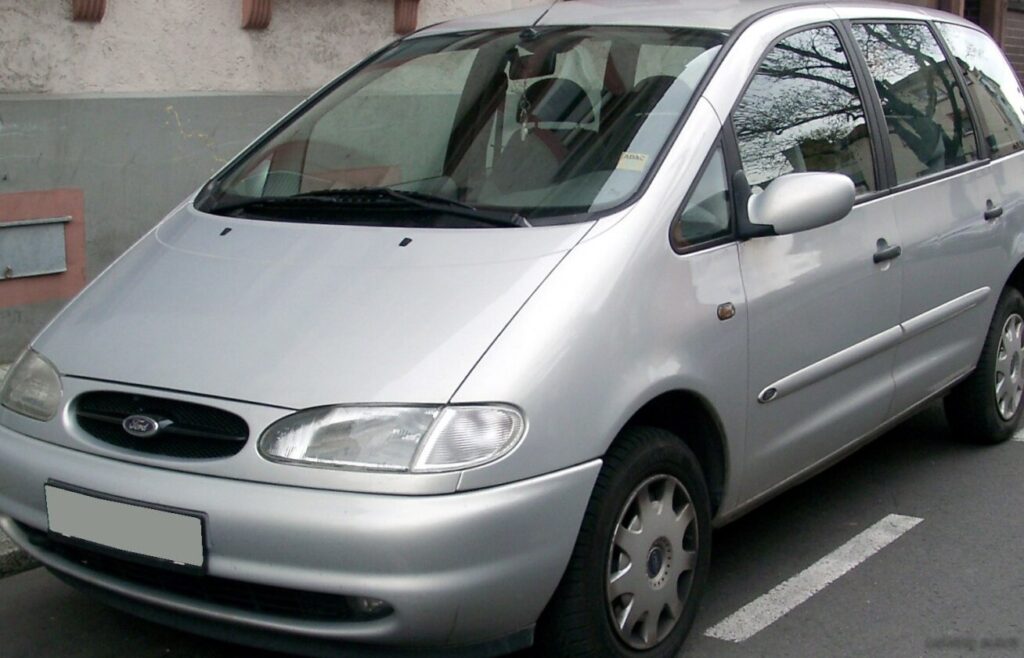
The Ford Galaxy I 2.8i V6 Automatic, produced between 1995 and 2000, represents a significant entry into the people-carrier market for Ford. Developed in collaboration with Volkswagen (sharing a platform with the VW Sharan and SEAT Alhambra – the 1HX0/A3 platform), the Galaxy aimed to provide a spacious, comfortable, and practical vehicle for families. This particular variant, equipped with the 2.8-liter V6 engine and a four-speed automatic transmission, occupied a mid-to-upper position within the Galaxy lineup, offering a balance of performance and convenience. It was primarily marketed in Europe, where the demand for multi-purpose vehicles (MPVs) was strong, and aimed at buyers seeking a more refined and powerful alternative to the base four-cylinder models.
Technical Specifications
| Brand | Ford |
| Model | Galaxy |
| Generation | Galaxy I |
| Type (Engine) | 2.8i V6 (174 Hp) Automatic |
| Start of production | 1995 |
| End of production | 2000 |
| Powertrain Architecture | Internal Combustion engine |
| Body type | Minivan |
| Seats | 7 |
| Doors | 5 |
| Fuel consumption (urban) | 17.2 l/100 km (13.7 US mpg, 16.4 UK mpg, 5.8 km/l) |
| Fuel consumption (extra urban) | 9.3 l/100 km (25.3 US mpg, 30.4 UK mpg, 10.8 km/l) |
| Fuel Type | Petrol (Gasoline) |
| Acceleration 0 – 100 km/h | 11 sec |
| Acceleration 0 – 62 mph | 11 sec |
| Acceleration 0 – 60 mph | 10.5 sec |
| Maximum speed | 195 km/h (121.17 mph) |
| Weight-to-power ratio | 10.3 kg/Hp, 97.5 Hp/tonne |
| Weight-to-torque ratio | 7.6 kg/Nm, 131.7 Nm/tonne |
| Power | 174 Hp @ 5800 rpm |
| Power per litre | 62.3 Hp/l |
| Torque | 235 Nm @ 4200 rpm (173.33 lb.-ft. @ 4200 rpm) |
| Engine layout | Front, Transverse |
| Engine Model/Code | AAA, AMY |
| Engine displacement | 2792 cm3 (170.38 cu. in.) |
| Number of cylinders | 6 |
| Engine configuration | V-engine |
| Cylinder Bore | 81 mm (3.19 in.) |
| Piston Stroke | 90.3 mm (3.56 in.) |
| Compression ratio | 10:1 |
| Number of valves per cylinder | 2 |
| Fuel injection system | Multi-port manifold injection |
| Engine aspiration | Naturally aspirated engine |
| Valvetrain | DOHC |
| Engine oil capacity | 5.5 l (5.81 US qt | 4.84 UK qt) |
| Coolant | 9.2 l (9.72 US qt | 8.09 UK qt) |
| Kerb Weight | 1785 kg (3935.25 lbs.) |
| Max. weight | 2440 kg (5379.28 lbs.) |
| Max load | 655 kg (1444.03 lbs.) |
| Trunk (boot) space – minimum | 266 l (9.39 cu. ft.) |
| Trunk (boot) space – maximum | 2610 l (92.17 cu. ft.) |
| Fuel tank capacity | 75 l (19.81 US gal | 16.5 UK gal) |
| Length | 4641 mm (182.72 in.) |
| Width | 1810 mm (71.26 in.) |
| Height | 1730 mm (68.11 in.) |
| Wheelbase | 2835 mm (111.61 in.) |
| Front track | 1530 mm (60.24 in.) |
| Rear (Back) track | 1524 mm (60 in.) |
| Drivetrain Architecture | The Internal combustion engine (ICE) drives the front wheels of the vehicle. |
| Drive wheel | Front wheel drive |
| Number of gears and type of gearbox | 4 gears, automatic transmission |
| Front suspension | Wishbone |
| Rear suspension | Coil spring |
| Front brakes | Ventilated discs |
| Rear brakes | Disc |
| Assisting systems | ABS (Anti-lock braking system) |
| Steering type | Steering rack and pinion |
| Power steering | Hydraulic Steering |
| Tires size | 205/60 R15 |
| Wheel rims size | 15 |
Powertrain & Engine Architecture
The heart of the Galaxy 2.8i V6 Automatic is the AAA or AMY engine code, a 2.8-liter naturally aspirated V6. This engine, part of Ford’s Cologne V6 family, features a 60-degree V-angle and a dual overhead camshaft (DOHC) valvetrain with two valves per cylinder. It utilizes a multi-port fuel injection system, delivering fuel directly into the intake ports. The engine’s design prioritized smooth operation and reasonable power output over outright performance. The four-speed automatic transmission, while providing convenience, was a relatively conventional unit for the time. It wasn’t known for particularly quick shifts or advanced features, but it was generally reliable. The transmission’s gear ratios were tuned for comfortable cruising and adequate acceleration, rather than sporty driving.
Driving Characteristics
The 2.8i V6 Automatic Galaxy offered a noticeable step up in performance compared to the base 1.8 and 2.0-liter four-cylinder models. While not a sports car, the V6 provided sufficient power for effortless highway cruising and confident overtaking. The automatic transmission, however, did detract somewhat from the driving experience. Gear changes were not always seamless, and the transmission could sometimes feel hesitant when downshifting. Acceleration from 0-60 mph took around 10.5 seconds, and top speed was approximately 121 mph. Compared to the manual transmission versions of the same engine, the automatic typically resulted in slightly slower acceleration and reduced fuel economy. The focus was on ease of use and comfort, making it ideal for drivers prioritizing convenience over sporty handling.
Equipment & Trim Levels
The 2.8i V6 Automatic trim generally included features such as power windows, central locking, power steering, and an anti-lock braking system (ABS). Interior upholstery was typically cloth, although leather options were available. Dashboard configuration was functional and straightforward, with a focus on practicality. Optional extras included air conditioning, a sunroof, and upgraded audio systems. The Galaxy was designed to be a family vehicle, and as such, emphasized interior space and versatility. The rear seats could be folded or removed entirely to create a large cargo area.
Chassis & Braking
The Galaxy I utilized a front-wheel-drive layout with independent wishbone suspension at the front and a coil spring setup at the rear. The suspension was tuned for comfort, providing a relatively smooth ride, although it wasn’t particularly sporty. Braking duties were handled by ventilated discs at the front and solid discs at the rear. The ABS system helped to maintain control during emergency braking situations. Stabilizer bars were fitted to both the front and rear axles to reduce body roll during cornering.
Market Reception & Comparison
The Ford Galaxy I 2.8i V6 Automatic was generally well-received by critics as a practical and comfortable family vehicle. The V6 engine was praised for its smoothness and adequate power, while the automatic transmission was seen as a convenient, if not particularly exciting, feature. Fuel economy was a common criticism, as the V6 engine consumed significantly more fuel than the four-cylinder alternatives. Compared to the VW Sharan and SEAT Alhambra, which shared the same platform, the Galaxy offered a slightly different styling and trim level. The Galaxy aimed for a more mainstream appeal, while the VW Sharan often targeted a slightly more premium buyer.
Legacy
The Ford Galaxy I 2.8i V6 Automatic, while not a particularly rare or collectible vehicle, remains a reasonably popular choice in the used car market. The Cologne V6 engine, when properly maintained, is known for its durability. However, potential buyers should be aware of potential issues such as oil leaks and timing belt failures. The automatic transmission, while generally reliable, may require servicing or rebuilding after high mileage. Overall, the Galaxy I 2.8i V6 Automatic represents a solid and practical MPV that offered a good balance of space, comfort, and performance for its time. It laid the foundation for subsequent generations of the Galaxy, which continued to be a popular choice for families in Europe.
