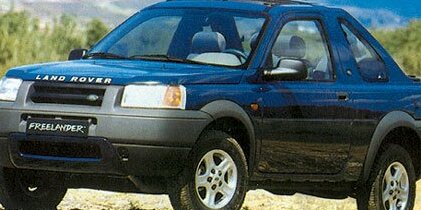
The Land Rover Freelander I Soft Top 1.8 i 16V, produced between 1998 and 2001, represented a unique offering within the first generation Freelander lineup. Positioned as an entry-level variant, it aimed to broaden the appeal of the Freelander – Land Rover’s attempt to enter the compact SUV market – by offering a more affordable and accessible price point. The Soft Top distinguished itself with a retractable fabric roof, providing an open-air driving experience not typically associated with the brand. It was built on the 1HX0/A3 platform, shared with other Rover Group products, and represented a departure from Land Rover’s traditionally more rugged and utilitarian vehicles, focusing instead on lifestyle and leisure use.
Technical Specifications
| Brand | Land Rover |
| Model | Freelander |
| Generation | Freelander I Soft Top |
| Type (Engine) | 1.8 i 16V (120 Hp) |
| Start of production | 1998 |
| End of production | 2001 |
| Powertrain Architecture | Internal Combustion engine |
| Body type | SUV |
| Seats | 4 |
| Doors | 3 |
| Fuel consumption (urban) | 13 l/100 km (18.1 US mpg, 21.7 UK mpg) |
| Fuel consumption (extra urban) | 8.6 l/100 km (27.4 US mpg, 32.8 UK mpg) |
| Fuel Type | Petrol (Gasoline) |
| Acceleration 0 – 100 km/h | 11.9 sec |
| Acceleration 0 – 62 mph | 11.9 sec |
| Acceleration 0 – 60 mph | 11.3 sec |
| Maximum speed | 165 km/h (102.53 mph) |
| Weight-to-power ratio | 11.5 kg/Hp |
| Weight-to-torque ratio | 8.4 kg/Nm |
| Power | 120 Hp @ 5550 rpm |
| Power per litre | 66.8 Hp/l |
| Torque | 165 Nm @ 2750 rpm (121.7 lb.-ft. @ 2750 rpm) |
| Engine layout | Front, Transverse |
| Engine Model/Code | 18K4F |
| Engine displacement | 1796 cm3 (109.6 cu. in.) |
| Number of cylinders | 4 |
| Engine configuration | Inline |
| Cylinder Bore | 80 mm (3.15 in.) |
| Piston Stroke | 89.3 mm (3.52 in.) |
| Compression ratio | 10.5:1 |
| Number of valves per cylinder | 4 |
| Fuel injection system | Multi-port manifold injection |
| Engine aspiration | Naturally aspirated engine |
| Valvetrain | DOHC |
| Engine oil capacity | 4.5 l (4.76 US qt | 3.96 UK qt) |
| Coolant capacity | 5.5 l (5.81 US qt | 4.84 UK qt) |
| Kerb Weight | 1380 kg (3042.38 lbs.) |
| Max. weight | 1960 kg (4321.06 lbs.) |
| Max load | 580 kg (1278.68 lbs.) |
| Trunk (boot) space – minimum | 370 l (13.07 cu. ft.) |
| Trunk (boot) space – maximum | 1315 l (46.44 cu. ft.) |
| Fuel tank capacity | 59 l (15.59 US gal | 12.98 UK gal) |
| Length | 4380 mm (172.44 in.) |
| Width | 1805 mm (71.06 in.) |
| Height | 1760 mm (69.29 in.) |
| Wheelbase | 2556 mm (100.63 in.) |
| Front track | 1535 mm (60.43 in.) |
| Rear (Back) track | 1545 mm (60.83 in.) |
| Drive wheel | All wheel drive (4×4) |
| Number of gears and type of gearbox | 5 gears, manual transmission |
| Front suspension | Coil spring |
| Rear suspension | Coil spring |
| Front brakes | Disc |
| Rear brakes | Drum |
| Assisting systems | ABS (Anti-lock braking system) |
| Steering type | Steering rack and pinion |
| Power steering | Hydraulic Steering |
| Tires size | 195/80 R15 |
Powertrain & Engine Architecture
The 1.8 i 16V engine, designated as the 18K4F, was a naturally aspirated, inline-four cylinder engine. It featured a multi-port fuel injection system and a double overhead camshaft (DOHC) valvetrain, contributing to its relatively high output for its displacement. The engine produced 120 horsepower at 5550 rpm and 165 Nm (121.7 lb-ft) of torque at 2750 rpm. This engine was part of the K-series family, a powerplant extensively used across Rover Group vehicles. The Freelander 1.8 paired with a 5-speed manual transmission as standard, although an automatic transmission option was also available. The automatic, a Jatco unit, was a four-speed design. The engine’s transverse mounting and all-wheel-drive system contributed to the Freelander’s compact footprint and enhanced traction.
Driving Characteristics
The 1.8L engine, coupled with the manual transmission, provided adequate, but not exhilarating, performance. Acceleration from 0-60 mph took around 11.3 seconds, and top speed was limited to 102.53 mph. Compared to the more powerful 2.5L V6 or the torquey 2.0L diesel options, the 1.8 felt noticeably less responsive, particularly when fully loaded or tackling steep inclines. The automatic transmission further dulled performance, with slower gear changes and a less engaging driving experience. However, the 1.8 offered a more fuel-efficient option, and its lighter weight contributed to slightly improved handling compared to its heavier siblings. The gear ratios in the manual transmission were geared towards economy, making it less suited for aggressive driving.
Equipment & Trim Levels
The 1.8 i 16V Soft Top typically came with a relatively basic level of equipment, reflecting its entry-level positioning. Standard features included power steering, ABS brakes, and a basic audio system. Interior upholstery was typically cloth, and the dashboard featured a functional, if somewhat utilitarian, design. Optional extras included air conditioning, alloy wheels, and upgraded audio systems. The Soft Top itself was manually operated, adding a degree of involvement to the open-air experience. Trim levels were relatively limited, with most variations stemming from the addition of optional packages.
Chassis & Braking
The Freelander I utilized an independent front suspension with coil springs and a multi-link rear suspension, also with coil springs. This setup aimed to provide a balance between on-road comfort and off-road capability. Front brakes were ventilated discs, while rear brakes were drums. This configuration was typical for vehicles in this weight class during the late 1990s and early 2000s. Stabilizer bars were fitted to both the front and rear axles to reduce body roll during cornering. The all-wheel-drive system, featuring electronic traction control, provided enhanced grip on slippery surfaces.
Market Reception & Comparison
The Freelander 1.8 i 16V Soft Top received mixed reviews. Critics generally praised its affordability and unique open-top design, but often criticized its lack of outright performance. Compared to the V6 model, the 1.8 offered significantly lower running costs, but at the expense of driving enjoyment. The diesel variants provided superior fuel economy and torque, making them more suitable for towing and off-road use. The 1.8 appealed to buyers seeking a stylish and practical SUV for urban driving and light off-road adventures, prioritizing affordability and fuel efficiency over performance.
Legacy
The 18K4F engine, while generally reliable, is known to be susceptible to head gasket failures, a common issue with the K-series engine family. Regular maintenance, including coolant checks and timely replacement, is crucial to prevent this problem. The Soft Top mechanism itself can also require attention over time, with potential issues related to the fabric and folding mechanism. Today, the Freelander I Soft Top 1.8 i 16V is a relatively rare vehicle, appealing to enthusiasts seeking a unique and affordable Land Rover experience. Its value in the used car market is generally lower than that of the V6 or diesel models, but well-maintained examples are gaining recognition as a quirky and charming classic.