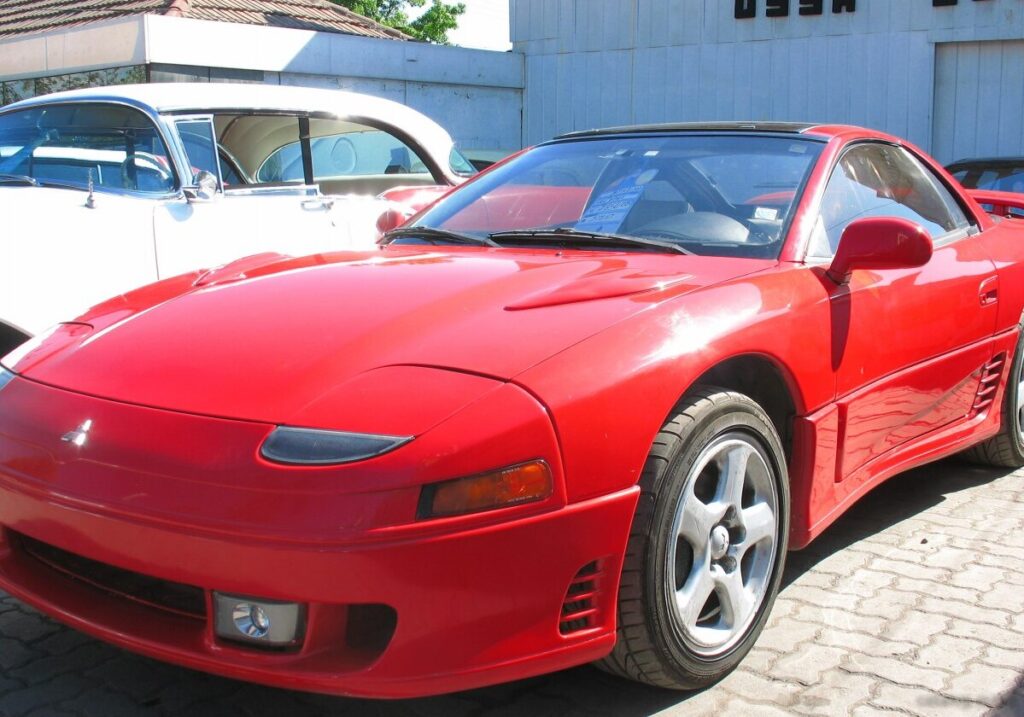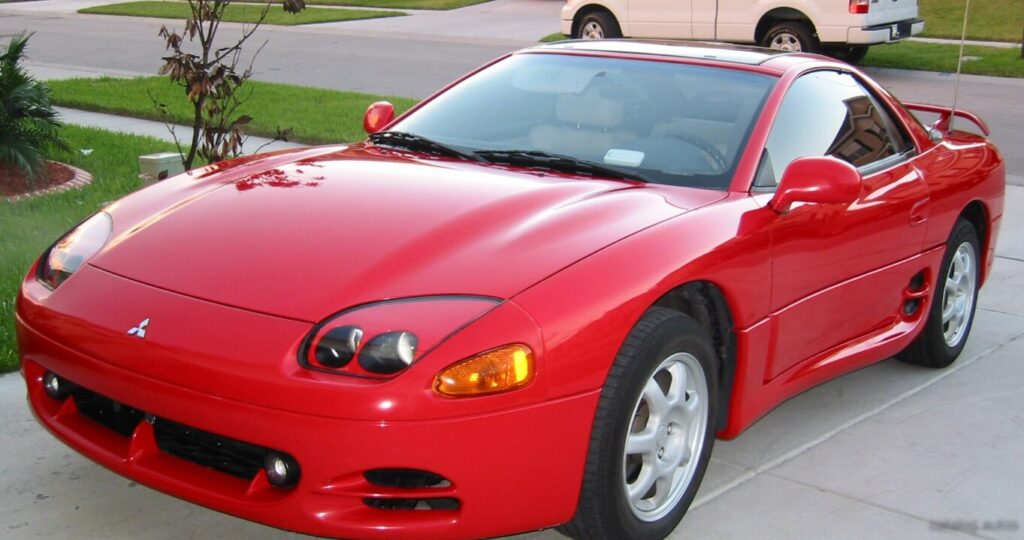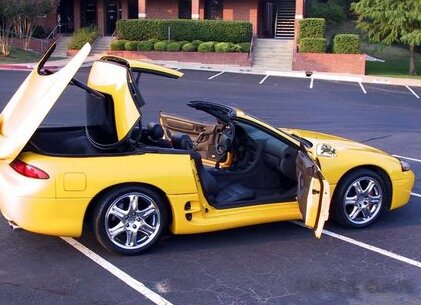
The Mitsubishi 3000 GT Spyder 3.0 Turbo Automatic, produced between 1995 and 2000, represented the open-top variant of Mitsubishi’s flagship sports car. Positioned as the premium offering within the 3000 GT lineup, the Spyder combined the performance of the 3.0-liter turbocharged V6 engine with the convenience of an automatic transmission and the appeal of a convertible body style. It was part of the broader 3000 GT (GTO in Japan) series, which aimed to compete with established sports cars like the Mazda RX-7 and Toyota Supra. The Spyder specifically targeted buyers seeking a blend of performance and open-air driving enjoyment, differentiating itself from the hardtop coupe versions.
Technical Specifications
| Brand | Mitsubishi |
| Model | 3000 GT |
| Generation | 3000 GT Spyder |
| Type (Engine) | 3.0 Turbo (320 Hp) Automatic |
| Start of production | 1995 |
| End of production | 2000 |
| Powertrain Architecture | Internal Combustion engine |
| Body type | Cabriolet |
| Seats | 4 |
| Doors | 2 |
| Fuel consumption (combined) | 11.5 l/100 km |
| Fuel consumption (US mpg) | 20.5 US mpg |
| Fuel consumption (UK mpg) | 24.6 UK mpg |
| Fuel consumption (km/l) | 8.7 km/l |
| Fuel Type | Petrol (Gasoline) |
| Weight-to-power ratio | 5.4 kg/Hp |
| Power-to-weight ratio | 185.5 Hp/tonne |
| Weight-to-torque ratio | 4 kg/Nm |
| Torque-to-weight ratio | 247.5 Nm/tonne |
| Power | 320 Hp @ 6000 rpm |
| Power per litre | 107.7 Hp/l |
| Torque | 427 Nm @ 2500 rpm (314.94 lb.-ft. @ 2500 rpm) |
| Engine layout | Front, Transverse |
| Engine displacement | 2972 cm3 (181.36 cu. in.) |
| Number of cylinders | 6 |
| Engine configuration | V-engine |
| Cylinder Bore | 91.1 mm (3.59 in.) |
| Piston Stroke | 76 mm (2.99 in.) |
| Compression ratio | 8:1 |
| Number of valves per cylinder | 4 |
| Fuel injection system | Multi-port manifold injection |
| Engine aspiration | Turbocharger |
| Valvetrain | DOHC |
| Kerb Weight | 1725 kg (3802.97 lbs.) |
| Trunk (boot) space – maximum | 160 l (5.65 cu. ft.) |
| Fuel tank capacity | 75 l (19.81 US gal | 16.5 UK gal) |
| Length | 4565 mm (179.72 in.) |
| Width | 1840 mm (72.44 in.) |
| Height | 1290 mm (50.79 in.) |
| Wheelbase | 2470 mm (97.24 in.) |
| Front track | 1560 mm (61.42 in.) |
| Rear (Back) track | 1580 mm (62.2 in.) |
| Drivetrain Architecture | The Internal combustion engine (ICE) drives the front wheels of the vehicle. |
| Drive wheel | Front wheel drive |
| Number of gears and type of gearbox | 4 gears, automatic transmission |
| Front suspension | Wishbone |
| Rear suspension | Coil spring |
| Front brakes | Ventilated discs |
| Rear brakes | Ventilated discs |
| Assisting systems | ABS (Anti-lock braking system) |
| Steering type | Steering rack and pinion |
| Power steering | Hydraulic Steering |
| Tires size | 245/45 R17 |
| Wheel rims size | 17 |
Powertrain & Engine Architecture
The heart of the 3000 GT Spyder 3.0 Turbo was the 6G72 3.0-liter DOHC 24-valve V6 engine. This engine featured a twin-scroll turbocharger and Mitsubishi’s proprietary multi-point fuel injection system. The turbocharger was designed to minimize turbo lag and provide a broad torque curve. The engine’s 8:1 compression ratio was a compromise between performance and reliability, allowing for the use of readily available gasoline. The four-speed automatic transmission, while offering convenience, was a key differentiator from the five-speed manual available on other 3000 GT models. This automatic was designed to handle the engine’s substantial torque output, but it wasn’t always as responsive as the manual counterpart. The engine code for this configuration is often associated with variations within the 6G72 family, and specific details can vary based on the production year and market.
Driving Characteristics
The 3000 GT Spyder 3.0 Turbo Automatic delivered strong acceleration, with the turbocharger providing a noticeable boost in power. However, the automatic transmission did impact the overall driving experience compared to the manual version. Gear changes weren’t as crisp, and the driver had less control over engine braking. The Spyder’s weight, approximately 3803 pounds, was noticeable, especially during cornering. The suspension, while capable, wasn’t as firm as the coupe’s, resulting in slightly more body roll. Despite these characteristics, the Spyder offered a comfortable and enjoyable driving experience, particularly for cruising and open-road driving. The automatic transmission made it more accessible to a wider range of drivers who preferred the ease of use over the engagement of a manual gearbox.
Equipment & Trim Levels
The 3000 GT Spyder 3.0 Turbo Automatic typically came well-equipped. Standard features included leather upholstery, power seats, air conditioning, a premium sound system, and alloy wheels. The convertible top was fully automatic and featured a glass rear window. Optional extras included a CD changer, upgraded sound systems, and various cosmetic enhancements. The interior design was focused on providing a comfortable and luxurious environment, with a driver-centric layout and easy-to-use controls. The Spyder’s trim level was generally considered the highest within the 3000 GT range, reflecting its higher price point and more comprehensive feature set.
Chassis & Braking
The 3000 GT Spyder utilized a front-engine, front-wheel-drive layout. The suspension consisted of independent wishbone suspension in the front and a multi-link coil spring suspension in the rear. Braking duties were handled by ventilated disc brakes on all four wheels, assisted by an Anti-lock Braking System (ABS). The Spyder’s chassis was reinforced to compensate for the loss of structural rigidity associated with the convertible body style. However, the added weight of the reinforcement and the convertible mechanism did contribute to the car’s overall weight. The steering was a rack-and-pinion system with hydraulic power assistance, providing a responsive and precise feel.
Market Reception & Comparison
The 3000 GT Spyder 3.0 Turbo Automatic received generally positive reviews from automotive critics. It was praised for its powerful engine, comfortable interior, and stylish design. However, the automatic transmission was often criticized for its lack of responsiveness compared to the manual version. Fuel economy, at around 20.5 mpg, was considered average for a sports car of its class. Compared to the 3000 GT coupe with the manual transmission, the Spyder offered a more relaxed driving experience but sacrificed some performance. The 3000 GT VR-4, with its all-wheel-drive system and more aggressive tuning, was aimed at a more performance-oriented buyer. The Spyder appealed to those who wanted a stylish and powerful convertible without the need for a manual gearbox.
Legacy
The Mitsubishi 3000 GT Spyder 3.0 Turbo Automatic has become a sought-after vehicle among collectors and enthusiasts. While not as common as the coupe versions, the Spyder offers a unique combination of performance and open-air driving enjoyment. The 6G72 engine is generally considered reliable, but regular maintenance is essential to prevent issues. Common problems include turbocharger wear, oil leaks, and issues with the electronic control systems. The automatic transmission, while durable, can require more frequent servicing than the manual. Today, well-maintained examples of the 3000 GT Spyder 3.0 Turbo Automatic command a premium in the used car market, representing a piece of Mitsubishi’s performance heritage.