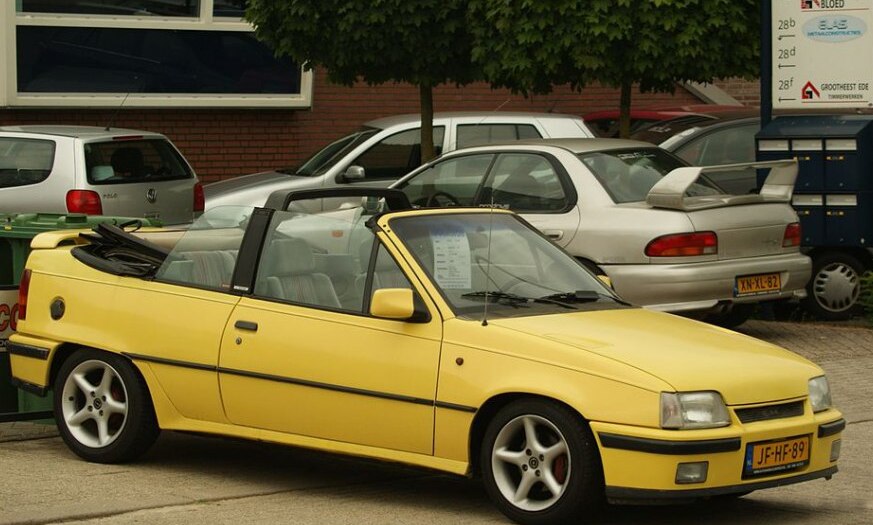
The Opel Kadett E Cabrio 2.0i CAT, produced between 1986 and 1993, represented the final iteration of the Kadett E series, and the last open-top Kadett offered by Opel. Positioned as a more premium variant within the Kadett E Cabrio range, the 2.0i CAT offered a blend of performance and style, appealing to buyers seeking a sporty and enjoyable driving experience. It was a key model in Opel’s lineup during a period of increasing competition in the European compact car market. The “CAT” designation refers to the catalytic converter fitted to the exhaust system, signifying compliance with emerging emissions regulations.
Technical Specifications
| Brand | Opel |
| Model | Kadett |
| Generation | Kadett E Cabrio |
| Type (Engine) | 2.0i CAT (115 Hp) |
| Start of production | 1986 |
| End of production | 1993 |
| Powertrain Architecture | Internal Combustion engine |
| Body type | Cabriolet |
| Seats | 5 |
| Doors | 2 |
| Fuel Type | Petrol (Gasoline) |
| Acceleration 0 – 100 km/h | 10 sec |
| Acceleration 0 – 62 mph | 10 sec |
| Acceleration 0 – 60 mph | 9.5 sec |
| Maximum speed | 195 km/h (121.17 mph) |
| Weight-to-power ratio | 9.2 kg/Hp, 109 Hp/tonne |
| Weight-to-torque ratio | 6.2 kg/Nm, 161.1 Nm/tonne |
| Power | 115 Hp @ 5400 rpm |
| Power per litre | 57.6 Hp/l |
| Torque | 170 Nm @ 3000 rpm (125.39 lb.-ft. @ 3000 rpm) |
| Engine layout | Front, Transverse |
| Engine Model/Code | C20NE |
| Engine displacement | 1998 cm3 (121.93 cu. in.) |
| Number of cylinders | 4 |
| Engine configuration | Inline |
| Cylinder Bore | 86 mm (3.39 in.) |
| Piston Stroke | 86 mm (3.39 in.) |
| Compression ratio | 9.2:1 |
| Number of valves per cylinder | 2 |
| Fuel injection system | Multi-port manifold injection |
| Engine aspiration | Naturally aspirated engine |
| Valvetrain | SOHC |
| Engine oil capacity | 4 l (4.23 US qt | 3.52 UK qt) |
| Coolant | 6.9 l (7.29 US qt | 6.07 UK qt) |
| Kerb Weight | 1055 kg (2325.88 lbs.) |
| Max. weight | 1460 kg (3218.75 lbs.) |
| Max load | 405 kg (892.87 lbs.) |
| Trunk (boot) space – minimum | 290 l (10.24 cu. ft.) |
| Trunk (boot) space – maximum | 620 l (21.9 cu. ft.) |
| Fuel tank capacity | 52 l (13.74 US gal | 11.44 UK gal) |
| Length | 3998 mm (157.4 in.) |
| Width | 1663 mm (65.47 in.) |
| Height | 1380 mm (54.33 in.) |
| Wheelbase | 2520 mm (99.21 in.) |
| Front track | 1406 mm (55.35 in.) |
| Rear (Back) track | 1406 mm (55.35 in.) |
| Minimum turning circle | 10.5 m (34.45 ft.) |
| Drivetrain Architecture | The Internal combustion engine (ICE) drives the front wheels of the vehicle. |
| Drive wheel | Front wheel drive |
| Number of gears and type of gearbox | 5 gears, manual transmission |
| Front brakes | Ventilated discs |
| Rear brakes | Drum |
| Tires size | 185/60 R14 |
| Wheel rims size | 14 |
Powertrain & Engine Architecture
The heart of the Kadett E Cabrio 2.0i CAT was the C20NE engine, a 1.998-liter inline-four cylinder powerplant. This engine featured a single overhead camshaft (SOHC) valvetrain operating two valves per cylinder. The C20NE utilized Bosch Motronic fuel injection, a multi-port system that precisely controlled fuel delivery for optimal combustion and emissions control. The catalytic converter, integral to the “CAT” designation, played a crucial role in reducing harmful exhaust gases. The engine produced 115 horsepower at 5400 rpm and 170 Nm (125 lb-ft) of torque at 3000 rpm. The engine’s transverse mounting and front-wheel drive configuration were typical for European compact cars of the era. The standard transmission was a five-speed manual gearbox, providing drivers with good control over the engine’s power band.
Driving Characteristics
The 2.0i CAT offered a noticeable step up in performance compared to the lower-displacement Kadett E Cabrio models. While not a sports car, the 115 hp engine provided adequate power for comfortable cruising and spirited driving. Acceleration to 60 mph took around 9.5 seconds, and the car could reach a top speed of approximately 121 mph. The five-speed manual transmission allowed drivers to keep the engine in its optimal power range. The gear ratios were well-suited for everyday driving, offering a balance between acceleration and fuel economy. Compared to the 1.6-liter versions, the 2.0i CAT felt more responsive and capable, particularly when carrying passengers or luggage. The handling was typical of front-wheel-drive cars of the period – safe and predictable, but not particularly engaging.
Equipment & Trim Levels
The 2.0i CAT was generally well-equipped for its time. Standard features typically included power steering, central locking, and a basic stereo system. Interior upholstery was usually cloth, with options for upgraded materials. The dashboard layout was functional and straightforward, with clearly marked gauges. Optional extras included alloy wheels, a sunroof (in addition to the convertible top), and upgraded sound systems. The Kadett E Cabrio 2.0i CAT occupied a mid-range position in the lineup, offering a good balance of features and price. It was aimed at buyers who wanted a stylish and enjoyable convertible without the expense of a more luxurious model.
Chassis & Braking
The Kadett E Cabrio utilized a MacPherson strut front suspension and a torsion beam rear suspension. The front suspension provided a comfortable ride and decent handling, while the torsion beam rear suspension was a cost-effective solution that offered adequate stability. Braking was handled by ventilated discs at the front and drum brakes at the rear. While adequate for normal driving, the braking system wasn’t particularly powerful. The Kadett E Cabrio’s chassis was reinforced to compensate for the loss of structural rigidity inherent in a convertible design. Stabilizer bars were fitted to both the front and rear axles to reduce body roll during cornering.
Market Reception & Comparison
The Kadett E Cabrio 2.0i CAT was generally well-received by automotive critics. It was praised for its stylish design, comfortable ride, and relatively affordable price. However, some critics noted that the handling wasn’t as sharp as some of its competitors. Compared to other trims in the Kadett E Cabrio lineup, the 2.0i CAT offered a significant performance advantage. Fuel economy was reasonable for a car of its size and engine displacement, averaging around 28-32 mpg. Reliability was generally good, although some owners reported issues with the electrical system. Compared to rivals like the Volkswagen Golf Cabriolet and the Peugeot 205 Cabriolet, the Kadett E Cabrio offered a compelling combination of value and style.
Legacy
The Opel Kadett E Cabrio 2.0i CAT remains a popular choice among classic car enthusiasts. The C20NE engine is known for its durability and relatively simple maintenance requirements. While parts availability can be a challenge, many components are still available through specialist suppliers. Today, well-maintained examples of the Kadett E Cabrio 2.0i CAT are sought after by collectors and enthusiasts who appreciate its classic styling and enjoyable driving experience. The car represents a significant chapter in Opel’s history, and a reminder of a time when convertibles were becoming increasingly accessible to the masses.