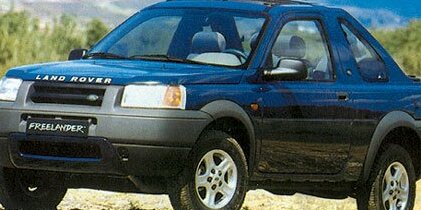
The Land Rover Freelander I Soft Top 2.0 TD4, produced between 2001 and 2006, represented a unique offering within the first generation Freelander lineup. Positioned as a more affordable and lifestyle-oriented variant, it combined the practicality of a compact SUV with the open-air experience of a convertible soft top. This model was primarily aimed at the European market, where smaller SUVs and convertibles enjoyed significant popularity. The 2.0 TD4 engine, delivering 112 horsepower, provided a balance between fuel efficiency and reasonable performance for everyday driving. It sat in the mid-range of the Freelander I offerings, below the more powerful petrol variants and above the base-level diesel models.
Technical Specifications
| Brand | Land Rover |
| Model | Freelander |
| Generation | Freelander I Soft Top |
| Type (Engine) | 2.0 TD4 (112 Hp) |
| Start of production | 2001 |
| End of production | 2006 |
| Powertrain Architecture | Internal Combustion engine |
| Body type | SUV |
| Seats | 5 |
| Doors | 5 |
| Fuel consumption (urban) | 9.1 l/100 km (25.8 US mpg, 31 UK mpg, 11 km/l) |
| Fuel consumption (extra urban) | 6.7 l/100 km (35.1 US mpg, 42.2 UK mpg, 14.9 km/l) |
| Fuel consumption (combined) | 7.6 l/100 km (30.9 US mpg, 37.2 UK mpg, 13.2 km/l) |
| Fuel Type | Diesel |
| Acceleration 0 – 100 km/h | 14.4 sec |
| Acceleration 0 – 62 mph | 14.4 sec |
| Acceleration 0 – 60 mph | 13.7 sec |
| Maximum speed | 159 km/h (98.8 mph) |
| Weight-to-power ratio | 14.4 kg/Hp, 69.3 Hp/tonne |
| Weight-to-torque ratio | 6.2 kg/Nm, 161 Nm/tonne |
| Power | 112 Hp @ 4000 rpm |
| Power per litre | 57.4 Hp/l |
| Torque | 260 Nm @ 1750 rpm (191.77 lb.-ft. @ 1750 rpm) |
| Engine layout | Front, Transverse |
| Engine Model/Code | 204D3 |
| Engine displacement | 1951 cm3 (119.06 cu. in.) |
| Number of cylinders | 4 |
| Engine configuration | Inline |
| Cylinder Bore | 84 mm (3.31 in.) |
| Piston Stroke | 88 mm (3.46 in.) |
| Compression ratio | 18:1 |
| Number of valves per cylinder | 4 |
| Fuel injection system | Diesel Commonrail |
| Engine aspiration | Turbocharger, Intercooler |
| Valvetrain | DOHC |
| Engine oil capacity | 6.8 l (7.19 US qt | 5.98 UK qt) |
| Coolant capacity | 7.25 l (7.66 US qt | 6.38 UK qt) |
| Kerb Weight | 1615 kg (3560.47 lbs.) |
| Max. weight | 2080 kg (4585.62 lbs.) |
| Max load | 465 kg (1025.15 lbs.) |
| Trunk (boot) space – minimum | 311 l (10.98 cu. ft.) |
| Trunk (boot) space – maximum | 1194 l (42.17 cu. ft.) |
| Fuel tank capacity | 60 l (15.85 US gal | 13.2 UK gal) |
| Length | 4368 mm (171.97 in.) |
| Width | 1809 mm (71.22 in.) |
| Height | 1708 mm (67.24 in.) |
| Wheelbase | 2557 mm (100.67 in.) |
| Front track | 1534 mm (60.39 in.) |
| Rear (Back) track | 1545 mm (60.83 in.) |
| Drive wheel | All wheel drive (4×4) |
| Number of gears and type of gearbox | 5 gears, manual transmission |
| Front suspension | Coil spring |
| Rear suspension | Coil spring |
| Front brakes | Ventilated discs |
| Rear brakes | Drum |
| Assisting systems | ABS (Anti-lock braking system) |
| Steering type | Steering rack and pinion |
| Power steering | Hydraulic Steering |
| Tires size | 195/80 R15 S |
| Wheel rims size | 15 |
Powertrain & Engine Architecture
The heart of the Freelander I Soft Top 2.0 TD4 was the 204D3 engine, a 1.998-liter inline-four cylinder diesel. This engine was part of the Rover/Land Rover MDi series, and utilized a turbocharger with an intercooler to boost power output. The 204D3 employed a Bosch diesel common rail fuel injection system, delivering fuel at extremely high pressure for improved combustion efficiency and reduced emissions. The engine featured a double overhead camshaft (DOHC) valvetrain with four valves per cylinder, contributing to its relatively high specific output for a diesel engine of its era. The 112 horsepower and 260 Nm (192 lb-ft) of torque were respectable figures, providing adequate performance for typical on-road driving. The engine was transversely mounted in the front of the vehicle. The five-speed manual transmission was the standard offering, providing a balance between fuel economy and drivability.
Driving Characteristics
The 2.0 TD4 Soft Top, with its 112 horsepower and manual transmission, offered a driving experience focused on practicality and fuel economy rather than outright performance. Acceleration was modest, taking around 14.4 seconds to reach 62 mph. The turbocharger provided a noticeable boost in power at higher engine speeds, but the engine lacked the responsiveness of more modern turbocharged diesels. The manual gearbox featured relatively long gearing, prioritizing fuel efficiency over rapid acceleration. Compared to the 2.5-liter V6 petrol versions, the 2.0 TD4 felt significantly slower, but it offered substantially better fuel economy. The soft top added a slight weight penalty compared to the hardtop models, potentially impacting handling slightly, but the overall driving experience remained comfortable and predictable.
Equipment & Trim Levels
The Freelander I Soft Top 2.0 TD4 typically came with a reasonable level of standard equipment. This included air conditioning, power steering, central locking, and an AM/FM radio. Interior upholstery was generally cloth, with options for leather upgrades. Dashboard trim was typically plastic, reflecting the vehicle’s price point. Optional extras included alloy wheels, a CD player, and upgraded sound systems. The soft top itself was a manually operated folding roof, offering a degree of open-air enjoyment. Safety features included ABS brakes and driver and passenger airbags.
Chassis & Braking
The Freelander I utilized a monocoque chassis construction, providing a good balance between strength and weight. Suspension consisted of coil springs all around, with independent suspension at the front and a multi-link setup at the rear. The front brakes were ventilated discs, providing good stopping power, while the rear brakes were drums, a cost-saving measure. The steering was a hydraulic rack and pinion system, offering precise and responsive handling. The 4×4 system was a permanent all-wheel drive setup, providing enhanced traction in slippery conditions. Stabilizer bars were fitted front and rear to reduce body roll during cornering.
Market Reception & Comparison
The Freelander I Soft Top 2.0 TD4 was generally well-received by critics as a stylish and practical SUV. The soft top added a unique appeal, differentiating it from more conventional SUVs. However, the 2.0 TD4 engine was sometimes criticized for its lack of outright performance. Compared to the V6 petrol versions, the diesel offered significantly better fuel economy, making it a more attractive option for drivers covering long distances. Reliability was generally good, although some owners reported issues with the diesel injection system. The soft top mechanism also required regular maintenance to prevent leaks and ensure smooth operation.
Legacy
The Land Rover Freelander I Soft Top 2.0 TD4 remains a popular choice among enthusiasts and used car buyers. The combination of practicality, style, and affordability has ensured its continued appeal. The 204D3 engine, while not the most powerful, is generally considered to be reliable if properly maintained. However, potential buyers should be aware of the potential for issues with the diesel injection system and the soft top mechanism. Today, these vehicles are often sought after as weekend vehicles or as a stylish alternative to more conventional SUVs. Parts availability is generally good, although some specific components may be becoming increasingly difficult to find.