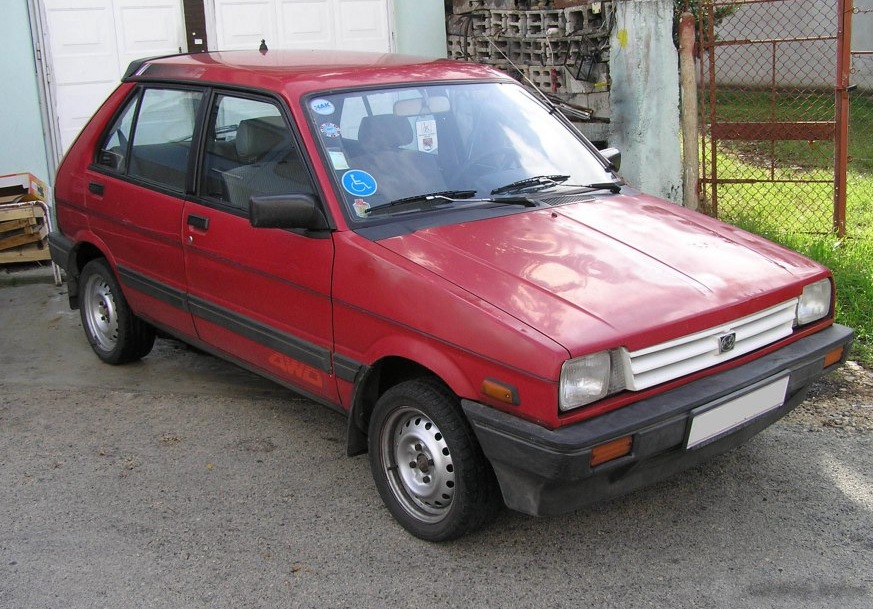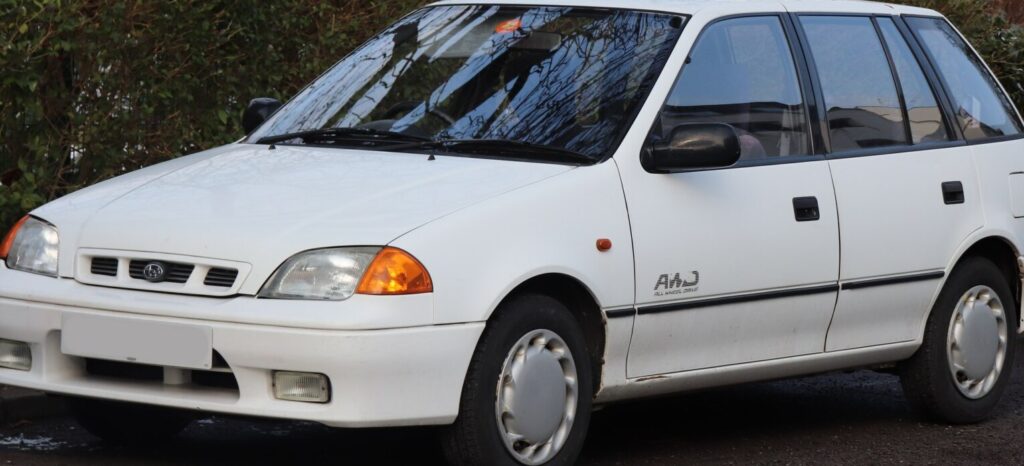
The Subaru Justy II, produced between 1995 and 2001, represented a significant evolution of Subaru’s entry-level offering. Specifically, the 1.3i 4×4 (5-door) variant, equipped with a 68 horsepower engine, occupied a unique position within the Justy II range (chassis codes JMA and MS). This model aimed to provide affordable all-wheel drive capability in a compact hatchback package, primarily targeting European and Japanese markets where smaller, fuel-efficient vehicles with all-weather traction were highly valued. It was positioned as the entry point to Subaru’s symmetrical all-wheel drive system, offering a practical and economical option for urban and rural drivers alike.
Technical Specifications
| Brand | Subaru |
| Model | Justy |
| Generation | Justy II (JMA,MS) |
| Type | 1.3 i 4×4 (5 dr) (68 Hp) |
| Start of production | 1995 |
| End of production | 2001 |
| Powertrain Architecture | Internal Combustion engine |
| Body type | Hatchback |
| Seats | 5 |
| Doors | 5 |
| Fuel consumption (urban) | 8.6 l/100 km (27.4 US mpg, 32.8 UK mpg, 11.6 km/l) |
| Fuel consumption (extra urban) | 6 l/100 km (39.2 US mpg, 47.1 UK mpg, 16.7 km/l) |
| Fuel Type | Petrol (Gasoline) |
| Acceleration 0 – 100 km/h | 13.6 sec |
| Acceleration 0 – 62 mph | 13.6 sec |
| Acceleration 0 – 60 mph | 12.9 sec |
| Maximum speed | 155 km/h (96.31 mph) |
| Weight-to-power ratio | 13.4 kg/Hp, 74.7 Hp/tonne |
| Weight-to-torque ratio | 9.2 kg/Nm, 108.8 Nm/tonne |
| Power | 68 Hp @ 6000 rpm |
| Power per litre | 52.3 Hp/l |
| Torque | 99 Nm @ 3500 rpm (73.02 lb.-ft. @ 3500 rpm) |
| Engine layout | Front, Transverse |
| Engine Model/Code | G13BA |
| Engine displacement | 1299 cm3 (79.27 cu. in.) |
| Number of cylinders | 4 |
| Engine configuration | Inline |
| Cylinder Bore | 74 mm (2.91 in.) |
| Piston Stroke | 75.5 mm (2.97 in.) |
| Compression ratio | 9.5:1 |
| Number of valves per cylinder | 2 |
| Fuel injection system | Multi-port manifold injection |
| Engine aspiration | Naturally aspirated engine |
| Valvetrain | OHC |
| Engine oil capacity | 3.3 l (3.49 US qt | 2.9 UK qt) |
| Coolant capacity | 4.7 l (4.97 US qt | 4.14 UK qt) |
| Kerb Weight | 910 kg (2006.21 lbs.) |
| Max. weight | 1380 kg (3042.38 lbs.) |
| Max load | 470 kg (1036.17 lbs.) |
| Trunk (boot) space – minimum | 145 l (5.12 cu. ft.) |
| Trunk (boot) space – maximum | 360 l (12.71 cu. ft.) |
| Fuel tank capacity | 37 l (9.77 US gal | 8.14 UK gal) |
| Length | 3845 mm (151.38 in.) |
| Width | 1590 mm (62.6 in.) |
| Height | 1380 mm (54.33 in.) |
| Wheelbase | 2365 mm (93.11 in.) |
| Front track | 1365 mm (53.74 in.) |
| Rear track | 1340 mm (52.76 in.) |
| Minimum turning circle | 9.6 m (31.5 ft.) |
| Drive wheel | All wheel drive (4×4) |
| Number of gears | 5 gears, manual transmission |
| Front suspension | Spring Strut |
| Rear suspension | Wishbone |
| Front brakes | Ventilated discs |
| Rear brakes | Drum |
| Assisting systems | ABS (Anti-lock braking system) |
| Steering type | Steering rack and pinion |
| Tires size | 165/70 R13 |
Powertrain & Engine Architecture
The heart of the Justy II 1.3i 4×4 was the G13BA engine, a 1.3-liter, inline-four cylinder gasoline engine. This engine, while not particularly powerful, was known for its relative simplicity and durability. It featured a single overhead camshaft (OHC) valvetrain with two valves per cylinder. Fuel delivery was handled by a multi-port fuel injection system, a common setup for the time, contributing to improved fuel efficiency and smoother operation compared to carbureted engines. The engine produced 68 horsepower at 6000 rpm and 99 Nm (73 lb-ft) of torque at 3500 rpm. The engine’s compact size and transverse mounting allowed for a relatively spacious interior for a vehicle of its overall length. The transmission was a five-speed manual, chosen for its affordability and efficiency. The 4×4 system employed a viscous coupling to distribute power between the front and rear axles, providing automatic all-wheel drive engagement when slip was detected.
Driving Characteristics
The 1.3i 4×4 Justy was not designed for outright speed. Its 0-60 mph time of around 12.9 seconds and top speed of 96 mph reflected its modest power output. However, the all-wheel drive system provided significantly improved traction, particularly on slippery surfaces. The five-speed manual transmission allowed drivers to keep the engine in its optimal power band, but required frequent shifting for brisk acceleration. Compared to the slightly more powerful (but often more expensive) Justy models, the 1.3i offered a more economical driving experience. The gear ratios were tuned for fuel efficiency rather than performance, resulting in a relaxed cruising experience but limited passing power. The steering was light and responsive, making it easy to maneuver in urban environments.
Equipment & Trim Levels
The 1.3i 4×4 trim level was generally considered the base model for the all-wheel drive Justy. Standard equipment typically included power steering, central locking, and basic instrumentation. Interior upholstery was typically cloth, and the dashboard featured a functional, if somewhat spartan, design. Optional extras could include power windows, a sunroof, and upgraded audio systems. The focus was on providing essential features at an affordable price point. The interior space was surprisingly good for a subcompact hatchback, offering adequate room for five passengers and a usable cargo area.
Chassis & Braking
The Justy II utilized a relatively simple chassis design. Front suspension consisted of MacPherson strut springs, while the rear employed a wishbone setup. This configuration provided a reasonable balance between ride comfort and handling. Braking duties were handled by ventilated discs at the front and drum brakes at the rear. An Anti-lock Braking System (ABS) was included as standard equipment, enhancing safety by preventing wheel lockup during hard braking. The relatively light weight of the vehicle (around 910 kg or 2006 lbs) helped to compensate for the modest braking power.
Market Reception & Comparison
The Subaru Justy II 1.3i 4×4 was generally well-received as an affordable and practical all-wheel drive vehicle. Critics praised its fuel efficiency and sure-footed handling, particularly in inclement weather. However, its lack of power was often noted. Compared to other trims in the Justy lineup, such as those equipped with larger engines, the 1.3i offered a more economical option but at the expense of performance. It competed with other small hatchbacks like the Fiat Punto and Peugeot 206, but the Justy’s all-wheel drive system gave it a unique selling point. Fuel economy was competitive for the time, making it an attractive option for budget-conscious buyers.
Legacy
The G13BA engine and the associated 5-speed manual transmission proved to be relatively reliable powertrains. While not known for exceptional longevity, they were generally durable and relatively inexpensive to maintain. Today, the Justy II 1.3i 4×4 is a relatively rare sight on the roads, but those that remain are often well-maintained by enthusiasts who appreciate their simplicity and all-weather capability. Parts availability can be a challenge, but many components are still obtainable. The Justy II 1.3i 4×4 represents a unique chapter in Subaru’s history, demonstrating the company’s commitment to providing affordable all-wheel drive technology to a wider audience.