
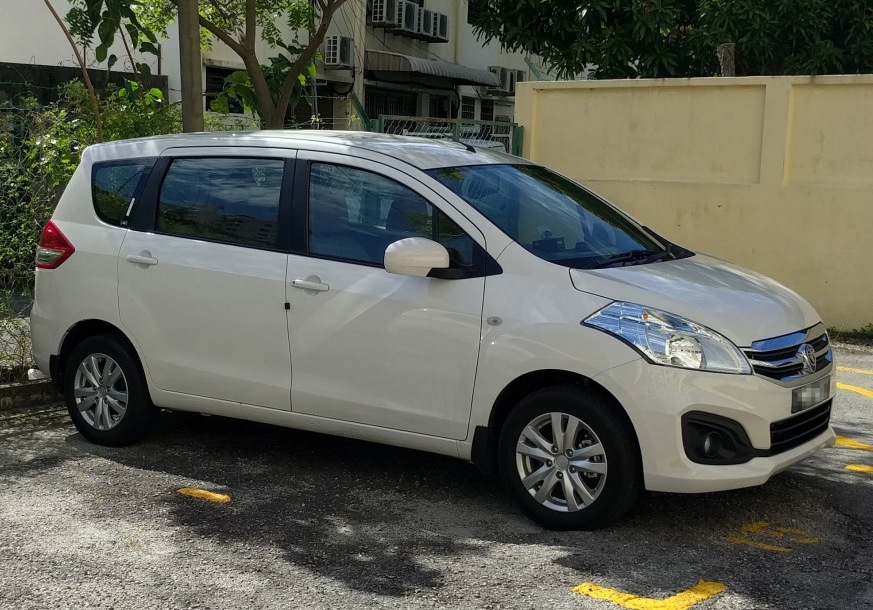
The Proton Ertiga 1.4, producing 92 horsepower, was a compact multi-purpose vehicle (MPV) manufactured by Proton between 2016 and 2018. This variant represented an entry-level offering within the Ertiga range, primarily aimed at budget-conscious families in the Malaysian market and select export regions. It was based on the Suzuki Ertiga, a result of Proton’s collaboration with Suzuki, and slotted into a segment demanding practicality and affordability. The 1.4L engine and five-speed manual transmission combination was designed to balance fuel efficiency with acceptable performance for everyday driving needs.
Technical Specifications
| Brand | Proton |
| Model | Ertiga |
| Generation | Ertiga |
| Type (Engine) | 1.4 (92 Hp) |
| Start of production | 2016 |
| End of production | 2018 |
| Powertrain Architecture | Internal Combustion engine |
| Body type | MPV |
| Seats | 6 |
| Doors | 5 |
| Fuel consumption (combined) | 6 l/100 km (39.2 US mpg, 47.1 UK mpg, 16.7 km/l) |
| Fuel Type | Petrol (Gasoline) |
| Weight-to-power ratio | 12.8 kg/Hp, 78.3 Hp/tonne |
| Weight-to-torque ratio | 9 kg/Nm, 110.6 Nm/tonne |
| Power | 92 Hp @ 6000 rpm |
| Power per litre | 67 Hp/l |
| Torque | 130 Nm @ 4000 rpm (95.88 lb.-ft. @ 4000 rpm) |
| Engine layout | Front, Transverse |
| Engine Model/Code | K14B |
| Engine displacement | 1373 cm3 (83.79 cu. in.) |
| Number of cylinders | 4 |
| Engine configuration | Inline |
| Cylinder Bore | 73 mm (2.87 in.) |
| Piston Stroke | 82 mm (3.23 in.) |
| Compression ratio | 11:1 |
| Number of valves per cylinder | 4 |
| Fuel injection system | Multi-port manifold injection |
| Engine aspiration | Naturally aspirated engine |
| Valvetrain | DOHC |
| Engine oil capacity | 3.1 l (3.28 US qt | 2.73 UK qt) |
| Coolant | 4.1 l (4.33 US qt | 3.61 UK qt) |
| Kerb Weight | 1175 kg (2590.43 lbs.) |
| Length | 4265 mm (167.91 in.) |
| Width | 1695 mm (66.73 in.) |
| Height | 1685 mm (66.34 in.) |
| Wheelbase | 2740 mm (107.87 in.) |
| Ride height (ground clearance) | 185 mm (7.28 in.) |
| Minimum turning circle | 10.4 m (34.12 ft.) |
| Drivetrain Architecture | The Internal combustion engine (ICE) drives the front wheels of the vehicle. |
| Drive wheel | Front wheel drive |
| Number of gears and type of gearbox | 5 gears, manual transmission |
| Front suspension | Independent, type McPherson with coil spring and anti-roll bar |
| Rear suspension | independent torsion suspension |
| Front brakes | Ventilated discs |
| Rear brakes | Drum |
| Assisting systems | ABS (Anti-lock braking system) |
| Steering type | Steering rack and pinion |
| Power steering | Electric Steering |
| Tires size | 185/65 R15 |
| Wheel rims size | 5.5J x 15 |
Powertrain & Engine Architecture
The Proton Ertiga 1.4 was powered by the K14B engine, a 1.4-liter inline-four cylinder gasoline engine. This engine, sourced from Suzuki, featured a multi-point fuel injection system and a double overhead camshaft (DOHC) valvetrain. The K14B engine was known for its relatively simple design and focus on fuel efficiency rather than outright performance. The 11:1 compression ratio helped to extract a reasonable amount of power from the small displacement. The five-speed manual transmission was the sole gearbox option for this variant, providing drivers with full control over gear selection. The transmission was chosen to maximize fuel economy and keep costs down.
Driving Characteristics
The 92 horsepower and 130 Nm (95.88 lb-ft) of torque delivered by the 1.4L engine resulted in modest, but adequate, performance. Acceleration was not brisk, and overtaking required careful planning, especially when the vehicle was fully loaded with passengers and luggage. The five-speed manual transmission allowed drivers to keep the engine in its optimal power band, but the overall driving experience was geared towards economy rather than sporty handling. Compared to potential higher-spec Ertiga variants (had they been offered in the market), this version lacked the punch needed for more spirited driving. The gear ratios were tuned for fuel efficiency, meaning that highway cruising at higher speeds could feel somewhat strained.
Equipment & Trim Levels
The Proton Ertiga 1.4 was generally equipped with basic, but functional, features. Standard equipment typically included air conditioning, power windows, and a basic audio system. Interior upholstery was usually cloth, and the dashboard design was straightforward and utilitarian. Optional extras were limited, reflecting the vehicle’s positioning as an affordable family MPV. Safety features were also basic, typically including ABS (Anti-lock Braking System) and dual front airbags. Higher trim levels, if available, might have added features like alloy wheels, a more advanced audio system, and rear parking sensors.
Chassis & Braking
The Ertiga 1.4 utilized a McPherson strut front suspension and a torsion beam rear suspension. This setup provided a reasonable balance between ride comfort and handling, although it wasn’t particularly sporty. The front brakes were ventilated discs, offering adequate stopping power, while the rear brakes were drums, a cost-saving measure. The electric power steering provided light and easy steering, making it convenient for maneuvering in urban environments. The 185/65 R15 tires were chosen for a balance of comfort and fuel efficiency.
Market Reception & Comparison
The Proton Ertiga 1.4 was generally well-received in the Malaysian market as an affordable and practical family vehicle. Critics praised its spacious interior and fuel efficiency, but noted its lack of performance. Compared to other MPVs in its class, the Ertiga 1.4 offered a competitive price point, but its engine lacked the refinement and power of some rivals. The manual transmission was seen as a positive by some, offering greater driver engagement, but others preferred the convenience of an automatic gearbox. Fuel economy figures of around 6 l/100 km (39.2 US mpg) were considered respectable for its class.
Legacy
The Proton Ertiga 1.4, while not a performance icon, served as a valuable entry point into the MPV segment for many families. The K14B engine proved to be relatively reliable, and parts availability remained good even after production ended in 2018. On the used car market, these models are often sought after for their affordability and practicality. While maintenance costs are generally low, potential buyers should be aware of the age-related wear and tear common to all vehicles of this era. The Ertiga 1.4’s legacy lies in its ability to provide a functional and affordable transportation solution for families on a budget.
