
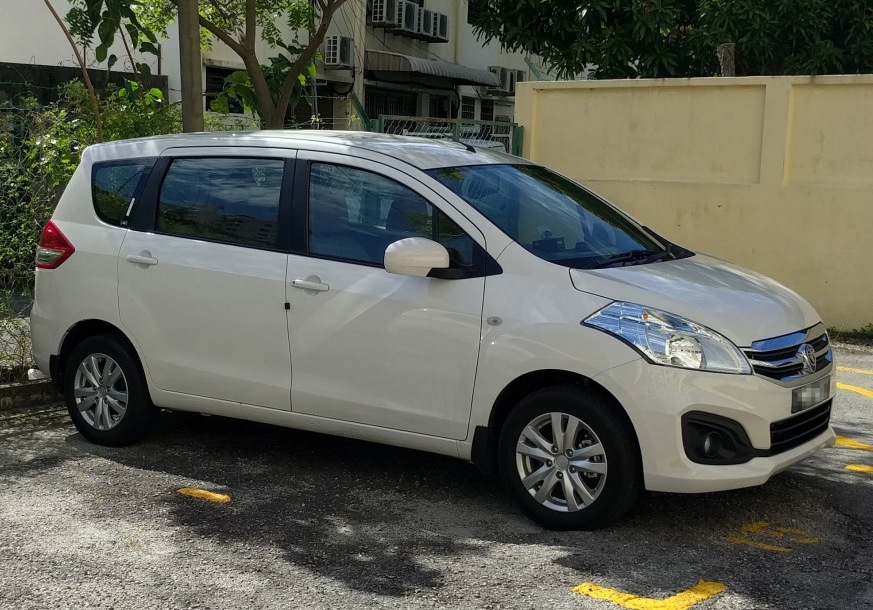
The Proton Ertiga 1.4 (92 hp) Automatic, produced between 2016 and 2018, represents a significant entry for Proton into the increasingly popular multi-purpose vehicle (MPV) segment. This variant was specifically tailored for the Malaysian market and surrounding regions, offering a practical and affordable family transport solution. It’s based on the Ertiga platform originally developed by Suzuki, reflecting Proton’s collaboration with the Japanese automaker. The 1.4L engine and automatic transmission combination positioned this Ertiga as a mid-range offering, balancing affordability with convenience, aimed at families seeking a comfortable and spacious vehicle for daily use.
Technical Specifications
| Brand | Proton |
| Model | Ertiga |
| Generation | Ertiga |
| Type (Engine) | 1.4 (92 Hp) Automatic |
| Start of production | 2016 |
| End of production | 2018 |
| Powertrain Architecture | Internal Combustion engine |
| Body type | MPV |
| Seats | 6 |
| Doors | 5 |
| Fuel consumption (combined) | 6 l/100 km (39.2 US mpg, 47.1 UK mpg, 16.7 km/l) |
| Fuel Type | Petrol (Gasoline) |
| Weight-to-power ratio | 12.9 kg/Hp, 77.6 Hp/tonne |
| Weight-to-torque ratio | 9.1 kg/Nm, 109.7 Nm/tonne |
| Power | 92 Hp @ 6000 rpm |
| Power per litre | 67 Hp/l |
| Torque | 130 Nm @ 4000 rpm (95.88 lb.-ft. @ 4000 rpm) |
| Engine layout | Front, Transverse |
| Engine Model/Code | K14B |
| Engine displacement | 1373 cm3 (83.79 cu. in.) |
| Number of cylinders | 4 |
| Engine configuration | Inline |
| Cylinder Bore | 73 mm (2.87 in.) |
| Piston Stroke | 82 mm (3.23 in.) |
| Compression ratio | 11:1 |
| Number of valves per cylinder | 4 |
| Fuel injection system | Multi-port manifold injection |
| Engine aspiration | Naturally aspirated engine |
| Valvetrain | DOHC |
| Engine oil capacity | 3.1 l (3.28 US qt | 2.73 UK qt) |
| Coolant | 4.1 l (4.33 US qt | 3.61 UK qt) |
| Kerb Weight | 1185 kg (2612.48 lbs.) |
| Length | 4265 mm (167.91 in.) |
| Width | 1695 mm (66.73 in.) |
| Height | 1685 mm (66.34 in.) |
| Wheelbase | 2740 mm (107.87 in.) |
| Ride height (ground clearance) | 185 mm (7.28 in.) |
| Minimum turning circle | 10.4 m (34.12 ft.) |
| Drivetrain Architecture | Front wheel drive, Internal Combustion engine |
| Number of gears and type of gearbox | 4 gears, automatic transmission |
| Front suspension | Independent, McPherson with coil spring and anti-roll bar |
| Rear suspension | Independent torsion suspension |
| Front brakes | Ventilated discs |
| Rear brakes | Drum |
| Assisting systems | ABS (Anti-lock braking system) |
| Steering type | Steering rack and pinion |
| Power steering | Electric Steering |
| Tires size | 185/65 R15 |
| Wheel rims size | 5.5J x 15 |
Powertrain & Engine Architecture
The heart of the Proton Ertiga 1.4 Automatic is the K14B engine, a 1.4-liter inline-four cylinder gasoline engine. This engine utilizes a multi-point fuel injection system, delivering fuel directly to the intake ports. The engine features a double overhead camshaft (DOHC) valvetrain, optimizing airflow for improved efficiency and power output. The 11:1 compression ratio is typical for naturally aspirated engines of this era, balancing performance and fuel economy. The four-speed automatic transmission was a common choice for this class of vehicle, prioritizing ease of use over outright performance. It’s a conventional hydraulic automatic, known for its relative simplicity and reliability. While not offering the efficiency of more modern transmissions with more gears, it provided smooth shifts suitable for everyday driving.
Driving Characteristics
The 92 hp output and 130 Nm of torque delivered by the K14B engine, coupled with the four-speed automatic, resulted in a driving experience geared towards practicality rather than sportiness. Acceleration was adequate for typical urban and highway driving, but overtaking maneuvers required careful planning. The automatic transmission’s gear ratios were tuned for fuel efficiency and smooth cruising, rather than aggressive acceleration. Compared to the manual transmission version of the Ertiga, the automatic offered less driver engagement but greater convenience. Higher-output variants, if available in the region, would have provided noticeably quicker acceleration and more responsive performance, but at the expense of fuel economy.
Equipment & Trim Levels
The Proton Ertiga 1.4 Automatic typically came equipped with standard features expected of a family MPV in its price range. These included air conditioning, power windows, central locking, and an audio system with basic connectivity options. Interior upholstery was generally fabric, with a focus on durability and ease of cleaning. Optional extras could include alloy wheels, a more advanced audio system with Bluetooth connectivity, and rear parking sensors. The dashboard layout was functional and straightforward, prioritizing usability over aesthetic flair. Safety features typically included dual airbags and ABS (Anti-lock Braking System).
Chassis & Braking
The Ertiga’s chassis featured an independent McPherson strut suspension at the front, providing a comfortable ride and decent handling characteristics. The rear suspension utilized a torsion beam setup, a cost-effective solution that offered adequate ride quality for most road conditions. The braking system consisted of ventilated discs at the front and drum brakes at the rear. While adequate for the vehicle’s weight and performance, the rear drum brakes were a cost-saving measure compared to disc brakes on all four wheels. Electric power steering provided light and easy steering input, making it convenient for maneuvering in tight spaces.
Market Reception & Comparison
The Proton Ertiga 1.4 Automatic was generally well-received in the Malaysian market as an affordable and practical family vehicle. Critics praised its spacious interior, comfortable ride, and reasonable fuel economy. However, some reviewers noted the engine’s lack of outright power and the automatic transmission’s somewhat dated technology. Compared to other MPVs in the segment, the Ertiga offered a competitive price point and a good balance of features. Its fuel economy was comparable to other 1.4-liter gasoline engines, and its reliability was generally considered to be good, benefiting from Suzuki’s engineering expertise.
Legacy
The Proton Ertiga 1.4 Automatic, while no longer in production, remains a common sight on Malaysian roads. The K14B engine and four-speed automatic transmission have proven to be relatively reliable, with many examples still in service today. Maintenance costs are generally reasonable, and spare parts are readily available. In the used car market, these Ertigas represent a good value proposition for budget-conscious buyers seeking a spacious and practical family vehicle. While not a performance icon, the Proton Ertiga 1.4 Automatic successfully fulfilled its role as an affordable and dependable MPV for Malaysian families.
