Technical Specifications
| Brand | Opel |
| Model | Kadett |
| Generation | Kadett E Caravan |
| Type (Engine) | 1.3i CAT (60 Hp) |
| Start of production | 1985 |
| End of production | 1991 |
| Powertrain Architecture | Internal Combustion engine |
| Body type | Station wagon (estate) |
| Seats | 5 |
| Doors | 3-5 |
| Fuel Type | Petrol (Gasoline) |
| Acceleration 0 – 100 km/h | 17.5 sec |
| Acceleration 0 – 62 mph | 17.5 sec |
| Acceleration 0 – 60 mph | 16.6 sec |
| Maximum speed | 155 km/h (96.31 mph) |
| Weight-to-power ratio | 15.1 kg/Hp, 66.3 Hp/tonne |
| Weight-to-torque ratio | 9.4 kg/Nm, 106.1 Nm/tonne |
| Power | 60 Hp @ 5600 rpm |
| Power per litre | 46.3 Hp/l |
| Torque | 96 Nm @ 3400 rpm (70.81 lb.-ft. @ 3400 rpm) |
| Engine layout | Front, Transverse |
| Engine Model/Code | C13N |
| Engine displacement | 1297 cm3 (79.15 cu. in.) |
| Number of cylinders | 4 |
| Engine configuration | Inline |
| Cylinder Bore | 75 mm (2.95 in.) |
| Piston Stroke | 73.4 mm (2.89 in.) |
| Compression ratio | 9:1 |
| Number of valves per cylinder | 2 |
| Fuel injection system | Multi-port manifold injection |
| Engine aspiration | Naturally aspirated engine |
| Valvetrain | SOHC |
| Engine oil capacity | 3 l (3.17 US qt | 2.64 UK qt) |
| Coolant | 7 l (7.4 US qt | 6.16 UK qt) |
| Kerb Weight | 905 kg (1995.18 lbs.) |
| Max. weight | 1420 kg (3130.56 lbs.) |
| Max load | 515 kg (1135.38 lbs.) |
| Trunk (boot) space – minimum | 565 l (19.95 cu. ft.) |
| Trunk (boot) space – maximum | 1800 l (63.57 cu. ft.) |
| Fuel tank capacity | 50 l (13.21 US gal | 11 UK gal) |
| Length | 4228 mm (166.46 in.) |
| Width | 1666 mm (65.59 in.) |
| Height | 1430 mm (56.3 in.) |
| Wheelbase | 2520 mm (99.21 in.) |
| Front track | 1400 mm (55.12 in.) |
| Rear (Back) track | 1406 mm (55.35 in.) |
| Minimum turning circle | 10.5 m (34.45 ft.) |
| Drivetrain Architecture | The Internal combustion engine (ICE) drives the front wheels of the vehicle. |
| Drive wheel | Front wheel drive |
| Number of gears | 4 gears, manual transmission |
| Front brakes | Disc |
| Rear brakes | Drum |
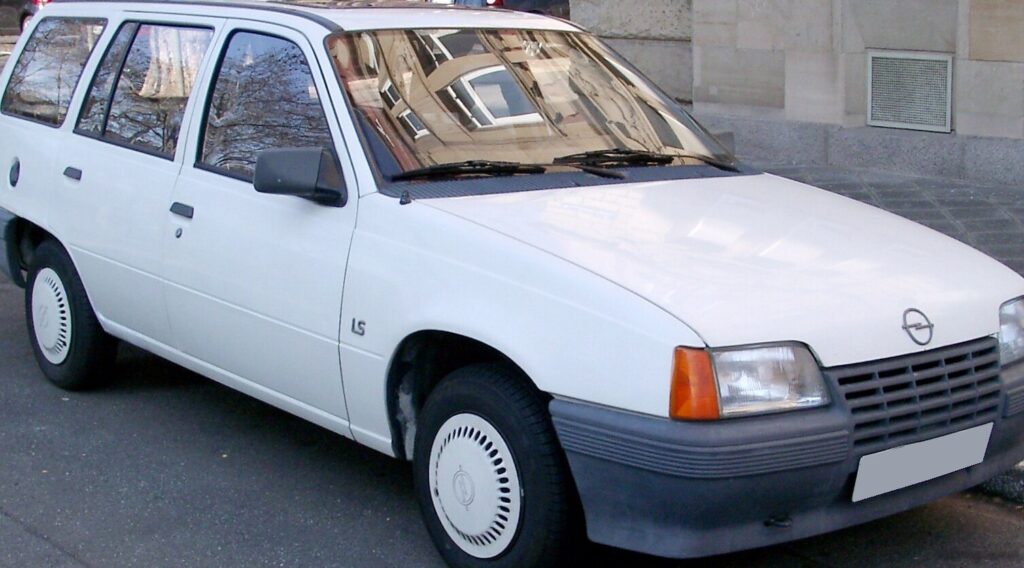
The Opel Kadett E Caravan 1.3i CAT, produced between 1985 and 1991, served as the entry-level variant within the Kadett E range. Positioned as a practical and economical family vehicle, it was a significant model for Opel, particularly in European markets. The Kadett E, and specifically the Caravan (station wagon) body style, aimed to provide affordable transportation with a focus on cargo capacity and fuel efficiency. This 1.3-liter version, equipped with a catalytic converter – denoted by the “CAT” designation – was engineered to meet increasingly strict emissions standards. It proved a popular choice for buyers who prioritized practicality and value over outright performance.
Powertrain & Engine Architecture
The Kadett E Caravan 1.3i CAT was powered by the C13N engine, a 1.3-liter inline-four cylinder unit. This engine featured a single overhead camshaft (SOHC) valvetrain operating two valves per cylinder. The C13N utilized multi-port fuel injection, a notable improvement over the carbureted engines found in earlier Opel models, contributing to better fuel economy and reduced emissions. The catalytic converter, central to the “CAT” designation, further minimized harmful exhaust gases. The engine’s relatively low compression ratio of 9:1 was typical for engines designed to operate on the fuel grades available at the time. A 4-speed manual transmission was standard, providing a straightforward and reliable way to transfer power to the front wheels.
Driving Characteristics
The 1.3i CAT powertrain delivered modest performance. With only 60 horsepower on tap, acceleration was unhurried, requiring approximately 17.5 seconds to reach 62 mph. The engine’s torque peak of 96 Nm (70.81 lb-ft) at 3400 rpm provided sufficient pulling power for everyday driving, but overtaking required careful consideration. Compared to the more powerful Kadett E variants, such as the 1.6 or 2.0-liter models, the 1.3i felt noticeably underpowered, especially when carrying a full load. The 4-speed gearbox was geared for economy rather than speed, with relatively tall gear ratios. The front-wheel-drive configuration offered predictable handling, but the car wasn’t designed for sporty driving. The emphasis was on providing a comfortable and economical driving experience.
Equipment & Trim Levels
The 1.3i CAT generally represented the base trim level for the Kadett E Caravan. Standard equipment typically included basic steel wheels, cloth upholstery, and a simple dashboard layout. Power steering and central locking were often offered as optional extras. Interior trim was functional and durable, prioritizing practicality over luxury. The Caravan body style itself was a key feature, offering a generous cargo capacity ranging from 565 to 1800 liters, making it well-suited for families or those needing to transport larger items. Optional extras could include a sunroof, upgraded audio systems, and a choice of exterior colors.
Chassis & Braking
The Kadett E Caravan utilized a relatively simple chassis design. Front suspension consisted of MacPherson struts, while the rear employed a twist-beam axle. This setup provided a reasonable balance between ride comfort and handling. Braking was accomplished via disc brakes on the front wheels and drum brakes on the rear. The braking system was adequate for the car’s performance level, but lacked the stopping power of the more advanced systems found on higher-spec Kadett models. Stabilizer bars were often omitted on the base 1.3i trim to minimize costs.
Market Reception & Comparison
The Kadett E Caravan 1.3i CAT was generally well-received as an affordable and practical family vehicle. Critics praised its fuel efficiency and spacious interior, but noted its limited performance. Compared to other Kadett E variants, the 1.3i offered the lowest price point, making it accessible to a broader range of buyers. The 1.6-liter version provided a noticeable performance boost, while the diesel models offered even better fuel economy. However, the 1.3i CAT remained a popular choice for those prioritizing economy and practicality over speed.
Legacy
The C13N engine, while not known for its high performance, proved to be a relatively reliable unit. Properly maintained examples of the Kadett E Caravan 1.3i CAT can still be found on the used car market today, often at very affordable prices. The car’s simplicity and durability have contributed to its longevity. While not a collector’s item, it represents a significant piece of automotive history, embodying the practical and economical values of the 1980s and early 1990s. Parts availability can be a challenge, but many components are still obtainable through specialist Opel parts suppliers. The Kadett E Caravan 1.3i CAT remains a testament to the enduring appeal of simple, reliable, and affordable transportation.