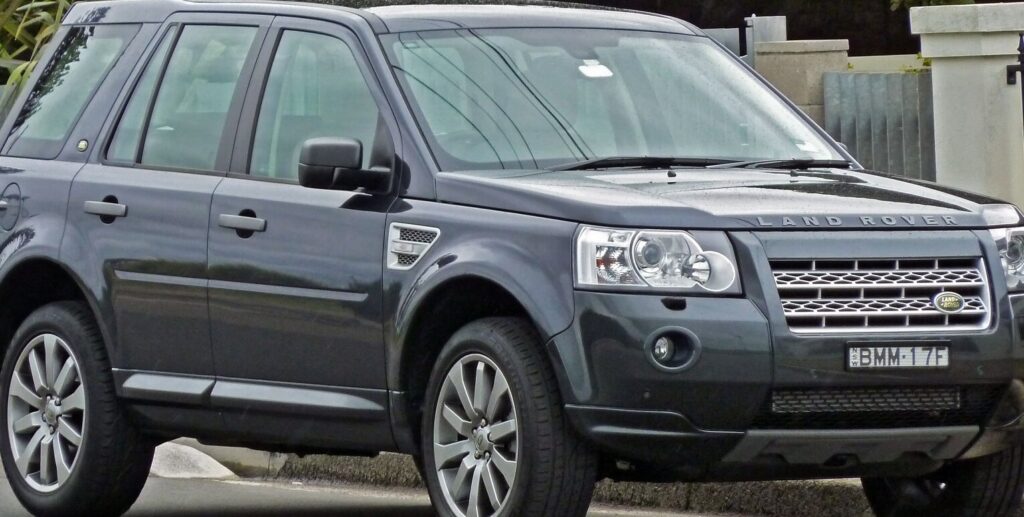
Technical Specifications
| Brand | Land Rover |
| Model | Freelander |
| Generation | Freelander II |
| Type (Engine) | 2.2 TD4 (160 Hp) Automatic |
| Start of production | 2006 |
| End of production | 2010 |
| Powertrain Architecture | Internal Combustion engine |
| Body type | SUV |
| Seats | 5 |
| Doors | 5 |
| Fuel consumption (urban) | 9.2 l/100 km (25.6 US mpg) |
| Fuel consumption (extra urban) | 6.2 l/100 km (37.9 US mpg) |
| Fuel consumption (combined) | 7.5 l/100 km (31.4 US mpg) |
| Fuel Type | Diesel |
| Acceleration 0 – 100 km/h | 11.7 sec |
| Acceleration 0 – 62 mph | 11.7 sec |
| Acceleration 0 – 60 mph | 11.1 sec |
| Maximum speed | 181 km/h (112.47 mph) |
| Weight-to-power ratio | 11.1 kg/Hp |
| Weight-to-torque ratio | 4.4 kg/Nm |
| Power | 160 Hp @ 4000 rpm |
| Torque | 400 Nm @ 2000 rpm (295.02 lb.-ft. @ 2000 rpm) |
| Engine layout | Front, Transverse |
| Engine Model/Code | 224DT |
| Engine displacement | 2179 cm3 (132.97 cu. in.) |
| Number of cylinders | 4 |
| Engine configuration | Inline |
| Cylinder Bore | 85 mm (3.35 in.) |
| Piston Stroke | 96 mm (3.78 in.) |
| Compression ratio | 16.5:1 |
| Number of valves per cylinder | 4 |
| Fuel injection system | Diesel Commonrail |
| Engine aspiration | Turbocharger, Intercooler |
| Engine oil capacity | 5.9 l (6.23 US qt | 5.19 UK qt) |
| Coolant capacity | 7.6 l (8.03 US qt | 6.69 UK qt) |
| Kerb Weight | 1770 kg (3902.18 lbs.) |
| Max. weight | 2505 kg (5522.58 lbs.) |
| Max load | 735 kg (1620.4 lbs.) |
| Trunk (boot) space – minimum | 755 l (26.66 cu. ft.) |
| Trunk (boot) space – maximum | 1670 l (58.98 cu. ft.) |
| Fuel tank capacity | 70 l (18.49 US gal | 15.4 UK gal) |
| Length | 4500 mm (177.17 in.) |
| Width | 1910 mm (75.2 in.) |
| Height | 1740 mm (68.5 in.) |
| Wheelbase | 2660 mm (104.72 in.) |
| Front track | 1611 mm (63.43 in.) |
| Rear track | 1624 mm (63.94 in.) |
| Minimum turning circle | 11.6 m (38.06 ft.) |
| Drive wheel | All wheel drive (4×4) |
| Number of gears | 6 |
| Gearbox type | Automatic transmission |
| Front suspension | Spring Strut |
| Rear suspension | Spring Strut |
| Front brakes | Ventilated discs |
| Rear brakes | Ventilated discs |
| Assisting systems | ABS (Anti-lock braking system) |
| Steering type | Steering rack and pinion |
| Tires size | 215/75 R16 |
| Wheel rims size | 16 |
The Land Rover Freelander II 2.2 TD4 Automatic, launched in 2006, was a crucial model in revitalizing the Freelander nameplate. The second-generation Freelander, built on the Ford-derived EUCD platform (shared with the Ford Escape/Kuga and Volvo models), represented a significant departure from its predecessor. The 2.2 TD4 Automatic variant specifically targeted buyers who desired the practicality and off-road ability of a Freelander, but preferred the convenience of an automatic transmission. It sat in the middle of the Freelander II range, below the more powerful SD4 models and above the entry-level manual TD4 versions.
Powertrain & Engine Architecture
At the heart of the Freelander II 2.2 TD4 Automatic lies the 224DT engine, a 2.2-liter four-cylinder turbodiesel. This engine, developed in collaboration with PSA Peugeot Citroën, utilizes common rail direct injection and a variable geometry turbocharger to deliver a balance of power and efficiency. The engine produces 160 horsepower at 4000 rpm and a substantial 400 Nm (295 lb-ft) of torque at just 2000 rpm. The engine features a 16.5:1 compression ratio and four valves per cylinder. The automatic transmission is a six-speed unit, offering smooth shifts and contributing to the vehicle’s relaxed driving experience. This transmission was designed to handle the engine’s torque output effectively, providing adequate acceleration and towing capacity.
Driving Characteristics
The 2.2 TD4 Automatic Freelander offers a comfortable and capable driving experience. While not particularly sporty, the engine provides sufficient power for everyday driving and highway cruising. The automatic transmission, while smooth, can feel somewhat hesitant at times, particularly during quick overtaking maneuvers. The gear ratios are tuned for fuel efficiency and relaxed cruising rather than outright performance. Compared to the manual TD4, the automatic version sacrifices some responsiveness, but gains in ease of use, especially in urban environments. Compared to the higher-output SD4 models, the 2.2 TD4 Automatic offers significantly less power, resulting in slower acceleration and a reduced towing capacity. However, it provides better fuel economy and lower running costs.
Equipment & Trim Levels
The Freelander II 2.2 TD4 Automatic typically came equipped with a respectable level of standard features. These included air conditioning, alloy wheels, a CD stereo system, electric windows, and central locking. Higher trim levels, such as the HSE, added features like leather upholstery, heated seats, a sunroof, and a more sophisticated audio system. Optional extras included satellite navigation, parking sensors, and upgraded audio systems. Interior upholstery was typically cloth on the base models, with leather available as an upgrade. The dashboard layout was modern for its time, with a clear instrument cluster and user-friendly controls.
Chassis & Braking
The Freelander II utilizes a robust chassis and suspension system designed to provide both on-road comfort and off-road capability. The front suspension features independent MacPherson struts, while the rear utilizes a multi-link setup. The 2.2 TD4 Automatic models typically featured ventilated disc brakes on all four wheels, providing ample stopping power. Anti-lock Braking System (ABS) was standard. The suspension was tuned to provide a comfortable ride, but could feel somewhat firm on rough surfaces. The all-wheel-drive system, Terrain Response, allowed drivers to select different driving modes to optimize performance for various conditions, including grass, gravel, snow, mud, and sand.
Market Reception & Comparison
The Freelander II 2.2 TD4 Automatic was generally well-received by automotive critics. It was praised for its comfortable ride, spacious interior, and capable all-wheel-drive system. However, some critics noted the automatic transmission could be slow to respond and the engine lacked the punch of its higher-powered counterparts. Fuel economy was considered good for a vehicle of its size and class, averaging around 31.4 US mpg in combined driving. Compared to rivals like the BMW X3 and Audi Q5, the Freelander II offered a more affordable price point and a greater emphasis on off-road capability. Reliability was generally good, although some owners reported issues with the electronic parking brake and the diesel particulate filter.
Legacy
The Land Rover Freelander II 2.2 TD4 Automatic remains a popular choice in the used car market. The 224DT engine, while not without its quirks, has proven to be relatively durable when properly maintained. Common issues include diesel particulate filter clogging and occasional turbocharger problems. However, these issues are often manageable with regular servicing and preventative maintenance. The Freelander II’s combination of practicality, capability, and affordability has ensured its continued appeal to buyers seeking a versatile and reliable SUV. It represents a significant step forward for the Freelander nameplate, establishing it as a credible competitor in the compact SUV segment.